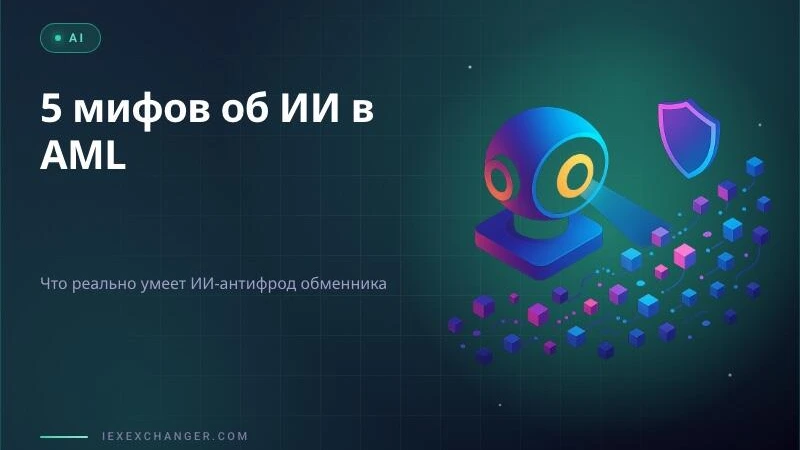
AI in AML compliance for a crypto exchanger gets pitched like a magic switch: turn it on, and shady transfers filter themselves out. Reality is messier. The system needs tuning for your jurisdiction, regular retraining, and a human to sort out the borderline alerts. Here are five myths that get in the way of a clear-eyed read on what AI transaction monitoring actually gives an exchanger.
Myth 1. AI will fully replace the compliance officer
No — and it won't anytime soon. The model is good at spotting patterns: transfer velocity, unusual amounts, links to blacklisted addresses. But the call on a borderline case — freeze the account or ask for documents — carries legal weight you can't hand off to an algorithm.
Take an example: the system flags an $8,000 transfer because the customer never moved more than $500 before. The compliance officer checks the context — the person just sold an apartment and wants to move part of it into crypto — and clears the alert in five minutes. That context isn't something AI reconstructs on its own.
Myth 2. An off-the-shelf model works equally well anywhere
In practice, no — without local tuning the model either misses risk or buries you in noise. Sanctions lists, typical P2P cash-out patterns, common transfer sizes: all of it varies by market.
Before signing with a vendor, ask what data trained the model and whether it can be retuned for your market.
Myth 3. More alerts means better protection
It's closer to the opposite: a system flagging one in five transfers loses the team's trust fast. Nobody can carefully review hundreds of alerts a day — people start clearing them on autopilot, without really looking. That's exactly when the whole point of the system falls apart.
Before tuning it further, worth checking:
- How many alerts the team can genuinely review with care each day
- How the false-positive rate has trended over the last three months
- Whether the system explains why a specific transfer got flagged
Myth 4. You configure AI monitoring once and forget it
You can't forget it — AML evasion tactics shift faster than most people expect. Anyone trying to slip past the checks splits amounts, switches networks, or reaches for a newer mixer. A model that hasn't been retrained in months gradually goes blind to fresh patterns.
A sane rhythm is reviewing thresholds and retraining at least quarterly, plus an extra pass after any major incident hits the industry.
Myth 5. Only big exchanges can afford AI
That was true maybe five years ago — cloud tools now run on subscriptions and are within reach of a small or mid-size exchanger. The entry cost has dropped, but the real total includes more than the subscription fee.
It includes the team's time triaging false positives, integration with your system, and staff training. A cheap plan that's poorly tuned sometimes ends up costing more than a pricier one with less noise.
Conclusion
AI monitoring handles the grunt work — a fast first pass over thousands of transactions no human team could check by hand. But the calls on borderline cases, jurisdiction-specific tuning, and keeping the model current stay the team's job. If you're building compliance from scratch or upgrading your exchanger's engine, it's worth looking at platforms with antifraud already built in — iEXExchanger offers a ready-made exchanger script with these tools on board.