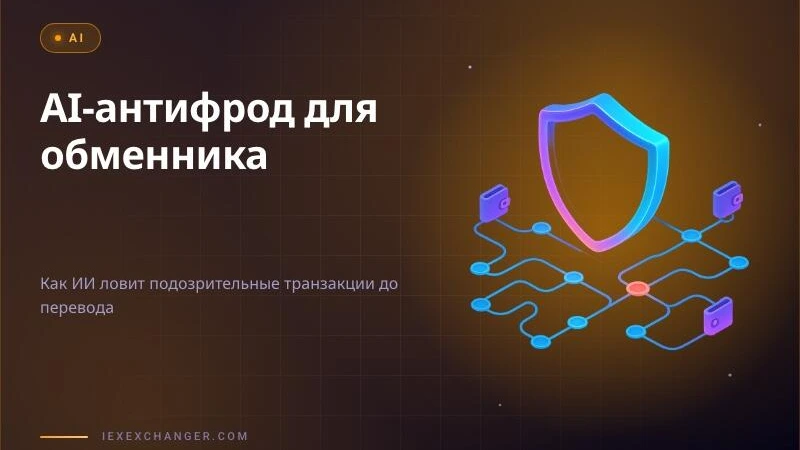
AI transaction scoring flags a risky crypto transfer in seconds, before an exchanger ever accepts it. Picture this: a $40,000 USDT transfer lands at 3 a.m. The amount is within limits, but the route — five brand-new wallets in ten minutes — is the real red flag, and a simple "amount over $X, review manually" rule will sail right past it. Here's how this scoring actually works, who needs it, and what to check before buying one.
What AI Actually Catches That Humans Miss
The model doesn't look at the amount — it looks at behavior: how many times a wallet changed hands, which services it touched, how fast the funds moved. One classic pattern is layering: money gets split into a dozen small transfers across different wallets within minutes, then reassembled into a single address.
A compliance officer can spot that pattern if they go looking for it. An AI model flags it automatically, because it's trained on millions of real transactions and keeps its list of risky addresses — mixers, darknet marketplaces, sanctioned wallets — updated around the clock.
Who Actually Needs This
If your exchanger processes five to ten transactions a day, manual review is genuinely fine — your compliance person has time to check each address by hand. The trouble starts closer to fifty transactions a day, when the review queue backs up and decisions get made in a hurry.
That's exactly when the cost of a miss goes up. A missed suspicious transaction isn't an abstract risk — it's one unchecked chain away from a partner bank freezing the exchanger's account.
What to Look for in an AI Anti-Fraud Tool
Not every scoring tool pulls its weight. Check for:
- Network coverage — it should read TRC-20, Solana and other chains where your actual volume moves, not just Bitcoin and Ethereum;
- Explainable scores — a risk score should come with a reason ("linked to a mixer," "sudden fragmentation"), not just a number from a black box;
- Adjustable thresholds — vendor defaults are usually tuned for a large bank, not an exchanger with a different customer profile;
- API speed — the check has to run in seconds, or it kills the exact speed advantage that made a client pick an exchanger over an exchange in the first place.
Most anti-fraud modules on the market are built on blockchain analytics from providers like Chainalysis, Elliptic or TRM Labs.
What AI Won't Catch — Honestly
The model is strong against known patterns and weak against new ones. If a scheme wasn't in the training data, the scoring will miss it — much like antivirus software that doesn't recognize a brand-new strain.
The second issue is false positives. An overly sensitive model starts flagging ordinary customers just because their wallet recently touched an exchange with lax KYC. The result: annoyed users, and a compliance team now sorting through false alarms instead of actual fraud.
Mistakes Exchangers Make When Rolling This Out
Even a solid tool can be undone by bad setup:
- Handing the decision fully to the algorithm — without a human final check, a model eventually errs in both directions;
- Leaving thresholds at factory settings — they're tuned for someone else's volume and risk profile;
- Ignoring a rising false-positive rate — if customers keep dropping off at review, the threshold is wrong, not the customers;
- Skipping manual updates to the risky-address list where the vendor lags — sanctions lists move faster than some integrations do.
Conclusion
AI transaction scoring doesn't replace a compliance officer — it saves them hours by filtering the obvious and surfacing what actually deserves a closer look. It only works with sane thresholds and a human still watching over the model.
For anyone building or scaling their own crypto exchanger who wants tools like this running on ready infrastructure instead of built from scratch, there's iEXExchanger.