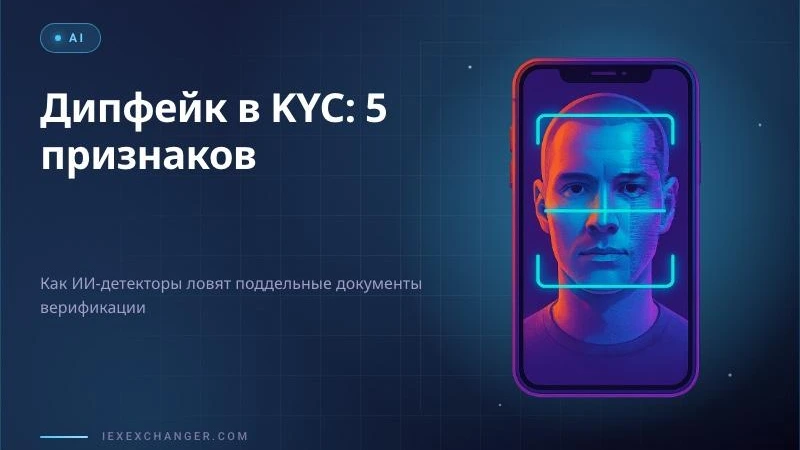
Deepfake KYC fraud means a scammer feeds an AI-generated face into your identity check instead of showing up in person. Since late 2025, these attempts have gone from rare to routine — face generators got cheap enough for any fraudster with a laptop. Here are five signs your moderation team and fraud tools can catch before a fake slips through.
Why This Became a Real Problem
A couple of years ago, a faked selfie-with-ID was a crude Photoshop job anyone could spot. Now a handful of public photos are enough for a model to generate a video that blinks, turns its head, and reads back the phrase your moderator asks for.
For an exchanger, that's not an abstract risk. Identity checks gate large withdrawals, new payout methods, higher limits. Missing one fake isn't just a future chargeback — it's your service becoming a link in a money-laundering chain, followed by uncomfortable questions from your payment partner or bank.
5 Signs of a Deepfake Verification Video
- Light doesn't behave. In a real video, light falls evenly across the face, neck and background. In synthetic footage, the reflection in the eyes doesn't match the scene's light source, and the chin shadow sometimes lags a beat behind a head turn.
- Metadata doesn't line up. The passport scan says yesterday, but the photo's EXIF data comes from a phone discontinued two years ago. Or the document's issuing region doesn't match the applicant's IP address or interface language.
- The face is "too average." Generative models smooth out features to avoid artefacts. Real faces are asymmetric — uneven brows, moles, a slightly lopsided smile. A suspiciously perfect face on video is worth a manual second look.
- Same face, different applications. Fraudsters batch-create accounts, changing only hair colour or background each time. Biometric comparison by facial vectors, not just the photo, catches the repeat even when the crop looks different.
- Odd reaction to a live prompt. Ask for a head turn instead of a simple blink — many 2025-2026 deepfake models still choke or glitch on an unpredictable real-time command.
How AI Tools Actually Catch It
A modern fraud tool doesn't just "look" at the video — it cross-checks dozens of signals at once: micro muscle movement, blink rate, lighting consistency frame to frame, file metadata, and behavioural patterns across the whole application. These models are trained specifically on deepfakes, not classic photo edits, so they pick up generation artefacts a human moderator would miss.
It works best as a pair: the AI detector assigns a risk score, and a human moderator makes the final call on borderline cases. Fully automated verification with no manual override is a bad idea for an exchanger — the cost of a false approval is too high.
Where AI Detectors Fall Short
Honestly, there's no such thing as 100% protection. Detector models and generator models race each other, and the lead keeps swapping sides. A fresh generator can outrun detectors trained on older artefacts for months.
A deepfake detector also won't catch the older trick — a stolen genuine document paired with a real, live person, a paid "mule," going through verification in person. That needs behavioural analysis and blacklist checks, not biometrics.
Common Rollout Mistakes
First: buying a deepfake detector and switching off manual review for borderline cases to save on staffing. Second: leaving the model untouched for months while generators update every quarter. Third: keeping the out-of-the-box risk thresholds instead of calibrating them to your own customer flow and the fraud patterns typical of your region.
Conclusion
Deepfakes in KYC aren't a future threat — they're a working tool fraudsters use today. Trusting a moderator's eyes alone is risky, and trusting automation blindly is worse; you need the detector and a human decision on edge cases working together. If you're building verification and fraud defence for your own exchanger from scratch, a ready platform makes the starting point easier — iEXExchanger offers products for launching and protecting your own crypto exchanger business.