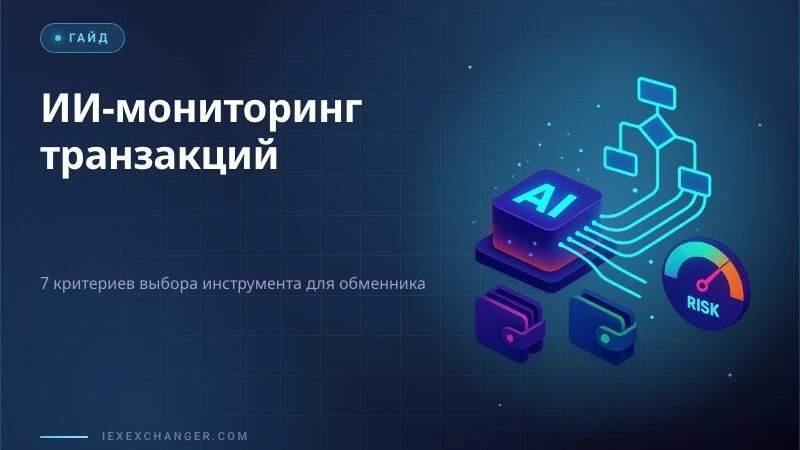
AI transaction monitoring for a crypto exchanger checks every payment by behavior, not a flat rule like "over $X, stop." It looks at where funds came from, how a wallet has acted over time, and whether the route resembles a laundering pattern. For an exchanger owner, that's the difference between a hundred false blocks a day and a handful of cases actually worth a manual look.
How it differs from old-school rules
Rule-based systems act like a bouncer with a checklist: over the limit, stop; under it, walk through. The trouble is fraudsters know the limits too and just split the amount. An AI model looks at connections instead — how many hops sit between a customer's wallet and a known mixer, how transaction frequency shifted over the last month, whether the pattern fits known structuring. An exchanger doing a couple hundred trades a day often catches the same red flags a ten-year compliance veteran would spot — except the model does it in seconds, not an hour of manual digging.
Which exchangers actually need this
If you're running 20-30 deals a day and know your regulars by name, a full AI platform is overkill — rules plus manual review handle it fine. The point where AI monitoring starts paying for itself is usually a few hundred transactions a day, or operating under strict AML reporting requirements. The other trigger is a heavy fiat on/off-ramp: banks and payment processors freeze exchanger accounts fast when they spot a suspicious flow, and here the model's reaction speed directly protects the business.
How it works in practice
Risk scoring
Every transaction gets a numeric risk score based on wallet history, blacklist proximity, and how fast funds are moving. A score above the threshold sends the deal to a manual review queue instead of an automatic block.
Wallet clustering
The model groups addresses that likely belong to one owner or share a scheme, even when they look like separate wallets on paper. That surfaces the whole chain, not just one suspicious transaction.
Human in the loop
A good system never bans a customer on its own — it hands a compliance officer a case file with the reasoning attached. Fully automatic bans on a single alert almost always cost you an honest customer and a support complaint.
A 7-point checklist for picking a tool
- Does it cover the networks your customers actually use, not just BTC and ETH
- Can you tune risk thresholds to your volume, or only use the defaults
- Does each alert come with an explanation, not just a risk number
- How often are sanctions-list and known-mixer address databases refreshed
- Is there an API to plug into your existing exchanger dashboard
- How long does your team actually spend clearing one alert
- What's the false-positive rate on a live pilot, not in the sales deck
That last point matters most. Ask for a pilot period on your real transaction flow, not a demo run on the vendor's historical data.
Common rollout mistakes
The most common one: switching the system to maximum strictness on day one. Customers flood support with delay complaints, the team drowns in alerts, and within a week someone dials the thresholds back to zero, killing the whole point. The second mistake is letting the vendor configure everything without checking it against fraud cases you've actually seen. The third is forgetting the model needs periodic retraining — fraud patterns shift faster than most platforms' default settings do.
Limits and risks
AI monitoring doesn't replace a compliance officer and doesn't guarantee you'll avoid a regulator's fine — the final call and the liability stay with a person. It also won't catch an insider threat on your own team, and it doesn't remove the need to manually check counterparties in edge cases. Treat it as a filter that saves hours of work, not a legal guarantee.
Conclusion
AI transaction monitoring isn't magic and it isn't a cure-all — it pays off at a certain volume and customer mix, and it needs tuning to your specific exchanger rather than working out of the box. If you're building this from scratch, it's easier to lean on exchanger infrastructure that already has it built in than to stitch together separate services — for example, the iEXExchanger platform, where compliance tooling ships with the engine.