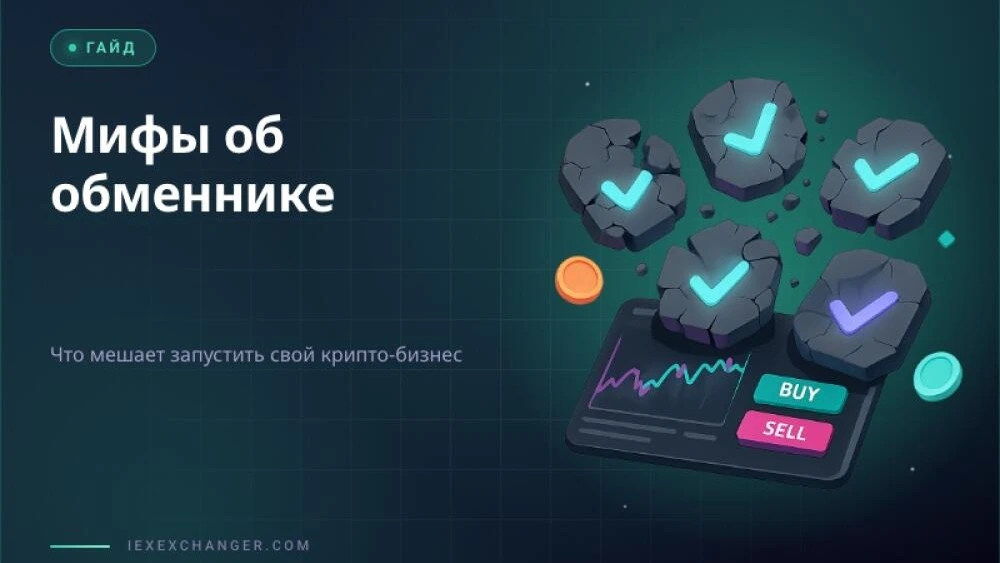
Launching a crypto exchanger comes with a surprising number of persistent myths. Some say it is expensive and complicated; others claim the market is saturated and there is no room to enter. Here are five misconceptions that hold back would-be operators — and a clear-eyed look at what is actually true.
Myth 1: You Need Millions to Get Started
You do not. Building an exchanger no longer means commissioning a custom platform at six-figure prices. Ready-made engines with full functionality — rate management, AML checks, and operator dashboards — cost a fraction of that. The real startup budget breaks into three parts: software, liquidity (working capital to process orders), and marketing. The software piece can be covered modestly today, whether you rent the platform or buy it outright.
Myth 2: You Cannot Operate Without a License
It entirely depends on jurisdiction. Regulatory requirements for small exchangers in most CIS countries and Southeast Asia are significantly lighter than in the EU or the US. That is not an invitation to ignore compliance — it matters and is tightening year by year. But the gap between cannot operate at all and need to understand what your local regulator actually requires is enormous. Many operators run successfully after a basic sole-trader or LLC registration, building out compliance as they grow.
- Lighter-touch jurisdictions: Georgia, Armenia, Kazakhstan, UAE, parts of Latin America.
- Strict jurisdictions: EU (MiCA), USA, United Kingdom.
- Starting in a strict jurisdiction without legal advice is a real risk.
Myth 3: The Market Is Saturated — No Room to Compete
There are hundreds of exchangers listed on BestChange. But truly active and competitive ones? Far fewer. The market is not homogeneous: large national players coexist with small niche exchangers tied to specific payment systems or regions. Competing in the middle of the field on rates alone is brutal. Carving out a niche is realistic.
A clear example: an exchanger focused on USDT to a local mobile payment system often captures steady traffic simply because no large competitor offers that direction.
Myth 4: You Have to Build the Tech from Scratch
Probably the most persistent myth. The logic is understandable — if you want something truly yours, build it yourself. But the market has long offered ready-made engines that are anything but rough placeholders. A proper exchanger engine handles order processing, payment gateway integration, automatic rate updates, verification workflows, notifications, and an admin panel. Building all that from scratch is not just slow (six months to a year minimum) — it is expensive to maintain long-term: bugs, security patches, new payment API versions.
A ready-made engine is not a compromise. It is a way to focus on what actually generates revenue: rates, service quality, and customer acquisition.
Myth 5: Automation Is Only for Big Players
A small exchanger that updates rates manually does not lose to competitors because of a smaller budget — it loses because it cannot react fast enough. Rates shift quickly, especially on volatile days. Automation based on BestChange lets even a small exchanger maintain competitive rates around the clock without constant manual work. The tools for this are available from day one — no large-platform privileges required.
Conclusion
Most myths about launching a crypto exchanger grew out of an era when market entry really was expensive and technically complex. Today the barrier is lower, the tools are better, and niche opportunities are real. The key: model your economics carefully, choose your jurisdiction deliberately, and avoid spending budget on things that have already been built for you. iEXExchanger brings together everything an exchanger operator needs — from a ready-made engine to rate automation and a proprietary wallet.