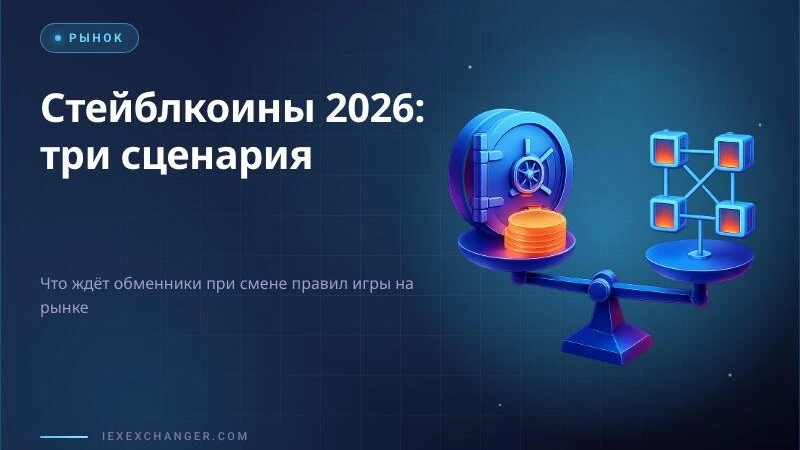
Stablecoins in 2026 are no longer just "dollars on a blockchain." Banks are rolling out their own tokens, regulators are tightening the screws, and crypto-native coins like USDT and USDC are fighting to defend market share. For anyone running an exchanger, this isn't background noise — which stablecoins stay liquid and legal in your market decides which networks you can actually use to take in and pay out client funds.
What's Actually Changing With Stablecoins Right Now
The stablecoin market is being stress-tested: total value keeps climbing, but the structure underneath is shifting faster than in any previous year. Regulators in the EU and US have visibly tightened reserve and licensing requirements over the past year — reserves now need proof, and licenses need to come before launch, not after. That favors big issuers like Tether and Circle, who can afford audits and lawyers. Smaller, regional stablecoins are feeling the squeeze — some are quietly winding down or relocating to lighter-touch jurisdictions.
Bank Tokens vs. Crypto-Native Coins: Where the Split Runs
This isn't really a tech debate — it's about who's on the hook when something goes wrong. A bank-issued stablecoin is typically backed by reserves sitting inside a real bank and follows traditional financial rules — reassuring to regulators, but slow: new listings and network support crawl. Crypto-native tokens like USDT and USDC move faster and already live across a dozen networks, but they lean on issuer reputation and external audits rather than a banking license.
For an exchanger, the difference is very practical: a bank token gives you predictability and, usually, slower rollout on new networks; a crypto-native token gives you speed and flexibility, but a sharper price reaction the moment rumors about the issuer start circulating.
Three Scenarios for 2026
Nobody can pin an exact date on any of this, so it's smarter to hold three working scenarios in mind rather than one prediction:
- Regulated consolidation — if oversight keeps tightening in sync across the EU, US and Asia, the market narrows to three or four fully-audited stablecoins, while the rest slowly lose exchange liquidity.
- Coexistence — if regulators keep moving at different speeds in different countries, bank tokens and crypto-native coins keep running in parallel, each strong in its own niche and jurisdiction, and exchangers end up supporting several at once.
- Bank pivot — if major banks roll out their own tokens with smooth integration into existing payment rails, some volume could shift away from classic crypto-native coins — though that migration would take years, not months.
None of these scenarios fully cancels out the others — 2026 will likely play out as some mix of all three, moving at different speeds in different regions.
What This Means for Your Exchanger Right Now
The nice thing about a forecast is you don't have to wait until 2027 to act on it.
- Support at least two or three stablecoins across different networks — it's cheap insurance if one loses liquidity or gets restricted.
- Watch issuers' public reserve reports, not just the price — trust collapses faster than price does.
- Build in a way to quickly switch settlement networks with clients and partners if fees or confirmation times spike on one of them.
The Risks People Usually Underrate
The most common mistake is treating a stablecoin like a static "digital dollar" that simply can't fail. In practice, there's de-peg risk, redemption risk — not every issuer guarantees fast fiat redemption for non-institutional holders — regulatory risk in specific jurisdictions, and concentration risk from parking everything in one token or network.
This rarely blows up overnight. Spreads widen first, then it gets harder to find a counterparty for a large trade, and only after that do the headlines about the issuer's problems show up.
Conclusion
Stablecoins are still a solid settlement tool — but by 2026 they're no longer a "set and forget" choice. They're something to monitor as closely as exchange rates themselves. An exchanger running on a single token and a single network is taking on more risk than one that's already lined up a backup plan.
Tracking rates and fees across multiple networks and stablecoins is a lot easier on a ready-made platform — the rate-automation tool from iEXExchanger takes that monitoring off your plate.