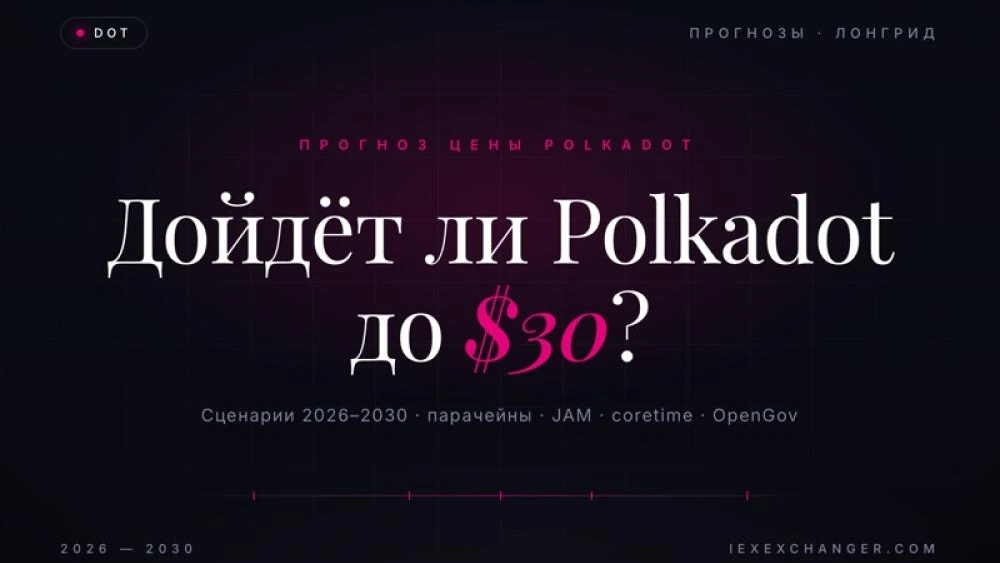
Polkadot (DOT) price prediction is one of the most technologically rich topics in crypto. Polkadot was created by Gavin Wood — co-founder of Ethereum, author of the Solidity language, and the person who coined the term "Web3" itself. The project was conceived as an "internet of blockchains": a network where dozens of independent chains (parachains) share unified security and can communicate with each other. DOT reached $55 in November 2021, went through the era of parachain auctions, the transition to the coretime model, and the announcement of the grand JAM redesign. Is a $30 per coin target realistic — and where are the bull-case limits? Below: current network state, price history, the technology roadmap, quotes from Gavin Wood and critics, analyst forecasts, and year-by-year scenario tables through 2030.
Polkadot today: key numbers
Before forecasting, it helps to pin down where we stand. Core DOT metrics at the current moment:
| Metric | Value |
|---|---|
| Current price | ~$4 - $10 (2025 range) |
| Market capitalization | ~$8-15B |
| Circulating supply | ~1.5B DOT |
| Issuance | Inflationary (~10% per year, flexible) |
| All-time high (ATH) | ~$55 (November 2021) |
| Consensus | Nominated Proof-of-Stake (NPoS) |
| Staking yield | ~10-14% per year (nominal) |
| Staked | ~50% of DOT |
| Architecture | Relay chain + parachains |
| Governance | OpenGov (fully on-chain) |
Polkadot's key feature is shared security across multiple chains. Instead of each blockchain securing itself, Polkadot's parachains rent security from a shared relay chain. For DOT to reach $30, market cap needs to grow to ~$45B at current supply — current ADA territory.
DOT price history: from launch to the 2021 ATH
Over five years Polkadot went from one of 2020's most anticipated launches to a deep re-rating amid the complex adoption of the parachain model.
| Year | Key events | Price range |
|---|---|---|
| 2020 May | Relay chain mainnet launch | $2.70 - $6.80 |
| 2021 H1 | Ecosystem growth, parachain anticipation | $8 - $49 |
| 2021 November | Parachain auctions, ATH ~$55 | $30 - $55 |
| 2022 | Crypto winter, declining parachain interest | $4.20 - $30 |
| 2023 | OpenGov development, Polkadot 2.0 vision | $3.90 - $9.40 |
| 2024 H1 | JAM (Join-Accumulate Machine) announced by Gavin Wood | $5.80 - $11.50 |
| 2024 H2 | Transition to coretime model, agile coretime | $4 - $9 |
| 2025 | JAM development, ecosystem growth, ETF filings | ~$4 - $10 |
The main lesson: Polkadot is an example of a project with the strongest technology base and weak price momentum. The parachain model proved harder to adopt than expected, and DOT significantly lagged its 2021 peak despite continuing development.
Technology roadmap: from parachains to JAM
Polkadot constantly evolves. The original parachain-auction model is being replaced by a more flexible system, and the future is anchored by the radical JAM redesign.
| Stage | What it is | Status |
|---|---|---|
| Relay chain | Main chain providing security | Live since 2020 |
| Parachain auctions | Slot leasing via DOT bonding | Ending, replaced by coretime |
| OpenGov | Fully decentralized on-chain governance | Live |
| Agile Coretime | Flexible purchase of network compute time | Rolling out |
| Async Backing | Faster blocks and higher throughput | Deployed |
| JAM | Radical redesign: hybrid of Polkadot and Ethereum smart contracts | In development (2025-2027) |
JAM (Join-Accumulate Machine) is the most ambitious item on the roadmap. It's a complete redesign of Polkadot's core, turning the network into a decentralized supercomputer combining Polkadot's security with smart-contract flexibility. It's a long-term bet with a multi-year horizon.
What key voices say about Polkadot
Polkadot is a project with one of crypto's strongest technical founders, but also constant criticism for the gap between ambition and adoption.
Gavin Wood (Polkadot founder, Ethereum co-founder)
"Web3 isn't about token speculation but about a new architecture of trust. Polkadot is built as the foundation of a decentralized internet, where applications don't depend on single points of control."
Wood is one of crypto's most respected figures: co-founder of Ethereum, creator of the Solidity language, author of the term "Web3." He founded Parity Technologies and the Web3 Foundation. JAM is his personal long-term vision for Polkadot's future.
Web3 Foundation analysts
"Coretime is a rethink of how blockchains sell their space. Instead of expensive auctions, developers buy compute time flexibly, like cloud resources. This lowers the barrier to entering the ecosystem."
The Web3 Foundation funds Polkadot development and drives the transition from rigid parachain auctions to the market-based coretime model.
Polkadot supporters (community)
"Polkadot solves a problem others ignore — secure interoperability between independent chains. OpenGov makes it one of the most decentralized projects in governance. It's infrastructure for a decade ahead."
The DOT community values the project's technical depth and fully on-chain governance, where every holder can vote and propose changes.
Vitalik Buterin (Ethereum)
Vitalik and Gavin Wood worked together on Ethereum. Vitalik speaks neutrally and respectfully about Polkadot:
"Polkadot chose an interesting path to sharding via parachains. It's a different philosophy than Ethereum's rollups, but both solve the same problem — scaling without losing security."
A polite acknowledgment: both projects solve scaling, but via different architectural paths.
Critics (ambition-adoption gap)
"Polkadot has promised revolution for years, but real parachain activity and TVL are significantly below expectations. Architectural complexity scares off developers, and DOT inflation pressures the price. The technology outran demand."
This is the most common critique: brilliant engineering with weak practical adoption. Demand for parachain slots fell after the 2021-2022 boom, and high DOT inflation pressures holders.
Institutional analysts
"DOT is fundamentally strong but undervalued on momentum. JAM could be a re-rating catalyst, but it's a long-term bet with high execution uncertainty."
What could push DOT's price up
Several structural factors work in favor of long-term coin growth.
- JAM execution. The main long-term bet. If the JAM redesign turns Polkadot into a decentralized supercomputer with real demand — it fully changes the investment case.
- Agile Coretime model. Flexible purchase of compute time lowers the barrier for developers and could revive ecosystem growth.
- Spot DOT ETF. Filings are under consideration by providers (21Shares, Grayscale). Approval would open an institutional channel.
- OpenGov and decentralization. Fully on-chain governance is a strong narrative for those who value decentralization over speed.
- Parachain ecosystem growth. If key projects (Moonbeam, Astar, Acala, Hydration) gain users — DOT demand grows.
- Cross-chain interoperability. XCM (cross-chain messaging format) positions Polkadot as the standard for inter-blockchain communication.
- Gavin Wood's reputation. One of crypto's most respected technical minds maintains long-term trust in the project.
What could hold or crash DOT's price
Symmetrically, there are factors that can freeze growth or trigger a deep drawdown.
- Weak adoption. The main risk — if parachains, coretime, and JAM never reach real demand. Without users, price rests only on narrative.
- High DOT inflation. ~10% annual issuance creates constant pressure. Without demand growth it dilutes price.
- Architectural complexity. Polkadot is harder for developers than EVM networks. This scares off part of the ecosystem.
- Long JAM horizon. JAM execution is years of development with uncertain results. The market could lose patience.
- Competition. Ethereum L2, Cosmos, Avalanche subnets solve similar interoperability and scaling problems.
- Declining parachain demand. After the 2021-2022 boom, slot interest dropped significantly.
- Macro shock. Global recession and risk-off — DOT as a mid-cap asset will suffer more than BTC and ETH.
DOT price prediction by year: scenarios 2026-2030
A single number is always an oversimplification. A scenario approach is more realistic: what happens in bear, base, and bull paths. Three trajectories through 2030:
| Year | Bear scenario | Base scenario | Bull scenario |
|---|---|---|---|
| 2026 | $3 - $6 | $10 - $16 | $20 - $28 |
| 2027 | $4 - $7 | $13 - $20 | $25 - $35 |
| 2028 | $4 - $8 | $16 - $24 | $30 - $42 |
| 2029 | $5 - $9 | $18 - $28 | $35 - $48 |
| 2030 | $5 - $10 | $20 - $30 | $40 - $55+ |
These aren't precise predictions — they're conditional bands based on historical volatility, adoption pace, and the technology roadmap. Actual price action will almost certainly move between them non-linearly — especially sensitive to JAM execution and ecosystem growth.
What would have to happen for $30 per DOT
Math first: at ~1.6B DOT by 2028 (accounting for inflation), a $30 price = ~$48B market cap. That's current ADA territory. Several conditions need to align.
- Successful JAM execution. The core redesign demonstrates real value and attracts developers and users.
- Ecosystem growth via coretime. The flexible model attracts new projects, and DOT demand recovers.
- Spot ETF approval. At least one major fund launches a product with real AUM.
- Inflation control. High issuance is offset by demand and staking growth.
- Retaining recognition. DOT stays in the top 20 and attracts capital in a bull cycle.
- Time. Even under ideal conditions, this is a 4-6 year horizon.
Analyst forecasts on DOT
Analysts are cautious on DOT due to the gap between technology and adoption. But there are several reference points in the crypto industry.
| Analyst / source | Target price | Horizon | Key condition |
|---|---|---|---|
| VanEck (bull) | $20 - $30 | 2030 | Ecosystem growth and JAM execution |
| Bitwise | $15 - $25 | 2027 | BTC post-halving cycle + alt rally |
| 21Shares | $20+ | 2028 | ETF approval + coretime adoption |
| Coinpedia (average) | $25 - $45 | 2030 | Bull case, JAM success |
| Changelly forecasts | $30+ | 2030 | Aggressive bull case |
| CryptoNews panels | $15 - $28 | 2030 | Expert panel average |
| Standard Chartered (informal) | $10 - $18 | 2026 | Moderate adoption |
Between these poles lies the real range of expectations. Averaging them into a single number loses the point: for DOT the key question is whether strong technology turns into real usage, especially via JAM.
What this means for different participants
For the long-term holder
DOT is a bet on a long-term technology base and Gavin Wood's Web3 vision. If JAM and coretime deliver mass adoption, DOT benefits. But it requires patience — Polkadot moves slower than the market. It's important to account for inflation: staking (10-14% nominal) partly offsets dilution. A sensible approach: DCA + staking + minimum 3-5 year horizon.
For the trader
DOT delivers moves around technology updates (JAM, coretime), ETF news, and general alt cycles. Volatility is comparable to other top alts. Standard rules — stop-loss, leverage discipline. DOT often lags at the start of a rally and moves on narrative shifts around network development.
For an exchanger operator
DOT is a recognized asset with a loyal technology base and a high staking ratio. DOT support in an exchanger matters for serving long-term investors and the Web3 audience. DOT staking is an in-demand additional feature.
Conclusion
Whether Polkadot reaches $30 — that's a bull-case scenario for 2028-2030. Scenario analysis shows: 2030 base range $20-30, bull case $40-55+ if conditions align (JAM execution, ecosystem growth via coretime, ETF, inflation control). Bear: $5-10 if the gap between technology and adoption persists. DOT is one of the most "engineering" top-20 assets: Gavin Wood's strongest technical vision with historically lagging momentum. The main question — whether the ambitious JAM redesign turns into real mass usage.
For those building a business around crypto — for example, launching their own crypto exchanger — ready infrastructure works under any scenario. The iEXExchanger platform lets you focus on customers and operations, including DOT and staking support, without building an engine from scratch.
This material is for informational purposes only and is not investment advice. Cryptocurrencies are a high-risk asset, and past performance does not guarantee future returns.