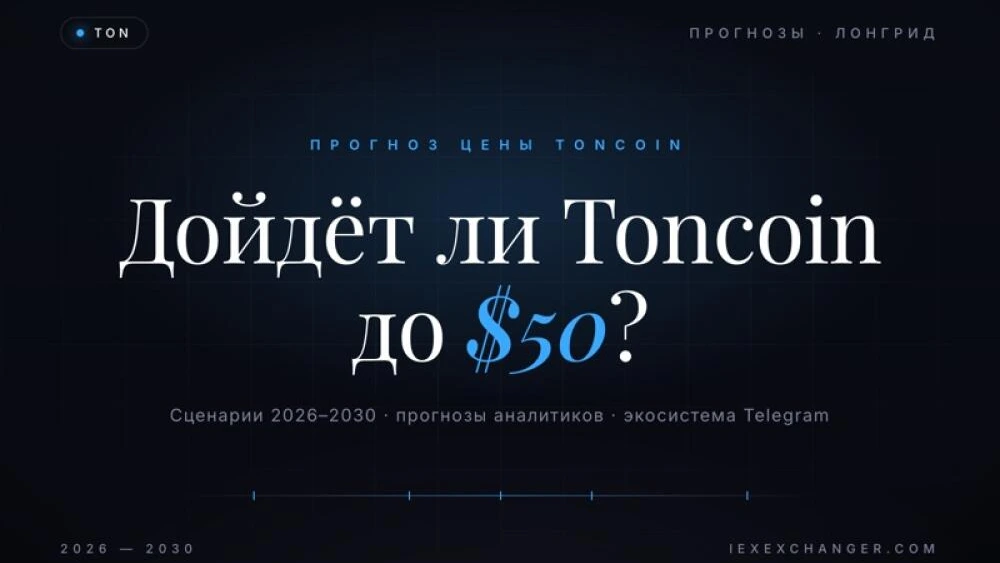
Toncoin (TON) price prediction is one of the hottest topics in crypto after the explosive growth of the Telegram ecosystem and the 2024-2025 integrations. TON went from an SEC-banned Gram project to an independent L1 network tied to a messenger with a billion active users. Can TON become the "next Ethereum for retail," and are $20-50 per coin targets realistic? Below — current network state, project history, key catalysts, quotes from Pavel Durov and the TON Foundation team, analyst forecasts, and year-by-year scenario tables through 2030.
Toncoin today: key numbers
Before forecasting, it helps to pin down where we stand. Core TON metrics at the current moment:
| Metric | Value |
|---|---|
| Current price | ~$3-7 (2025 range) |
| Market capitalization | ~$15-20B |
| Circulating supply | ~3.5B TON |
| Total supply | ~5.1B TON (growing ~0.6% per year) |
| All-time high (ATH) | ~$8.2 (June 2024) |
| Consensus | BFT Proof-of-Stake with sharding |
| Network speed | ~100,000 TPS (theoretical) |
| Telegram user base | ~1B monthly active |
| Validators | ~400+ |
The key thing that sets TON apart from most L1s is built-in access to Telegram's audience. No other network has native distribution to a billion users through a single interface. This is both its main trump card and its main concentration risk.
TON history: from Gram to an independent network
TON is one of the most unusual cases in crypto history: the project survived a full SEC ban, a community relaunch, and explosive growth thanks to Telegram integrations.
| Year | Key events | Project state |
|---|---|---|
| 2018 | Pavel and Nikolai Durov announce Telegram Open Network and the Gram token | $1.7B private ICO |
| 2019 | Testnet launch, preparing for mainnet | SEC sues Telegram |
| 2020 | Telegram exits, returns money to investors | Project picked up by the community (NewTON, then TON Foundation) |
| 2021 | Community-led mainnet launch, rebrand to The Open Network | Price ~$1-5, low visibility |
| 2022 | Infrastructure buildout (TON DNS, TON Storage) | Price drops below $1 in crypto winter |
| 2023 | Telegram Wallet launches, adoption grows | Price recovers to $2-3 |
| 2024 H1 | USDT on TON, Notcoin, Mini Apps boom, ATH ~$8.2 | Massive bull-run |
| 2024 H2 | Pavel Durov arrested in France (August), correction | Price pulls back to $4-5 |
| 2025 | Telegram announces 1B MAU, Stars, TON DeFi expansion | Stabilization and new catalysts |
The main lesson: TON survived an event that would have killed 95% of projects — a complete SEC ban and the exit of the original team. That speaks to real decentralization, but also to high regulatory exposure.
TON's main catalysts: Telegram integration
Most L1 networks compete for developers, liquidity, and DeFi protocols. TON solves the problem differently — it reaches the user through a messenger they already use every day.
| Year | Integration | Effect |
|---|---|---|
| 2023 | Telegram Wallet (built-in) | Entry barrier lowered to a couple of clicks |
| 2024 | Telegram Mini Apps on TON | Launch of Notcoin, Hamster Kombat, Catizen with tens of millions of players |
| 2024 | USDT on TON (by Tether) | Simple stablecoin transfers inside the messenger |
| 2024 | Telegram Stars (internal currency) | Content and channel monetization via TON infrastructure |
| 2025 | Extended TON Connect integration | Authentication standard between DApps and Telegram |
The pattern: every major Telegram update triggers a spike in activity and often in TON price. This is a unique competitive advantage and at the same time the main risk.
What key voices say about TON
TON is rarely discussed in traditional finance the way Bitcoin is — but inside the ecosystem there are plenty of influential voices, both bullish and cautious.
Pavel Durov (Telegram)
"TON is the natural blockchain for Telegram. We want every messenger user to have simple and safe access to crypto tools without having to learn technical details."
Durov publicly supports TON, although Telegram formally does not control the project. His decisions on embedding Wallet, Mini Apps, and Stars largely determined the network's growth in 2024-2025.
Nikolai Durov (TON architect)
"TON was designed to scale to billions of users. The sharded, asynchronous-messaging architecture is fundamentally different from classical EVM blockchains."
Nikolai is the main technical ideologue of the network. Despite Telegram's exit from direct involvement in 2020, his architectural choices still define TON's technological identity.
Andrew Rogozov (TON Foundation)
"Our goal is to turn 500 million Telegram users into active Web3 participants by 2028. That's tens of times the current audience of all L1s combined."
Rogozov and the TON Foundation team handle grant programs, marketing, and ecosystem work. Their KPI is converting passive messenger users into active TON holders and users.
Vitalik Buterin (Ethereum)
Vitalik has repeatedly noted TON's technical ambition while also flagging risks:
"TON is interesting as an experiment with complex sharding architecture, but I would watch carefully how it handles validator decentralization at scale."
This is a typical position from technical critics: impressive engineering, but an open question on decentralization.
Messari analysts
In quarterly reports, Messari highlights TON's unique advantage:
"No other L1 has a native interface to a billion users. This is a fundamental factor that the market still underestimates."
Analysts also note the high correlation of TON activity with Telegram releases — both a strength and a dependency.
US compliance skeptics
Many lawyers remain cautious in their assessments:
"TON's history as Gram and its tight link to Telegram create long-term regulatory risk, especially in the US. Any new investigation could hit the price harder than competitors."
This stance explains why TON is still unavailable on several major US exchanges.
What could push TON's price up
Several structural factors work in favor of long-term Toncoin growth.
- Telegram base growth. Every additional 100M messenger MAU equals potential millions of new TON wallets. By 2028 Telegram targets 1.5B MAU.
- Converting passive audience into active. Active on-chain TON users are in the tens of millions today. Room for an order-of-magnitude growth as UX improves.
- USDT and the stablecoin economy. Tether already made TON one of the key networks for USDT. Stablecoin settlement volume grows faster than total crypto cap.
- Mini Apps and gamification. Notcoin, Hamster Kombat, Catizen, Major — dozens of games have already driven hundreds of millions of sessions. The next wave: fintech and social apps.
- Corporate integrations. Brands and channels can accept payments via Telegram Stars and TON directly. A completely new content monetization layer.
- Institutional products. Spot ETPs/ETFs on TON in Europe and Switzerland will open the path for institutional capital.
- Scarce emission. Inflation of ~0.6% per year is lower than most PoS networks. With rising demand this supports the price.
What could hold or crash TON's price
Symmetrically, there are factors that can freeze growth or trigger a deep drawdown.
- Regulatory pressure. A new SEC investigation, Telegram restrictions in major jurisdictions, or arrest of key figures — historically triggered 30-50% drawdowns in days.
- Telegram dependency. If the messenger faces serious issues (ban in a major country, regulatory settlement, feature restrictions), TON takes the brunt.
- Validator concentration. Despite 400+ validators, actual stake concentration remains a question that worries part of the research community.
- Competition for retail. Solana, BNB Chain, and Base actively compete for the same users as TON. Any serious competitor advantage could siphon liquidity.
- Token unlocks. Gradual unlocking of early positions can pressure price in moments of weak demand.
- Mini App manipulation. If several big Tap-to-Earn projects turn out to be exit-scams — trust in the whole ecosystem suffers.
- Macroeconomics. A global recession, risk-off — TON as a mid-cap asset will suffer more than majors.
TON price prediction by year: scenarios 2026-2030
A single number is always an oversimplification. A scenario approach is more realistic: what happens in bear, base, and bull paths. Three trajectories through 2030:
| Year | Bear scenario | Base scenario | Bull scenario |
|---|---|---|---|
| 2026 | $1.5 - $3 | $7 - $12 | $15 - $22 |
| 2027 | $2 - $4 | $10 - $16 | $22 - $32 |
| 2028 | $2 - $5 | $12 - $20 | $30 - $45 |
| 2029 | $3 - $6 | $15 - $25 | $40 - $55 |
| 2030 | $3 - $7 | $18 - $30 | $50+ |
These aren't precise predictions — they're conditional bands based on historical volatility, Telegram growth rates, tokenomics models, and analyst-house views. Actual price action will almost certainly move between them non-linearly — especially sensitive to the regulatory environment and integration progress.
What would have to happen for $50+ per TON
Math first: at ~5B TON supply, a $50 price = ~$250B market cap. That's current ETH or BNB territory. Several conditions need to align, and none works in isolation.
- Telegram reaches 1.5B+ MAU. The main driver — user base growth and its payment activity.
- Stablecoins on TON cross $50B+. If TON becomes one of the main rails for USDT/USDC in Asia and emerging markets, it fundamentally changes value capture.
- Mini Apps become a real economy. Not short-lived games but fintech, education, e-commerce — with sustainable revenue and active fee base.
- Institutional products in Europe and Asia. Spot ETPs/ETFs, access for pension and insurance funds.
- Regulatory normalization. Clear rules in the US, EU, Japan. Without this, institutional capital won't allocate at scale.
- Time. Even under ideal conditions, this is a 4-6 year horizon, not 1-2.
Analyst forecasts on TON
Because TON is younger than Bitcoin and Ethereum and depends on a unique driver (Telegram), most traditional banks don't yet publish long-term models on it. But there are several influential calls inside the crypto industry.
| Analyst / source | Target price | Horizon | Key condition |
|---|---|---|---|
| Messari (bull) | $35 - $50 | 2028 | 500M+ active Web3 users via Telegram |
| Messari (base) | $15 - $25 | 2028 | Moderate adoption growth |
| The Block Research | $20 - $30 | 2027 | USDT settlement growth on TON |
| Delphi Digital | $25 - $40 | 2028 | Mini Apps as a sustainable economy |
| VanEck (informal) | $15+ | 2027 | Institutional demand |
| Bitwise | $20 - $30 | 2027 | Post-halving BTC cycle + alt rally |
| JPMorgan crypto notes | $10 - $15 | 2026 | Telegram momentum continues |
Between these poles lies the real range of expectations. Averaging them into a single number loses the point: the TON market moves on Telegram events more than on classical macro factors.
What this means for different participants
For the long-term holder
The main thing is understanding concentration risk. TON is a bet not only on a blockchain but on Telegram as a product. Horizon of at least 3-5 years, DCA strategy, storage on a self-custody wallet or Telegram Wallet with understanding of its specifics.
For the trader
TON historically delivers strong moves around Telegram releases, Mini App launches, and regulatory news. That requires monitoring not just charts but messenger announcements. Strict risk management is critical — volatility is higher than BTC and ETH.
For an exchanger operator
TON is one of the fastest-growing networks for USDT volume and retail transfers. TON and USDT-TON support in an exchanger is becoming practically mandatory for serving users from the CIS, Southeast Asia, and Latin America. Under any price scenario — volume flows through operators who covered this direction in time.
Conclusion
Whether TON will reach $50 per coin depends on whether a billion Telegram users can be converted into an active on-chain economy. Scenario analysis shows that the base case range by 2030 is $18-30, with a bull case at $50+. The bear case is $3-7, with the key risk being regulatory restrictions and parent-messenger issues. TON's unique advantage — native access to a billion-user audience — has no analogues in the L1 sector, but its concentration risk is also historically record-setting.
For those who build a business around crypto — for example, launching their own crypto exchanger — ready infrastructure works under any scenario. The iEXExchanger platform lets you focus on customers and operations, including TON and USDT-TON support, without building an engine from scratch.
This material is for informational purposes only and is not investment advice. Cryptocurrencies are a high-risk asset, and past performance does not guarantee future returns.