A stablecoin depeg hits an exchanger harder than most expect: you hold your reserve in a "stable" coin, and it drops 10% overnight. This happened to USDC, DAI, and UST — and in smaller ways, even USDT. Here is how to not be the one left counting the losses.
What a depeg is and why it happens
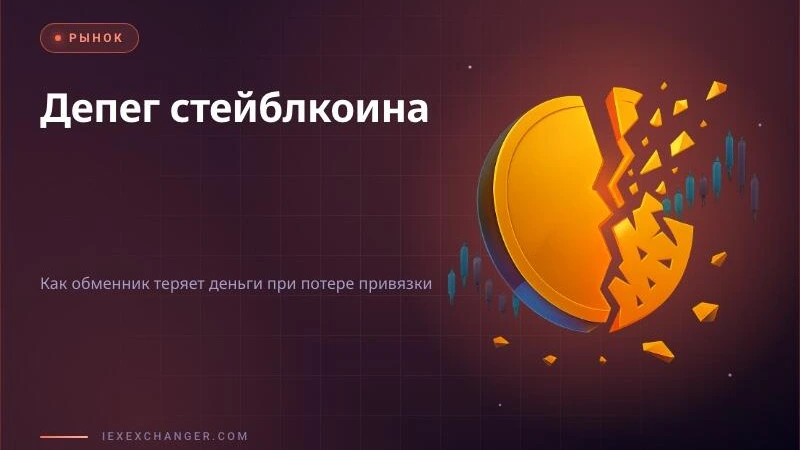
A depeg is when a stablecoin's market price drifts away from $1. Picture the peg as an anchor rope: in calm weather it is slack, but a bad storm can snap it — and then the coin starts to drift.
The causes vary. Algorithmic stablecoins like UST relied on demand and a burn mechanism tied to a paired token. Once demand fell below a critical point, a death spiral kicked in. USDC briefly dropped to $0.87 in March 2023: $3.3 billion of its reserves were sitting in Silicon Valley Bank when it collapsed over a weekend. That was panic, not an actual loss of backing — the coin recovered in two days. But the losses for those who reacted badly were entirely real.
USDT has held up far more steadily overall, but even it had a scare: during the Terra collapse in 2022, it briefly traded at $0.95 on some platforms.
Three types of depeg — and what they mean for you
Not every move away from $1 is a disaster. Knowing what you are dealing with matters:
- Micro-depeg (under 2%). Happens regularly during volatile periods. Arbitrageurs typically restore the peg within hours. For an exchanger, this is background noise — unless your reserves are running with heavy leverage.
- Structural depeg (2–15%). The peg broke, but real backing exists. Recovery takes days. If you are holding a large reserve in that coin, you carry a real paper loss — and some clients will start demanding rate adjustments.
- Stablecoin death. Like UST in May 2022 — from $1 to zero in roughly 72 hours. No backing, no recovery. For an exchanger holding a large reserve, this meant insolvency.
The first type you survive without a plan. The second demands a pre-written response protocol. The third is prevented through diversification — you do not manage it after the fact.
How much an exchanger actually loses during a depeg
An exchanger holds a $50,000 working reserve in USDC. A depeg hits, and the coin trades at $0.91 for 48 hours. Paper loss — $4,500. And that is the optimistic scenario.
It gets worse when clients sell you USDC near $1 (they have not seen the news yet), while you are paying out other assets at market prices. That loss is locked in immediately. This is exactly what happened to smaller exchangers in March 2023: customers were selling USDC at $0.99 while the interbank rate had already moved to $0.88. The gap settled on their balance sheets.
What to do in the first 15 minutes after a depeg starts
Speed matters more than perfect information. A few concrete steps:
- Update your rates immediately — not the ones from yesterday. An exchanger refreshing quotes manually once an hour is trading against itself.
- Pause accepting the affected stablecoin if the depeg runs deep (over 5%) until the picture clears.
- Calculate your actual reserve balance in that coin and estimate maximum exposure at zero recovery.
- Monitor official issuer channels — Circle for USDC, Tether for USDT. A clear statement confirming reserves is a sign the situation is manageable.
Panic-selling your reserve at the bottom is also a bad move: if the coin recovers, you lock in the loss. The key word is pause, not liquidate.
How to reduce your risk before anything happens
Three rules that work in practice and do not require complex infrastructure:
- Diversify your reserves. Do not keep everything in one stablecoin. Even a 50/50 split between USDT and USDC cuts concentration risk. If your volume allows, add a small FDUSD or PYUSD position.
- Set a per-instrument cap. No more than 60–70% of your reserve in a single coin. The exact threshold depends on your volume, but two stablecoins always beat one.
- Automatic market-linked pricing. If your exchanger updates rates manually or with a lag — you are exposed. Systems that pull live exchange prices automatically reflect a depeg in client-facing quotes before anyone exploits the gap.
Conclusion
A stablecoin depeg is an operational risk, not an act of God. It repeats, you can prepare for it, and most exchangers that got hurt were not caught off guard by the concept — they just did not react fast enough.
If you are building or running your own exchanger and want to automate rate management, take a look at iEXExchanger — a ready-made platform with flexible reserve management and live market rate feeds.