Is DEX eating into your exchange business? That question comes up more and more — and the answer isn't as simple as it sounds. Decentralized exchange volumes are growing, the trend is real, and ignoring it would be a mistake. But panic isn't warranted either: DEX and traditional exchangers serve different audiences, with different strengths and very different blind spots.
What Is a DEX — and Why You Shouldn't Dismiss It
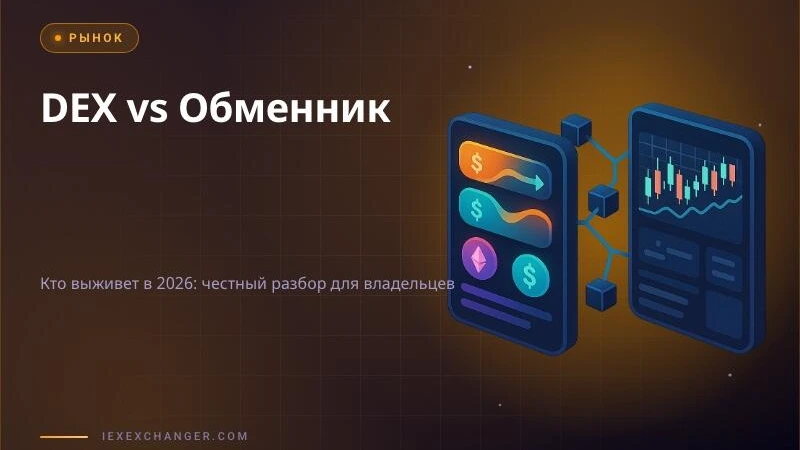
A DEX (decentralized exchange) is an exchanger with no owner. A smart contract automatically matches buyers and sellers, manages liquidity pools, and executes trades without a single human operator. Think of it as an ATM that belongs to no bank — it just dispenses.
The largest protocols — Uniswap, PancakeSwap, dYdX — process hundreds of billions of dollars every month. That's real volume, not an experiment. Analysts expect the DEX share of total crypto turnover to keep growing through 2026. Denying the trend means arriving too late to adapt.
Where DEX Genuinely Falls Short
Decentralized exchanges have structural limitations that nobody has solved yet — and those limitations matter directly to most traditional exchanger clients.
- Fiat is off the table. DEX lives entirely on-chain. Buying USDT with rubles or withdrawing ETH to a bank card is simply not possible through a DEX — by design.
- Verification and documentation. Corporate clients, large transactions, legally significant operations — all require documentation that DEX doesn't provide.
- Slippage and gas costs. On large trades or uncommon pairs, the real DEX rate is often worse than advertised. Slippage plus gas fees can cost 1–3% of the transaction.
- No support. Wrong address, stuck transaction — there's nobody to call. For inexperienced users, that's a genuine barrier.
Where DEX Actually Wins — Honestly
Underestimating DEX is just as costly as overestimating it. It genuinely solves specific problems well.
Fast crypto-to-crypto swaps without registration — DEX is unmatched here. Tokens that don't exist on centralized platforms often trade only on DEX. A degree of privacy for smaller amounts appeals to part of the market.
That's a real niche. But it's not your client — if your exchange handles fiat, requires verification, or serves users who expect real support.
Three Scenarios for the Exchange Market in 2026
What happens to the DEX–exchange dynamic depends on variables nobody controls. Here are three scenarios worth keeping in mind.
Scenario 1: DEX regulation tightens. The EU and several Asian countries are already debating KYC requirements for decentralized protocols. If AML rules reach DEX, they lose their main edge — privacy — and part of their user base returns to licensed exchangers.
Scenario 2: the market naturally segments. DEX handles small, anonymous crypto-to-crypto trades; traditional exchangers own fiat operations, corporate clients, and document-backed volume. Near zero direct competition — simply different markets.
Scenario 3: hybridization. Forward-thinking operators integrate DEX liquidity through aggregators like 1inch as an additional pricing source, automatically offering clients the best available rate. This is technically feasible today.
Scenario 2 with elements of 3 looks most probable. But Scenario 1 — especially given the latest EU regulation news — shouldn't be ruled out.
Conclusion
DEX won't kill the exchange business — it already claimed the slice of the market that traditional exchangers couldn't reach anyway. The territory left for real business — fiat pairs, support, verification, corporate clients — belongs to operators who know how to work it.
If you're ready to launch your own exchange with a modern, ready-made infrastructure, take a look at iEXExchanger — a B2B platform built for entrepreneurs running real exchange businesses, not just chasing trends.