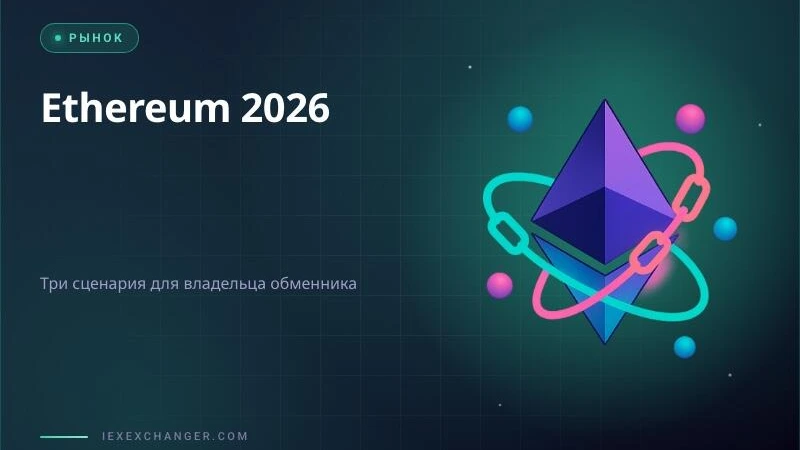
Ethereum in the second half of 2026 is not just a question of price. For exchanger owners, ETH is one of your core trading pairs — and what happens in the network directly affects your operating costs and client behaviour. The first six months were rough: BTC closed two consecutive quarters in the red, and ETH fell even harder in percentage terms. But beneath the numbers, three structural shifts are playing out.
What Is Happening with Ethereum Right Now
ETH is simultaneously a fee currency, a staking asset, and the base layer for hundreds of applications. Staking means locking coins in a smart contract: the holder earns a yield, the network gains security. In 2026, over a third of all ETH is locked in validators — shrinking the liquid supply available on the open market.
At the same time, Layer 2 networks — Arbitrum, Base, and Optimism — have absorbed most of the transaction volume. While an L2 transfer costs fractions of a cent, mainnet Ethereum fees can hit several dollars during busy periods. For small exchanger trades, that gap is already noticeable.
Scenario 1: Institutional Money Returns
Spot Ethereum ETFs launched in the US in 2024, but early 2026 brought mixed results — a portion of capital migrated to Bitcoin ETFs, which carry the "digital gold" narrative. If risk appetite returns, Ethereum ETFs could see a fresh wave of inflows.
For an exchanger, that translates directly: more demand means higher volume on the ETH/USDT pair. But large institutional buys move prices sharply and fast. Brief price spikes will become routine, which makes automated rate updates a necessity, not a nice-to-have.
Scenario 2: Layer 2 Pulls Your Clients Away
Many users already hold USDT and USDC on Arbitrum or Base — fees are simply lower there. If your exchanger only supports Ethereum mainnet, some clients will quietly go to a competitor who offers the right network. This is happening right now, not hypothetically.
Supporting at least one L2 has moved from "extra feature" to baseline expectation. Start with Arbitrum or Base — they are the most widely used among mid-size transaction clients.
Scenario 3: Regulatory Fork in the Road
MiCA is live in the EU. From July, major exchanges adjusted their European operations, and some users are looking for alternatives with less stringent KYC. For a smaller exchanger, that is a real opportunity — provided your compliance framework is solid.
In the US the picture is more complex: the SEC has yet to finalise its classification of ETH. That uncertainty keeps institutions cautious, though it has little effect on retail users.
Three Things to Check Before Summer Ends
- Make sure you support at least one L2 network for ETH and stablecoins — Arbitrum or Base.
- Set up automated rate updates for ETH: manual refreshes cannot keep pace with the market during volatile windows.
- Track weekly ETF flow data — a sharp swing in either direction is a signal to review your reserves.
Conclusion
Ethereum in 2026 is losing supply to staking, losing traffic to Layer 2, and navigating regulatory pressure from two continents at once. None of the three scenarios is guaranteed, but each one calls for preparation. For an exchanger owner, that means building a flexible, multi-network infrastructure now — not waiting for the dust to settle.
If you are launching or scaling an exchanger and want to add multi-network support without a long development cycle, iEXExchanger offers a ready-made engine with configurable multi-network trading pairs built in.