Crypto exchanger rate automation is not a nice-to-have — it is essential. While the operator is asleep or working through a support ticket, markets keep moving. Every stale rate either scares a client away or quietly trims your margin. Here is why manual monitoring no longer works, and what actually does.
Markets Don't Wait: What Happens in One Hour
Picture this: you updated rates at 9 a.m., and by 10:30 BTC had risen 1.5%. Your sell rate still shows the old figure. Two things can happen next — both bad.
First: a sharp client notices that your rate is better than the market and locks it in before you catch up. You pay out more than you bought in. That is a direct loss, straight out of the owner's pocket.
Second: a competitor already refreshed and is showing a live rate. BestChange ranks them above you. The client leaves — and you never find out why.
What One Stale Rate Actually Costs
The numbers speak clearly. If your USDT/RUB spread is 0.8% and your daily volume runs around 500,000 rubles, then a 0.3% rate discrepancy held for two hours costs roughly 1,500 rubles in lost margin. Do that every day for a month and you are looking at five-figure losses that never show up anywhere obvious.
The damage peaks during sharp market moves — major news releases, mass liquidations, late-night spikes. That is when a stale rate hands clients a textbook arbitrage opportunity, right on your own platform.
Why Manual Updates Don't Cut It
Some operators genuinely try: updating rates every 15–30 minutes by hand. Better than once a day — but still not enough.
- Humans make mistakes: a typo, a wrong direction — and you have published an off-market rate.
- Night shifts and weekends are not covered. Crypto runs 24/7; operators do not.
- It eats time you could spend on growth: marketing, new trading pairs, client support.
- The reaction speed simply is not there. A headline drops, the market moves in seconds. A person responds minutes later — if at all.
How Automatic Rate Sync Works
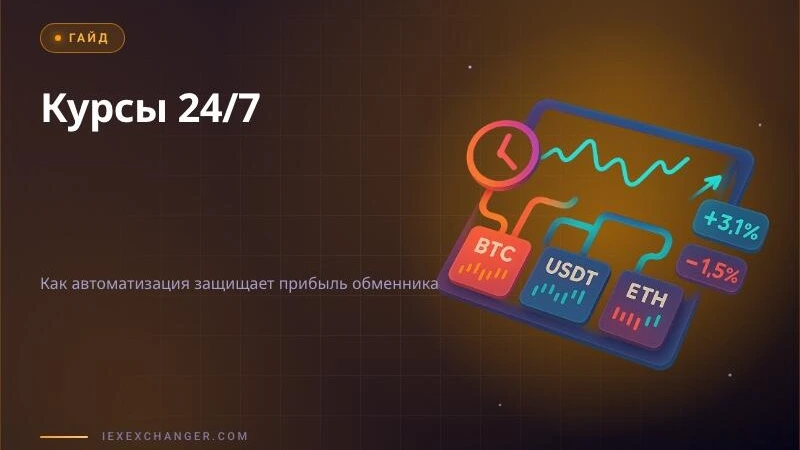
The model is straightforward: a script pulls data from exchanges, aggregators, and BestChange, recalculates rates according to your rules, and publishes them to your site. You set the spread, minimum margin, and deviation thresholds — the system handles everything else, every 1–5 minutes, without anyone lifting a finger.
BestChange is not just one data source here — it is also a ranking factor. The aggregator scores exchangers partly on how fresh their rates are. Stale data puts you lower on the list and cuts traffic. Current data holds your position.
What to Look for in a Rate Automation Tool
When evaluating automation solutions, check these five things.
- Update frequency — every 5 minutes is the minimum floor; quality systems refresh every 1–2 minutes.
- Data sources — the more independent feeds aggregated, the more accurate the resulting rate.
- Granular controls — you need per-pair spread settings, not a single rate applied to everything.
- Spike protection — the system should filter anomalous values and refuse to publish a suspicious rate.
- BestChange integration — automated export in the right format, no manual steps required.
Conclusion
Manual rate monitoring is slow, risky, and expensive in ways that rarely show up on a dashboard. Automation does not just save the operator's time — it defends your margin, keeps your BestChange ranking solid, and eliminates an entire class of human error.
If you run or are building a crypto exchanger and have not set up automatic rate sync yet, this is probably the first thing worth doing. A ready-made solution for exchanger owners is available on the iEXExchanger platform.