Liquidity in a crypto exchanger is not just "having funds in your wallet." It is the ability to close a client's deal instantly without taking a loss yourself. Most exchanger operators lose money not because of poor spread, but right here — when reserves are misaligned with demand or move against you overnight.
What Liquidity Actually Means for an Exchanger
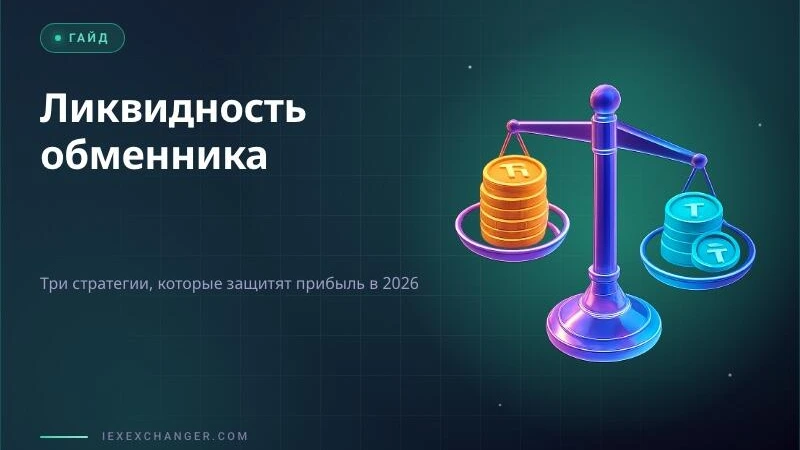
Liquidity is not the volume in your wallet — it is the balance between what you hold and what clients actually want. Three problems come up most often.
First, structural imbalance: clients actively buy USDT but rarely sell it back. Your USDT reserve drains while your fiat balance grows. Second, price movement: you hold ETH and it drops 8% overnight. Third, concentration risk: 70% of reserves in a single coin. When the market turns, your entire buffer can be wiped out in a week.
Strategy 1 — Scheduled Rebalancing
The simplest thing that actually works: once a day or every 12 hours, compare your actual reserve ratio to your target allocation. Think of it like stepping on a scale — uncomfortable, but without it you have no idea where things are heading.
Example: target portfolio — 40% USDT, 30% BTC, 20% ETH, 10% other. If USDT climbs to 55%, buy more BTC and ETH, or nudge your USDT buy rate slightly less competitive to slow the inflow. You can automate this through an exchange API.
- Set deviation thresholds: ±10% is fine, ±20% triggers rebalancing.
- Rebalance through liquid exchanges, not through your own exchanger — the spread is lower there.
- Recalibrate target weights once a month based on real order volume.
Strategy 2 — Hedging Your Open Position
Hedging works for operators who hold large positions in volatile coins and do not want to be hostage to market mood.
The mechanics are straightforward: if you hold 5 ETH in reserve, open a short on 5 ETH on a futures exchange. If the price drops, the short's profit offsets the reserve loss. If the price rises, you lose on the short but earn on the spread from clients.
An honest caveat: a hedge requires collateral, trading fees, and ongoing management. For a small exchanger with under $50,000 monthly turnover, this is usually overkill — the costs eat the margin. But for large positions in volatile coins, it stops being a luxury and becomes a necessity.
Strategy 3 — Fewer Pairs, Deeper Reserve
It sounds counterintuitive, but it works: cut the number of trading pairs and deepen your liquidity on each remaining one.
An exchanger running 30 pairs often manages risk worse than one running 8 pairs well. A deep reserve in a tight selection lets you hold competitive rates, rebalance quickly, and predict demand more reliably. Add new coins only when you see consistent demand from real clients — not because everyone else added them.
Mistakes That Quietly Eat Your Profit
A few mistakes show up especially often, and each one costs real money.
- Spreads that are too thin "to compete." If you earn 0.1% but a coin swings 3% in a day, the reserve will eat you before the next client arrives.
- No buffer above working reserves. Keep at least 20% extra on top of your working reserve — for demand spikes and drawdowns.
- Manual rate management. With dozens of pairs, tracking rates by hand is impossible. Automated rate management is not a convenience — it is insurance against human error.
Conclusion
Liquidity is the operational foundation of your exchanger. Rebalancing, hedging, and focusing on strong pairs are not abstract advice — they are concrete tools that decide whether your exchanger earns or quietly sinks.
If you are building or automating an exchanger and want to remove manual work from rate management, take a look at iEXExchanger — specifically the BestChange rate automation that adjusts your rates in real time without manual intervention.