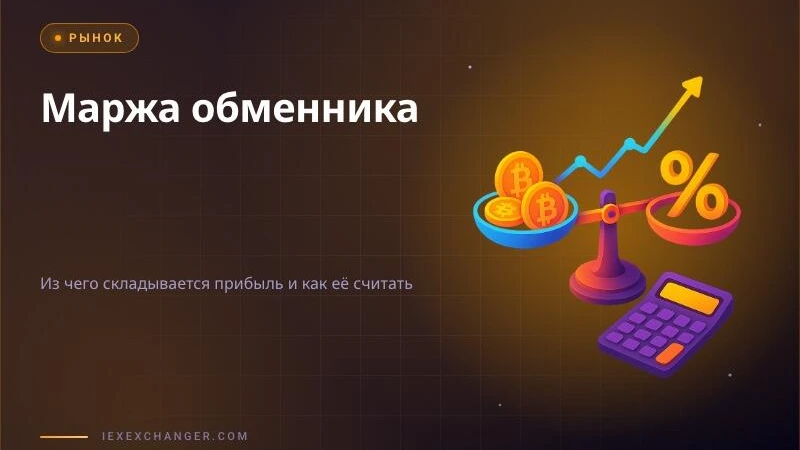
A crypto exchanger's profit margin is more than the gap between your buy and sell rates. Behind every trade hide network fees, payment processing charges, and price moves during the seconds your order sits open. Track revenue by spread alone and the business can look healthy for months — while quietly running at a loss. Here's what an exchanger's income actually consists of.
The Spread Is Only the Start
The spread — the difference between the rate at which a client sells you currency and the rate at which you sell it on — is the foundation of revenue. But it's far from the whole picture. Many exchangers also charge a flat fee per transaction, particularly for small trades where a percentage produces an embarrassingly tiny sum.
A "percentage plus minimum floor" structure looks something like this: 0.3%, but no less than $1. On a $50 trade that means $1 instead of $0.15 — a meaningful gap. It's not greed; it's covering real costs. Small trades demand the same network fees and operator time as large ones.
The Real Profit Formula: An Honest Look
Net income per trade = spread × volume − network fees − share of operational costs. Each component behaves differently, and the surprises are always in the details.
A concrete example: a client swaps $1,000 USDT. Your spread is 0.8%, so gross revenue is $8. Of that, $1.5–2 goes to network fees (Tron is roughly ten times cheaper than Ethereum), and another $0.50 covers the proportional cost of processing this transaction. Net profit: around $5–6. Not bad — unless the market moved while you were processing the order.
Five Hidden Costs That Eat Your Margin
- Network fees. Ethereum gas can hit $5–15 per transfer during peak hours. The choice of network directly changes your margin — sometimes by an order of magnitude.
- Payment processing. Card acceptance costs 1.5–3%. If a client pays by card and you work in USDT, that percentage is gone before you even touch the spread.
- Liquidity costs. No in-house reserve means buying from an aggregator at their spread. Your spread minus their spread is your actual margin.
- Chargebacks and cancellations. A single $300–500 reversal can wipe out the margin from two or three dozen small trades.
- Verification and support. Operator time, document processing, disputed cases — all of this spreads across every transaction as an invisible overhead cost.
Which Trading Directions Pay More
High-liquidity pairs — BTC/USDT, ETH/USDT — offer tight spreads and fierce competition. Per-trade margin is thin, but transaction volume can be high. Niche directions — cash deals, rare tokens, specific payment systems — let you hold a wider spread, but they demand more resources for liquidity and compliance.
The practical takeaway: mainstream directions work on volume, niche ones work on margin. Running both in parallel is a sound strategy if you have the resources to serve both client types properly.
Exchange-Rate Risk: The Silent Revenue Drain
Exchange-rate risk is the loss that occurs when an asset's price shifts between the moment you accept an order and the moment you fulfill it. Say Bitcoin drops 0.4% over five minutes while you hold a $5,000 open position. That's $20 gone — straight from your margin, without warning.
The fix is simple in theory: the more frequently you update quotes and the shorter your rate-lock window, the lower the risk. In practice, most professional exchangers refresh rates every one to three minutes and tighten the interval when market volatility picks up.
Conclusion
An exchanger's margin isn't a figure you set once and forget — it's a system you manage every day. Spread, fees, liquidity, rate risk: they all interact, and only the net result tells you whether the business is actually making money. Those who track it precisely tend to be in control. Those who only watch the spread sometimes find the explanation on their monthly statement.
Building this kind of economics is easier with tools that update rates automatically and reduce exposure to price-gap risk. If you're launching an exchanger or bringing order to an existing one, iEXExchanger offers dedicated rate-automation tools built for exchanger operators.