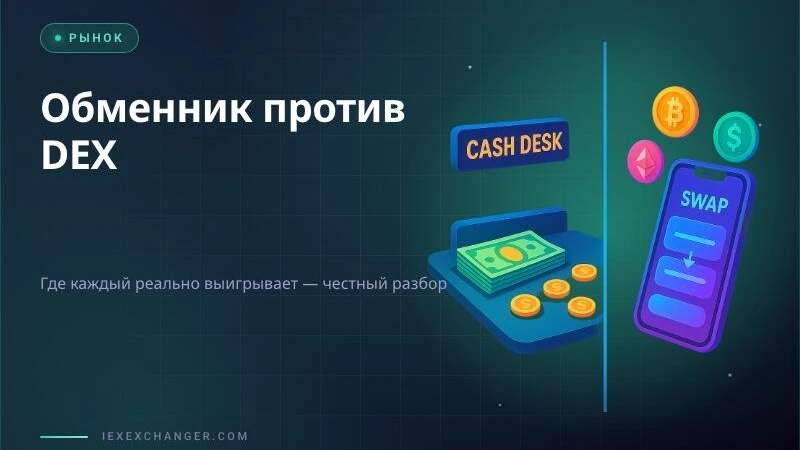
Exchanger vs DEX — this debate has been running since 2020, with no clear winner. DEX protocols rewrote how crypto trades, yet centralized exchangers are not going anywhere. Let's settle what each does best, honestly.
What DEX Actually Is — and Why It Matters
A DEX (Decentralized Exchange) is a smart contract that swaps tokens directly from your wallet, automatically, with no middleman. Think of it like a vending machine for crypto: put a token in, get another one out. No account, no ID check, nobody holding your funds on a server somewhere.
For certain use cases, that's genuinely powerful. A new token before it hits any major platform? DEX only. Interacting with DeFi protocols — staking (earning yield by locking coins), providing liquidity, borrowing — requires decentralized infrastructure. And if the website ever shuts down, the smart contract stays on-chain forever.
Where a Centralized Exchanger Objectively Loses
Three areas where DEX wins outright:
- Anonymity. No name, no passport, no transaction history stored on a central server.
- Token access. Any token on a blockchain is available the moment it's created — no listing requests, no waiting.
- No custodial risk. There is no central pool of funds to hack on the platform side; your money stays in your wallet.
For a crypto-native user who needs privacy or DeFi access, DEX is the natural choice. That's just a fact.
Fiat On-Ramps: The Wall DEX Cannot Climb
Here's where the situation flips. A DEX swaps crypto for crypto — full stop. Withdrawing USDT to a bank card via DEX? Impossible. Accepting cash? Impossible. Issuing a document a bank will recognise as a transaction record? Also impossible.
Yet that is exactly what most real-world exchanger clients need. They want to buy Bitcoin with local currency, cash out USDT to a bank account, or trade crypto for physical cash in their city. Only a centralized exchanger handles this — DEX simply cannot.
KYC: A Competitive Moat, Not a Burden
Nobody loves verification — fair enough. But look at it from the other side. Corporate clients, sole traders, and legal entities cannot use an anonymous DEX: they need documentation, AML checks, proof that funds are legitimate. Banks, payment processors, serious institutional partners only go where the rules are followed.
An exchanger with proper compliance attracts clients who have real money and need regular operations. DEX will never see those clients.
The Cheap-DEX Myth: What Fees Actually Look Like
Ethereum gas at peak hours runs $5–15 per transaction — that's real life, not a worst-case scenario. Add slippage: the gap between expected and actual swap price on a low-liquidity pair can reach 2–5%. Add interface complexity: setting slippage tolerance, picking the right chain, not mistyping an address — for a non-technical user, that's a genuine barrier.
A well-run exchanger with a competitive spread is often comparable in total cost — and considerably simpler for anyone who isn't already deep in DeFi.
Conclusion
DEX and centralized exchangers aren't rivals — they serve different people with different needs. DEX is irreplaceable for anonymous crypto operations and DeFi workflows. A centralized exchanger is irreplaceable wherever fiat, compliance, and real customer service matter.
If you're thinking about launching your own exchanger, understanding this distinction is the key to choosing your audience and positioning correctly. A ready-made platform with all the tools you need is iEXExchanger.