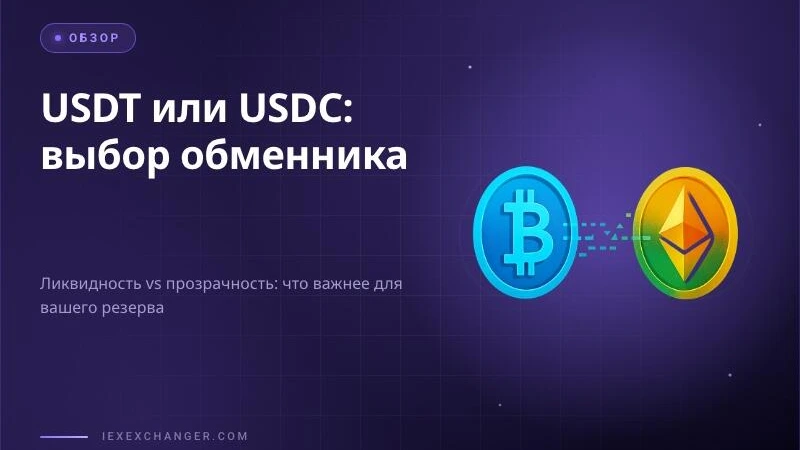
Stablecoins are the backbone of most exchanger reserves — but the difference between USDT and USDC is bigger than a single letter. It means different reserve transparency, different regulatory risk, and different client audiences. Pick the wrong one and you'll find problems exactly where you expected stability.
Why This Question Got Sharper in 2026
USDT recently overtook Ethereum in market cap for the first time in seven years — stablecoins have become the most traded asset in crypto. And regulators are now paying close attention.
Europe's MiCA framework is in force, and Tether doesn't comply with its requirements. Several European platforms have already delisted USDT. At the same time, USDC is positioning itself as the "regulatorily clean" option for businesses tied to Western markets. If your exchanger has any EU exposure at all, this is no longer an abstract concern.
USDT: Why Most Exchangers Default to It
Honest answer: because the liquidity is unmatched. USDT trades on every exchange worth mentioning — market depth on BTC/USDT and ETH/USDT pairs dwarfs USDC. In the CIS, Middle East, and Southeast Asia, USDT is simply a synonym for "stablecoin."
For an exchanger serving that audience, USDT on TRON adds another edge: transfer fees around a dollar, delivery in minutes. Clients don't think about networks; they just want their stablecoin fast.
The trade-off is transparency. Tether publishes quarterly attestations, but they aren't a full independent audit. How many actual dollars sit behind each USDT is a question the market can't fully answer. That's not a reason to panic — but it is a reason not to hold one hundred percent of your reserves in USDT.
USDC: When Transparency Beats Habit
Circle is a regulated US company. Monthly reserve attestations are conducted by a major audit firm and the reports are public. For an exchanger doing compliance reviews with European or American counterparties, that's a meaningful point in USDC's favour.
One thing worth knowing: in 2022, Circle froze addresses linked to Tornado Cash on OFAC's request. That means USDC is a managed asset — under certain conditions, your address can be blocked. For most legitimate exchangers this is a theoretical risk. For those operating in grey areas, it's a real one.
USDC liquidity in BTC and ETH pairs is solid, but trails USDT. In the CIS market, clients often haven't heard of USDC at all — you'll need to explain it.
Alternatives: What to Watch
FDUSD from First Digital (backed by Binance) is growing fast — a reasonable option for reserve diversification. PayPal's PYUSD is dollar-backed and US-oriented. Algorithmic stablecoins like DAI or FRAX are fine for DeFi operations, but holding them as your main exchanger reserves is risky: the TerraLUNA lesson hasn't expired.
In practice, most exchangers will find their real choice is still USDT vs. USDC, with FDUSD as a third option for hedging.
Three Questions That Will Answer It for You
Rather than a universal recommendation, here are three questions worth asking before you decide.
- Who are your clients? CIS, Middle East, Asia — USDT is more comfortable and familiar. Europe, USA, regulated business — USDC reduces friction in compliance reviews.
- What jurisdiction do you operate in? If you hold an EU licence or work with European banks, USDT in 2026 may create friction. USDC or a blended approach makes more sense.
- Liquidity or transparency — which matters more? High-frequency exchange demands liquidity. Institutional partnerships demand transparent reserves.
Many experienced exchangers hold both stablecoins in a 60/40 or 70/30 split toward USDT. It's a sensible compromise — you get USDT liquidity while reducing concentration risk through USDC.
Conclusion
There's no single right stablecoin for every exchanger — only the right choice for your audience, jurisdiction, and strategy. USDT wins on liquidity and reach; USDC wins on regulatory transparency. Holding only one means deliberately ignoring half the picture.
If you're building an exchanger from scratch or adding stablecoin support, iEXExchanger provides a ready-made engine with multi-currency support — so you can manage reserves flexibly from day one.