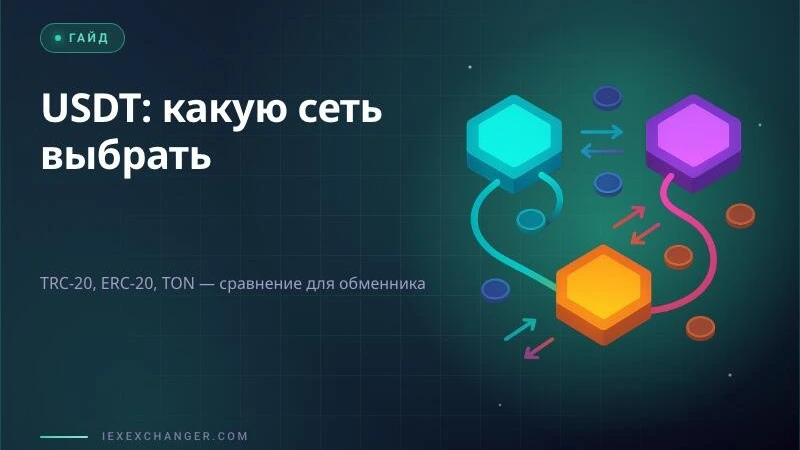
The USDT network your exchanger uses is not a technical detail — it is a business decision. At peak load on Ethereum, a single $500 transfer via ERC-20 can cost $10–20 in gas fees. The same transfer via TRC-20 runs about $1. Multiply that across thousands of transactions a month, and the difference adds up fast.
Why one network is never enough
An exchanger that supports only one USDT network is already turning away clients. People arrive from different platforms — some withdraw from Binance (BEP-20), some from Bybit (TRC-20), some from a self-custody Ethereum wallet (ERC-20). If you only accept TRC-20, a slice of your audience simply walks.
Each network is a separate blockchain with its own protocol, speed, and fee logic. USDT on Tron and USDT on Ethereum are technically different tokens, even though they are worth the same. Every supported network needs its own hot-wallet liquidity — capital sitting across multiple wallets at once, plus the operational load to manage it all.
TRC-20: the workhorse, with asterisks
TRC-20 is the de facto standard for USDT in most exchangers serving the CIS and Asia. Transfer fees run $1–3, confirmations land in 3–5 seconds. For retail-sized transfers, it is hard to beat.
The caveats matter, though. Tron is a relatively centralized network — a large share of its validators are affiliated with the Tron Foundation. That is rarely a problem for everyday exchange operations, but corporate clients and Western compliance teams sometimes ask questions. Major exchanges also occasionally pause TRC-20 USDT withdrawals during maintenance. Having a backup channel on another network is just sensible.
ERC-20: reputation has a price
ERC-20 runs on Ethereum — the most decentralized and institutionally trusted smart-contract network. It is the format large partners and corporate clients default to when setting up integrations.
The cost is gas. During heavy load, a single transfer can run $15–30. For an exchanger, that means either folding the fee into your rate (and becoming more expensive than competitors) or eating the loss on small transfers. The practical fix most operators land on: set a minimum ticket size for ERC-20 transactions — say, $300 or more.
TON, BEP-20, and others: niche but worth knowing
BEP-20 (Binance Smart Chain) is popular among BSC users, with fees as low as $0.10–0.50. TON — Telegram's own blockchain — is growing fast, driven by the messenger's built-in crypto wallet. If your exchanger runs on Telegram or operates through a bot, USDT on TON gives you a direct line to the @wallet audience.
Solana USDT is also gaining ground, especially among younger Western users. Fees are minimal and throughput is high. Coverage still lags TRC-20 and ERC-20 in terms of where people actually hold liquidity, but the gap is narrowing.
How to choose your network mix
There is no universal answer — it depends on your audience, average ticket size, and operational bandwidth. Here is a practical framework:
- TRC-20 first. Covers 60–70% of retail USDT traffic. Start here.
- ERC-20 for corporate clients and large amounts. Set a minimum: $200–300 per transaction to protect margins.
- TON if you operate on Telegram. Strong synergy with bots and Telegram Mini Apps.
- BEP-20 and Solana when you have the bandwidth. Broader reach, but each needs its own liquidity reserve.
The rule of thumb: every network you add is frozen capital, an extra risk surface, and more to monitor. Three networks done well beats seven done badly.
Conclusion
Your USDT network strategy directly shapes margins, client reach, and operational complexity. TRC-20 is the retail baseline, ERC-20 is for corporate flows and larger amounts, TON is for the Telegram crowd. Add the rest as volume warrants.
If you are building out your exchanger's custody infrastructure, take a look at iEXWallet — a purpose-built wallet for exchanger operators with no intermediary fees and multi-network support out of the box.