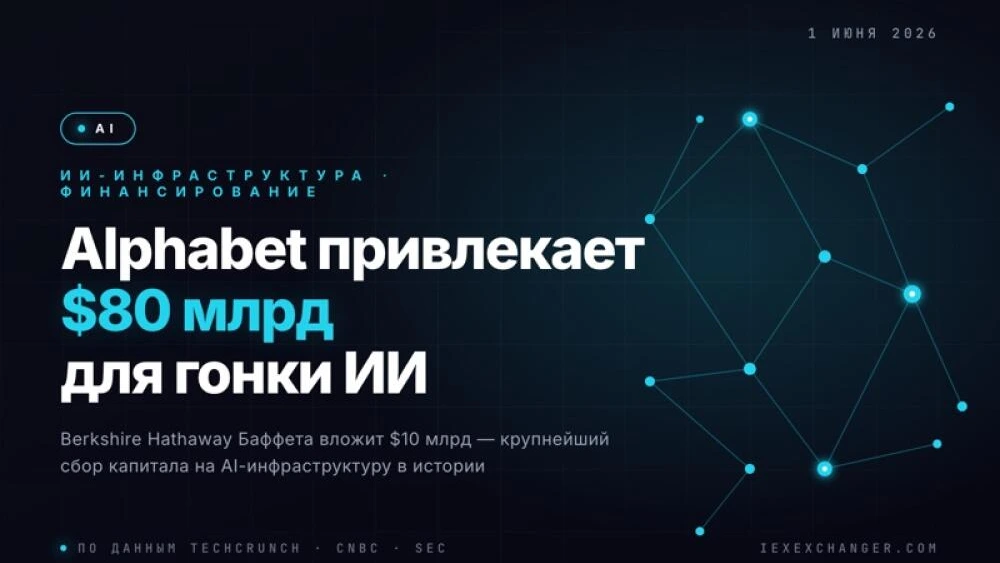
Alphabet, Google's parent company, announced the largest equity raise in tech history on June 1, 2026 — $80 billion in new share sales to fund artificial intelligence infrastructure. The company says demand for its AI solutions and services from businesses and consumers already exceeds available supply.
What Happened
Alphabet unveiled three simultaneous capital-raising mechanisms totaling $80 billion to scale its AI compute capacity globally. The company is issuing new Class A and Class C shares, alongside a private placement with Warren Buffett's Berkshire Hathaway. Alphabet stock declined on announcement day as investors weighed dilution risks against the company's bold AI ambitions — but the company's message was clear: the scale of demand justifies the scale of investment.
The $80 Billion Breakdown
The raise is structured in three parts:
- $30 billion — concurrent underwritten public offerings of Class A and Class C shares
- $40 billion — at-the-market (ATM) offering program, expected to launch in Q3 2026
- $10 billion — private placement with Berkshire Hathaway
Berkshire Hathaway's participation is notable. Warren Buffett has historically been wary of large tech bets, making this a powerful signal of long-term conviction in Google's AI strategy and future cash flows.
Why It Matters
This is not a routine funding round — it's an industrial-scale commitment to AI dominance. Alphabet explicitly stated that demand for its AI solutions already exceeds available supply. The funds will go toward custom TPU chip development to reduce reliance on Nvidia, global data center expansion, and a shift to nuclear and renewable energy to power compute at scale. Alphabet's 2026 capital expenditures are expected to reach $180–190 billion, with 2027 CapEx set to significantly increase.
The AI Infrastructure Arms Race
Alphabet is not alone. Microsoft has committed $80 billion to AI data centers, SoftBank announced €75 billion for French AI infrastructure, and Meta and Amazon are all racing for the same GPU racks, custom silicon, and energy contracts. The ability to raise and deploy capital at this scale has itself become a competitive moat — those who fall behind on infrastructure today risk losing market position for years.
What's Next
The $40 billion ATM program launches in Q3 2026, meaning Alphabet shares will flow steadily into the market over the coming quarters. Analysts expect the CapEx arms race to intensify across the sector. The combined signal from Alphabet and Buffett is hard to miss: the AI infrastructure buildout is not a passing trend but a decade-long capital cycle that is just getting started.