
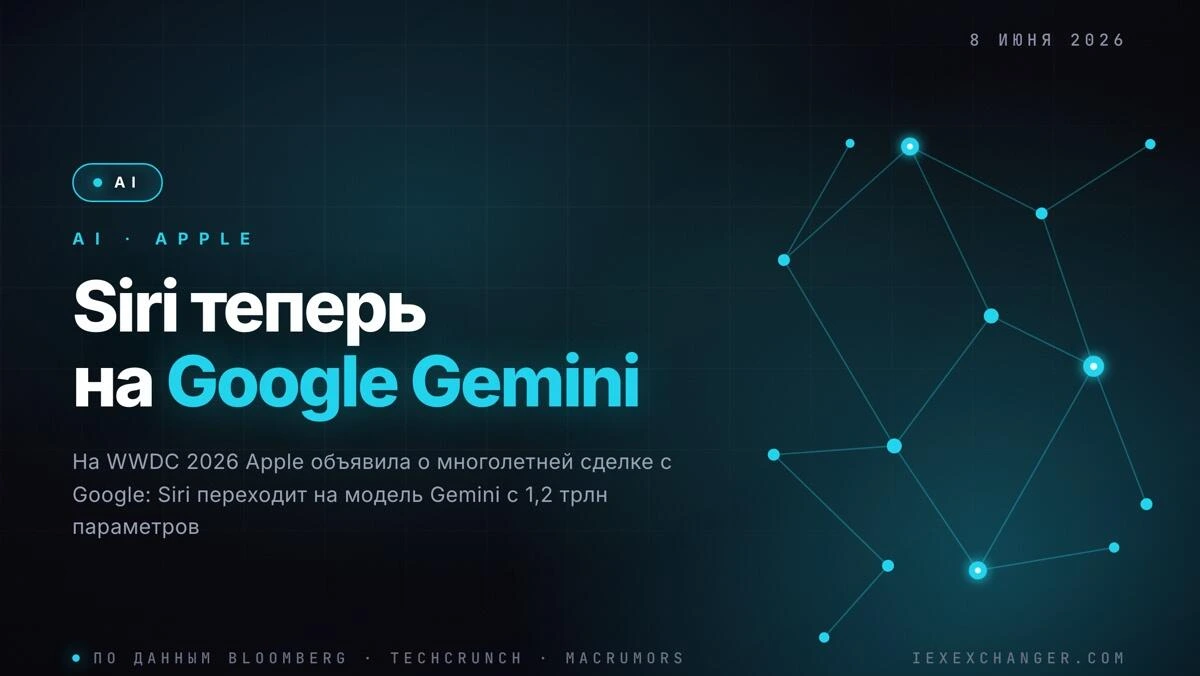
On June 8 in Cupertino, Apple opened WWDC 2026 with one of its most unexpected announcements in years: Siri is switching to Google Gemini. A company that spent years positioning its AI approach as uniquely private and deeply integrated chose to buy the best from a competitor instead.
Bloomberg reports Apple signed a multi-year agreement with Google worth roughly $1 billion annually. That money buys a custom Gemini model with approximately 1.2 trillion parameters — the brain handling Siri's heavy cloud-side reasoning. Apple's own compact on-device models stay in place for lighter tasks, but anything requiring multi-step logic or deep contextual understanding routes through Gemini.
The rebuilt Siri is a different product. It's a proper chat assistant now: text and voice input, access to a user's emails, files, and photos, multi-step request handling, and a standalone Siri app with a system-wide "Search or Ask" gesture and Dynamic Island integration. Developers get extension APIs to plug third-party AI models in, turning Siri into a platform rather than a locked-down product Apple controls alone.
The broader shift is harder to miss. Apple — with the world's largest base of custom silicon devices and its own AI research teams — chose someone else's model. Google picks up $1 billion a year and de facto status as the intelligence layer inside the most recognized smartphone on the planet. For OpenAI and Anthropic, this signals where the next major competition is forming: not who builds the best model, but who gets embedded in the biggest platforms.
iOS 27, macOS 27, and the rest of the operating system lineup were announced alongside Siri. Developer betas arrive in July; the full release lands this fall. The question that follows Apple out of WWDC: if Siri's intelligence belongs to Google, who actually controls the user experience on an iPhone?