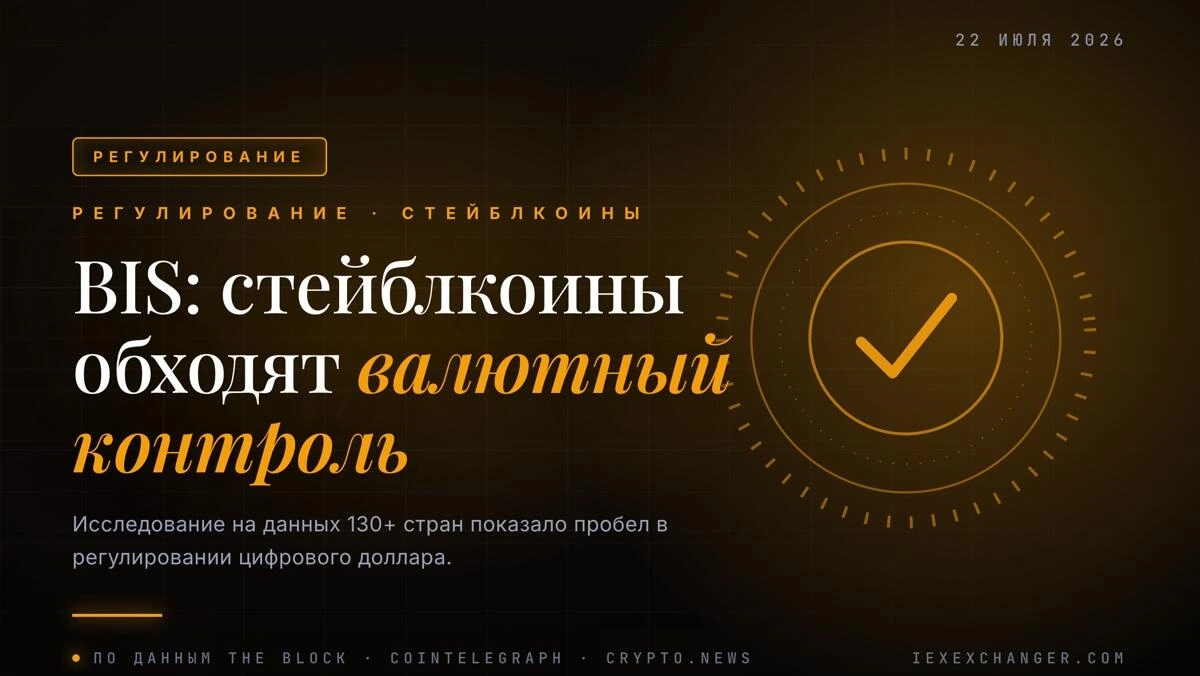
BIS Finds Stablecoins Slip Past Capital Controls More Easily Than Bank Deposits

iEXExchanger
BIS Finds Stablecoins Slip Past Capital Controls More Easily Than Bank Deposits

The Bank for International Settlements studied over 130 economies and found dollar-backed stablecoins barely respond to capital controls, unlike traditional foreign-currency bank deposits.

Capital controls work as long as money moves through a bank. A digital dollar sitting in a phone wallet is a different story — and now there is data to back that up. The Bank for International Settlements published a study on Tuesday covering more than 130 economies: ordinary foreign-currency bank deposits respond sharply to government restrictions, while dollar-backed stablecoins barely budge.

The reason lies in how the instrument itself works. A token like USDT or USDC can sit in a wallet with no bank account attached and move directly to another person, bypassing the exchanges and payment agents that capital controls are typically built to police. BIS researchers describe stablecoins as operating "partly outside the regulatory perimeter" — the rules technically exist, but enforcing them on a wallet-to-wallet transfer is close to impossible.

For countries with weak domestic currencies, that opens a direct channel into dollarization, skipping banks and exchange bureaus entirely. Once households and businesses shift into digital dollars at scale, BIS warns, reversing that shift is nearly impossible, and a central bank gradually loses part of its grip on monetary policy — even while headline inflation numbers still look manageable.

There's a flip side worth noting. For people living with runaway inflation, dollar access without a trip to the bank is a lifeline for savings, not a threat. The stablecoin market has already grown to roughly $300 billion, up from about $250-260 billion a year ago, and regulators in the US, EU and Japan are actively building frameworks for the sector. The open question is whether they finish that work before dollarization becomes irreversible.
Questions and answers

Frequently asked questions about this article

What is the Bank for International Settlements and why does its research matter?

BIS acts as a bank for central banks and helps coordinate global monetary policy. Its research sets the tone for regulators worldwide, so a finding about stablecoins slipping past controls quickly lands on central banks' agendas.

Why do capital controls exist in the first place, and what are they meant to protect against?

Governments restrict capital outflows and foreign-currency purchases to protect reserves, stabilize the local currency and prevent sudden money flight during a crisis. That only works if the money flow passes through banks that can be checked.

How exactly do stablecoins get around these restrictions technically?

A stablecoin can sit in a non-custodial wallet with no ties to a specific bank and move directly to another wallet anywhere in the world. The transaction settles on a blockchain rather than through a correspondent bank account or payment agent — the exact intermediaries usually required to screen currency transactions.

Does this mean stablecoins are unambiguously bad for emerging economies?

No, BIS does not claim that. For people living with high inflation, dollar access without a bank is often what protects their savings. The concern is more that central banks lose policy tools, not that the instrument itself harms an individual user.

What are US, EU and Japanese regulators doing about these risks?

All three jurisdictions are actively building rules specifically for stablecoins — reserve requirements, issuer licensing and platform oversight. The goal is to bring issuance and circulation into a checkable framework without killing the technology itself.