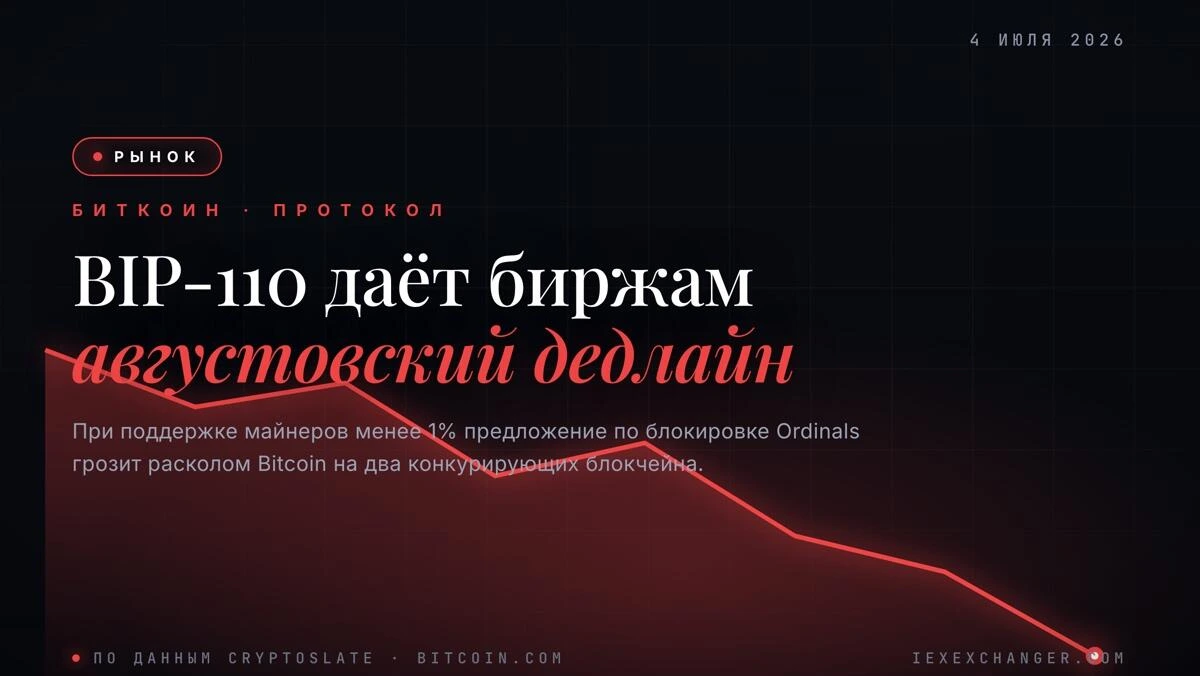
Five weeks out from the August mandatory signaling window and Bitcoin is heading into one of its most contentious protocol debates in years. BIP-110, authored by Dathon Ohm, proposes a one-year soft fork that would ban large arbitrary data from Bitcoin transactions — effectively ending Ordinals inscriptions, BRC-20 tokens, and certain Taproot constructions repurposed for data storage. Standard coin transfers would remain unaffected.
Supporters argue inscription methods clog the network, drive up fees, and inflate the storage burden for every node operator. The proposal is surgically narrow: pre-existing UTXOs are permanently exempt, and the restrictions expire automatically after roughly 52,416 blocks — about a year — with no further action required from anyone.
The critical number is 0.42%. That is Bitcoin's current miner support for BIP-110 as of early July 2026, with approximately 5 exahashes per second out of a network total near 940 EH/s — nearly all from Ocean pool. Lock-in requires 55% support within a single difficulty retarget period. That threshold is nowhere near being met.
Here lies the real danger. The UASF mechanism forces open a mandatory signaling window around August 7 regardless of miner sentiment. If enough nodes enforce BIP-110 rules while most miners ignore it, two competing chains emerge. Adam Back of Blockstream said it plainly: the proposal does not work, breaks multiple mechanisms, and has no technical consensus in the ecosystem. Jameson Lopp warned that activation greatly increases the chances of a chain split with competing versions both claiming to be the real Bitcoin.
Exchanges should already be stress-testing deposit policies, withdrawal procedures, and wallet compatibility. The deeper question underneath BIP-110 is one Bitcoin has wrestled with since the Ordinals boom: is the base layer a monetary network, a data layer, or both?