
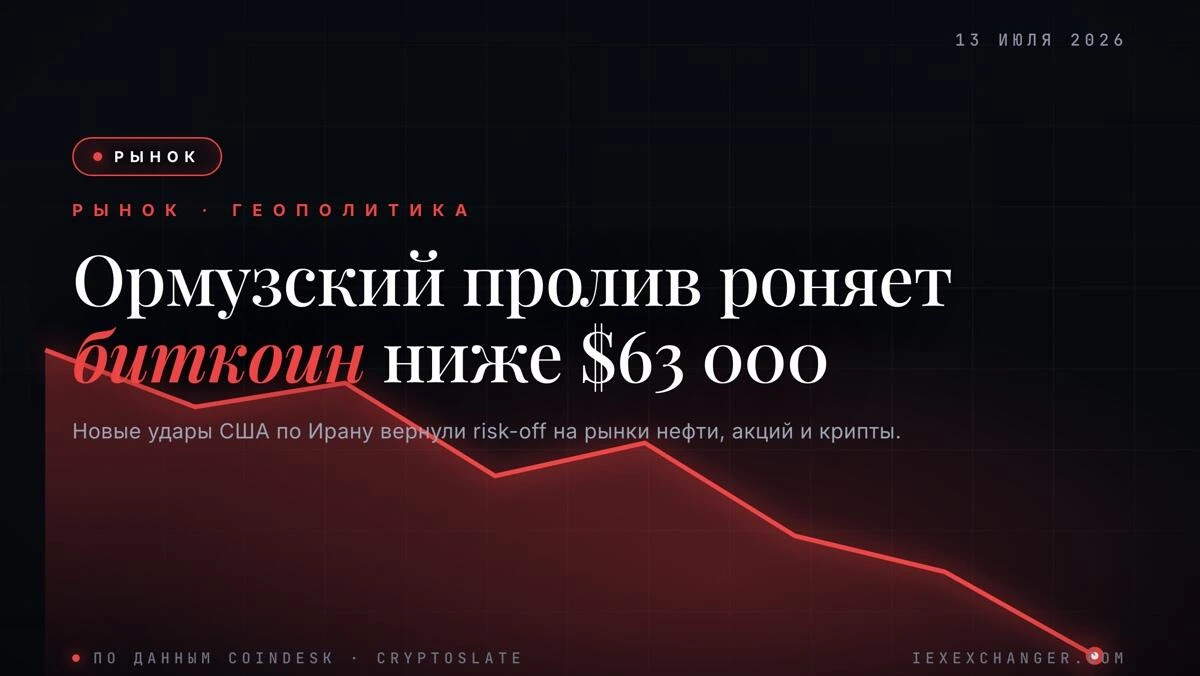
Bitcoin closed out the week above $64,300 on Friday. By Monday morning almost none of that gain survived — the price slid to $62,100–$63,100, with several altcoins falling harder. The trigger wasn't anything technical inside crypto markets. It was the United States striking new targets in Iran, Iran hitting back near the Strait of Hormuz, and traders once again pricing in risk to a corridor that carries roughly a fifth of the world's seaborne oil.
This is a direct sequel to a story that looked settled a month ago. In mid-June, a ceasefire announcement between Washington and Tehran pushed bitcoin above $65,000 as markets exhaled. Now the pendulum has swung back — Polymarket bettors are pricing just a 3% chance that Hormuz shipping traffic normalizes by July 31.
Crypto wasn't alone in taking the hit. South Korea's Kospi tumbled 9.2%, wiping out roughly $377 billion in market value. Japan's Nikkei and China's SSE each dropped more than 2%, and chipmaker SK Hynix crashed 15% — its worst single day on record. Brent crude climbed about 4%, edging toward $80 a barrel, as investors priced in the risk of a prolonged disruption to one of the planet's critical oil arteries.
On derivatives desks, the move triggered close to $253 million in liquidations over 24 hours, with roughly three-quarters hitting long positions — traders who had bet on the rally continuing got hit first. Bitcoin ETF inflows haven't dried up entirely, though: CoinDesk reports some institutional buyers kept adding on the dip, betting the conflict won't escalate into a sustained blockade of the strait.
From here, it's mostly about oil and how long the fighting drags on. Higher energy prices aren't just a pump-price story — they feed inflation, which threatens the Fed rate-cut bets markets built up over the summer. If Hormuz stays disrupted through late July, this stops being a crypto correction and turns into a broader repricing of risk across every asset class.