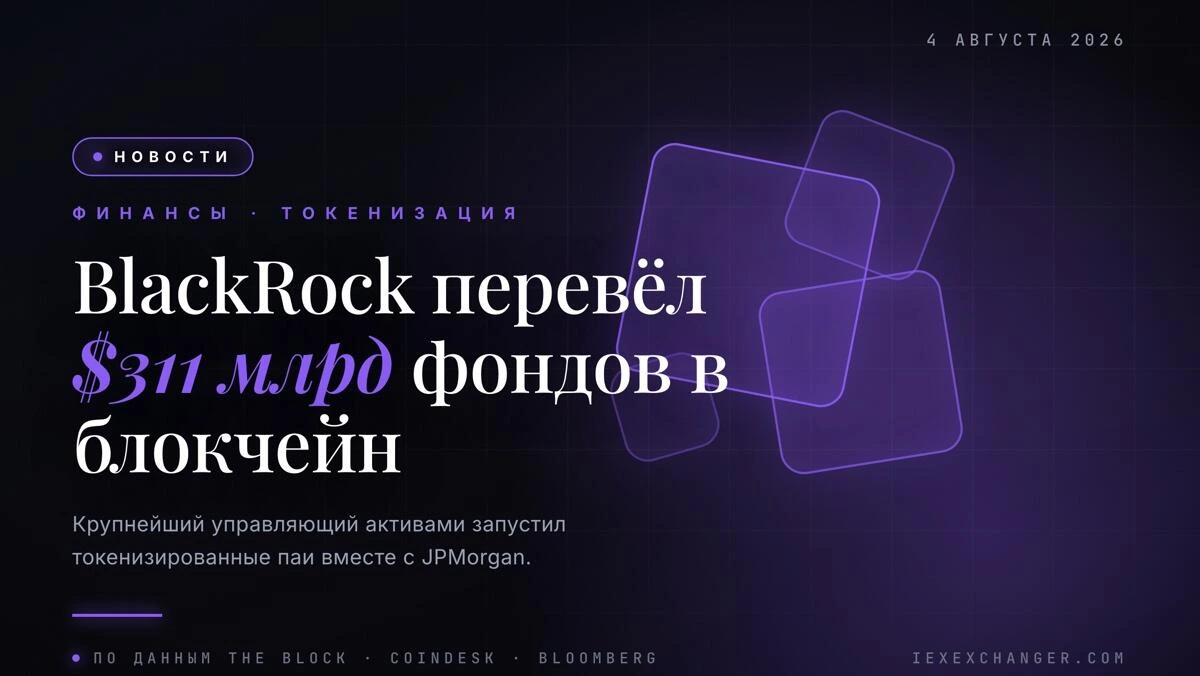
BlackRock, the world's largest asset manager with roughly $12 trillion under management, has moved part of its European money market fund lineup onto a blockchain. Twelve tokenized share classes now exist across six funds in its ICS range — from a U.S. dollar Treasury fund to euro- and sterling-denominated ones — covering a combined $311 billion in assets as of the end of June.
Mechanically, each token represents a stake in an ordinary, fully regulated fund. The official shareholder register is still kept by a conventional transfer agent, while Kinexys — JPMorgan's asset-tokenization arm — acts as the translation layer between the blockchain and that register. In practice, that lets an investor move a fund share to another approved wallet holder around the clock, outside banking hours, with near real-time visibility of the transfer on Ethereum.
This isn't BlackRock's first attempt. Back in 2024, the firm launched the BUIDL fund with Securitize; it has since grown to about $2.5 billion and become one of the most widely used collateral assets in crypto trading. The new European rollout dwarfs BUIDL in underlying fund size, though the actual tokenized slice will start small and grow only as institutional investors — corporate treasuries, banks, liquidity managers — choose to move their holdings on-chain.
The European launch comes just a day after BlackRock unveiled two similar U.S. products, BSTBL and BRSRV, designed to qualify as reserve assets for stablecoin issuers under the GENIUS Act. The timing isn't a coincidence: BlackRock already manages roughly $60 billion of Circle's USDC reserves and has said openly it wants to become the reserve manager of choice for the entire stablecoin industry.
The real significance isn't the $311 billion headline number itself — most of that stays in its traditional form for now. It's that tokenization is turning from a crypto-native experiment into routine back-office infrastructure at the institutions that anchor global finance. When BlackRock and JPMorgan jointly build round-the-clock settlement rails for money market funds, that reshapes what the rest of the asset-management industry expects to build next, faster than any bitcoin price swing.