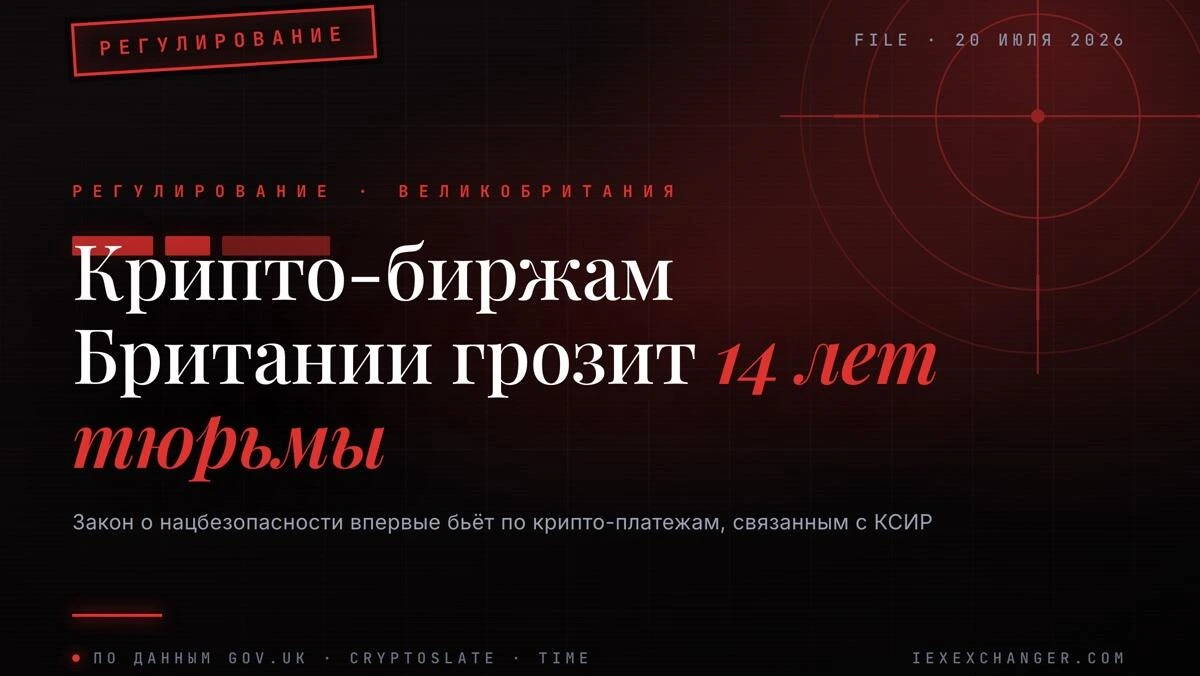
Britain has formally added Iran's Revolutionary Guard Corps to its list of national security threats, and crypto is the sector feeling the sharpest edge of that decision. The designation, which took effect on July 17 under Schedule 6A of the National Security Act, also covers a religious movement called IMCR and Russia's GRU Volunteer Corps. For most of the economy, the move barely registered. For exchanges and custodians, it created a very specific new risk.
The law never mentions bitcoin, stablecoins or blockchain by name. But its wording — money or anything of value supplied directly or indirectly, including through companies — is broad enough to sweep in any crypto asset by default. An exchange, custodian or OTC desk that accepts or holds funds tied to the IRGC, knowing or reasonably suspecting their origin, now faces up to 14 years in prison. Merely agreeing to accept such funds carries up to 10.
The catch is timing. A blockchain transfer settles in seconds, but figuring out whose wallet actually sent it can take weeks — sometimes only after the funds have already moved through an exchange. UK firms now have to log the exact moment a transaction landed, what risk data existed about that wallet at the time, when an IRGC link first surfaced, and what the firm did once it found out. That's a documentation burden closer to bank-grade sanctions screening than anything most crypto companies were built to handle.
One nuance is worth keeping straight: being placed on Schedule 6A isn't the same as a financial sanction. It doesn't automatically freeze assets or lock stablecoin smart contracts — that still requires a separate sanctions action. The law also carves out exceptions for reasonable payment for lawful goods and services, humanitarian work under recognized standards, and legal obligations.
In practice, UK crypto firms now need paper trails that look a lot like a bank's compliance file — and a mistake in judging wallet risk carries a prison sentence, not just a fine.