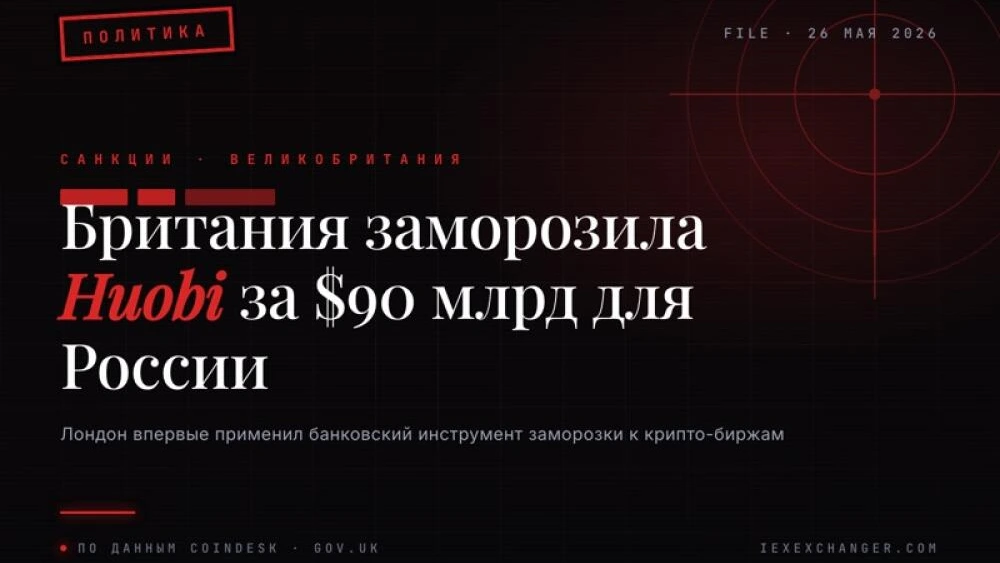
The UK delivered one of its sharpest blows yet to Russia's crypto infrastructure, sanctioning 18 entities — including the HTX exchange — for allegedly helping move billions around Western war restrictions.
What Happened
On May 26, 2026, the UK's Foreign, Commonwealth & Development Office designated 18 companies and individuals linked to the A7 payments network. The list includes Huobi Global S.A. (operator of the HTX exchange), the issuer of the USDKG gold-backed stablecoin, Rapira Group, Aifory, Arvix, Bitpapa IC FZC, and four individuals from Russia, Kyrgyzstan, and Israel.
Why It Matters
For the first time, the UK applied Regulation 17A — a banking-grade enforcement tool — to crypto exchanges. This rule requires UK financial institutions to freeze assets and trace transactions across multiple blockchain hops, extending the reach of sanctions well beyond direct transfers.
The A7 network was allegedly built to bypass Western restrictions, finance military procurement, and recycle proceeds from Russian oil sales. According to the UK government, it moved over $90 billion last year — roughly half of Russia's annual military budget.
Who's in the Crosshairs
The headline name is HTX (formerly Huobi), one of the world's largest crypto exchanges with roughly $3.3 trillion in annual trading volume. London accused it of channeling more than $1.5 billion back to the Kremlin. A Kyrgyz bank suspected of serving as the network's financial backbone was also named. HTX did not respond to requests for comment.
- Huobi Global S.A. — operator of the HTX exchange
- USDKG issuer — gold-backed stablecoin operator
- Rapira Group, Aifory, Arvix, Bitpapa IC FZC
- Four individuals: Mendeleyev, Gorin, Akopyan, and Israeli national Cohen
What Comes Next
The application of Regulation 17A sets a new precedent: UK institutions must now track where funds flow even through multiple intermediate wallets. Analysts warn this may push Russia toward more decentralized infrastructure and privacy-focused protocols. The UK has now sanctioned more than 3,300 Russian individuals and entities in total, with estimated damage to Russia's war economy exceeding $450 billion.