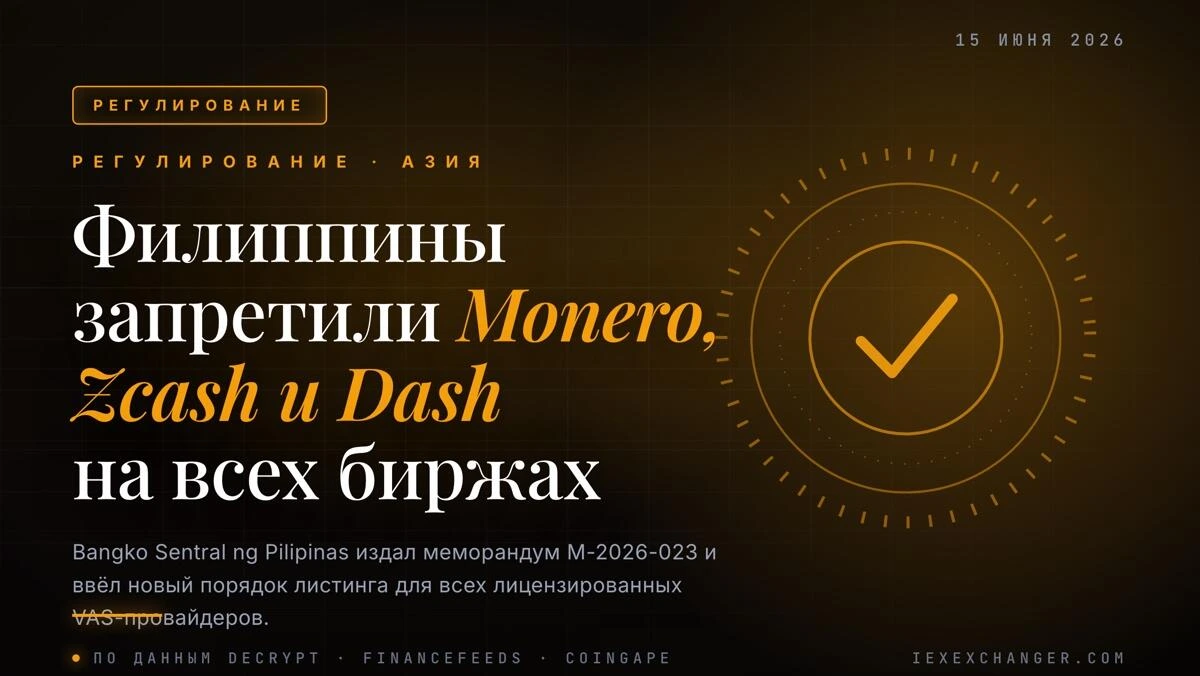
Privacy coins just lost another regulated market. The Bangko Sentral ng Pilipinas issued Memorandum M-2026-023, requiring all licensed virtual asset service providers to remove Monero, Zcash, and Dash from their platforms. Deputy Governor Lyn Javier signed off on the directive, citing consumer protection and the need for "safe, sound" digital asset services — though the underlying driver is unmistakably anti-money laundering compliance.
The three coins share a common problem from regulators' perspective: they're built to obscure transaction histories. Monero uses ring signatures and stealth addresses; Zcash offers shielded transactions via zero-knowledge proofs; Dash's PrivateSend mixes outputs to break traceability. For investigators and tax authorities, that's a dead end. European exchanges ran the same playbook in 2023–2024 under MiCA and national AML pressure, quietly delisting Monero from Bitfinex's regulated entities, Kraken Europe, and others. The Philippines is catching up.
Context matters here. The Philippines isn't a peripheral crypto market — it consistently ranks among the world's top adopters, driven by remittance flows, a large overseas worker population, and a mobile-first consumer base that once powered Axie Infinity's global boom. A BSP directive carries real weight in one of Asia's most active retail crypto ecosystems.
The memorandum goes further than the privacy coin ban. All new listings now require prior structured due diligence covering issuer background, governance, liquidity, legal status, and technology risk. Exchanges must monitor listed assets on an ongoing basis and have defined delisting triggers: liquidity collapse, security incidents, involvement in fraud, or misleading disclosures. Stablecoins face added scrutiny around reserve transparency and redemption terms.
Private ownership isn't criminalized. Monero in a self-custodied wallet stays legal, and peer-to-peer transfers outside regulated platforms remain untouched. But for most retail users, the regulated on-ramp is gone — and that's where the practical effect lands.
Japan, South Korea, the UAE, and most of Europe preceded the Philippines on this path. The Monero and Zcash networks will keep running. P2P volumes might even tick up as exchange access disappears. The open question is whether tightening regulated access actually reduces illicit use — or just shifts it further into channels that are even harder to monitor.