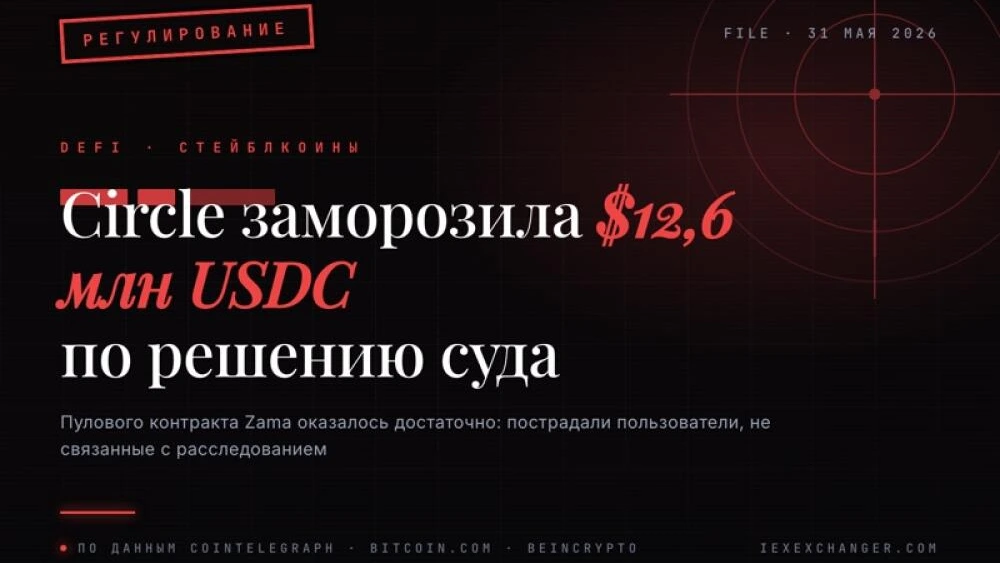
Circle, the issuer of the USDC stablecoin, has blacklisted a Zama protocol smart contract, freezing $12.6 million in user funds. A US federal court's temporary restraining order triggered the action — and the people who lost access to their money weren't the ones under investigation.
What Happened
On May 30, 2026, Circle blacklisted the Zama cUSDC contract address — a pooled vault using fully homomorphic encryption (FHE) to obscure token balances. The freeze was executed to comply with a temporary restraining order in Newton AC/DC Fund LP's lawsuit against Maxim Ermilov. Because the contract is pooled, every user's funds inside were frozen simultaneously.
Zama stated it received no advance notice from Circle or the court before the blacklist was executed. The ZAMA token fell 18% within hours of the news breaking.
Why Innocent Users Got Caught
The core issue is how pooled smart contracts work. Circle froze the entire contract rather than isolating the specific suspect address. Users who had no connection to Newton Finance or the defendant lost access to their USDC alongside the targeted funds.
On-chain data shows that approximately $12.4 million USDC was deposited into the contract in May 2026 from an address linked to Overnight Finance (OVN) — following rug-pull allegations and a controversial pre-vote treasury withdrawal.
Stablecoin Centralization Under the Microscope
The incident reignites a long-running argument: stablecoins like USDC are not neutral money. Circle has a built-in blacklist function that lets it freeze any Ethereum address on demand — whether by law enforcement request or court order.
Critics have long pointed out that these freezes are applied inconsistently. The Zama case drew particular attention because the victims were legitimate users of a privacy protocol who had nothing to do with the underlying dispute.
What Comes Next
A court hearing is scheduled for June 1, 2026. Possible outcomes include a narrower isolation order targeting specific funds, or a partial release of assets belonging to uninvolved users. Zama reportedly intends to challenge the broad scope of the freeze.
The incident is likely to accelerate interest in truly decentralized stablecoin alternatives that don't rely on a centralized issuer with freeze capabilities.