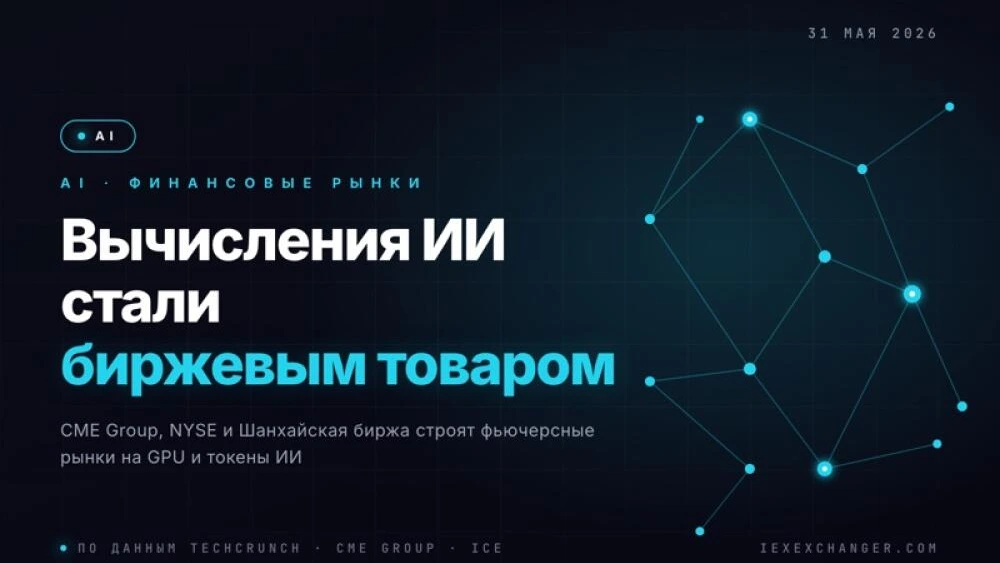
Not long ago, AI computing resources — tokens and GPU time — were just a line item on a cloud bill. Now they are on their way to becoming fully fledged exchange-traded commodities: three of the world's largest financial venues have simultaneously announced they are building futures markets for AI infrastructure.
What Happened
CME Group, the world's largest derivatives exchange, and Intercontinental Exchange (ICE), the owner of the New York Stock Exchange, have independently announced they are developing futures contracts on GPU compute rentals. At the same time, China's Shanghai Futures Exchange is working on derivatives tied directly to AI tokens. All of this emerged within a single week in May 2026.
Why It Matters
Futures contracts allow businesses to hedge risk. A company planning an expensive model training run three months from now could lock in GPU prices in advance — exactly the way airlines hedge against jet fuel spikes. For investors, this creates a new asset class: a bet not on any specific AI company, but on the price of AI infrastructure itself.
The signal is clear: financial giants no longer treat AI compute as a niche curiosity — they are placing it alongside oil, natural gas, and metals.
Context and Numbers
The market is already enormous. OpenAI charges $5 per million input tokens and $30 per million output tokens for GPT-5.5 API access. Renting an H100 GPU runs $1.40–$4.27 per hour; an H200 costs $2.34–$5 per hour. Meanwhile demand keeps climbing: hundreds of billions of dollars have been poured into AI data centers over the past two years.
- CME Group and ICE — futures on GPU compute rentals (H100, H200)
- Shanghai Futures Exchange — derivatives tied directly to AI tokens
- The broader AI crypto token market has surpassed $20 billion in market cap
What Comes Next
If these futures markets launch, companies will be able to budget for AI without the risk of price shocks. Smaller players — startups and research labs — will gain a tool to hedge against GPU market volatility. And standardized contracts will accelerate the formation of transparent pricing for AI compute, something the industry badly lacks right now.