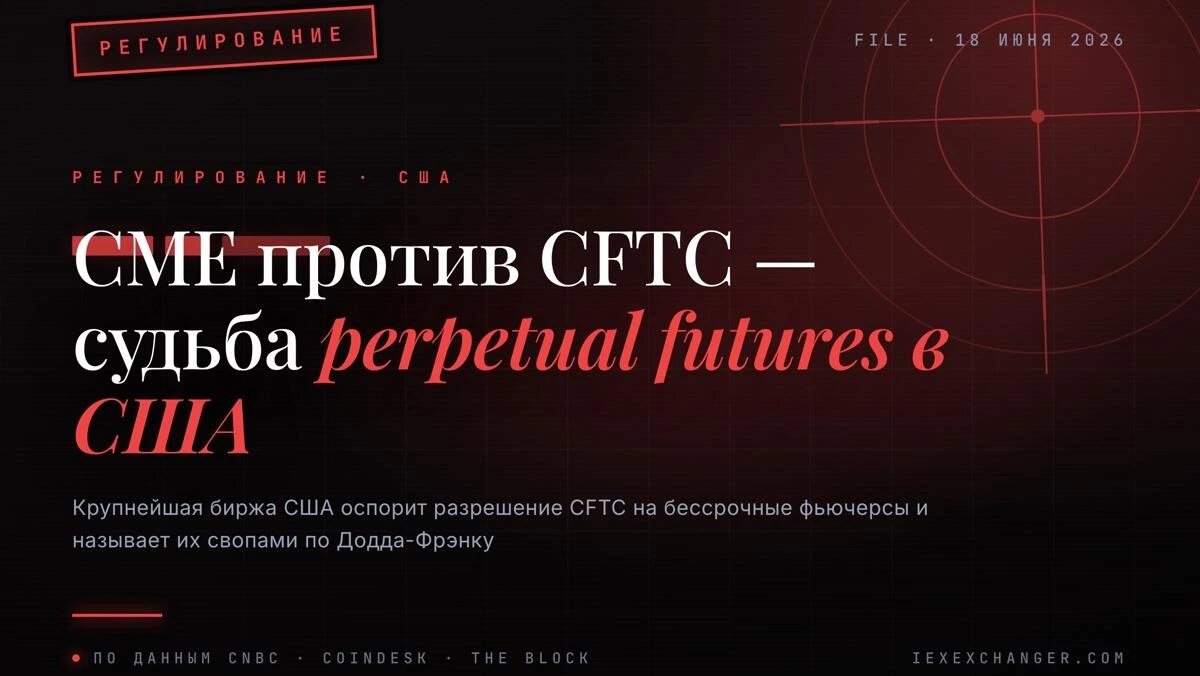
CME Is Suing the CFTC Over Kalshi's Perpetual Futures Green Light

iEXExchanger
CME Is Suing the CFTC Over Kalshi's Perpetual Futures Green Light

CME Group plans to sue the CFTC over its approval of Kalshi's bitcoin perpetual futures. CEO Terrence Duffy says the product is legally a swap — and expects to file Thursday.

CME Group is taking its own regulator to court. CEO Terrence Duffy told CNBC on Tuesday that the exchange plans to file a lawsuit against the CFTC as early as Thursday. The legal team has been building the case for eight months.

The trigger was a late-May decision: the CFTC approved prediction market platform Kalshi to offer bitcoin perpetual futures to U.S. retail traders. Perpetuals — futures contracts with no expiration date — have dominated offshore crypto trading for years on exchanges like Binance and Bybit. The U.S. had blocked the product class until Kalshi's green light.

CME's legal argument rests on the Dodd-Frank Act. Perpetual futures have no expiry; instead, they use a funding rate mechanism where holders of long and short positions exchange periodic payments based on how the contract price diverges from spot. Duffy argues that structure — two parties continuously exchanging payments — fits Dodd-Frank's definition of a swap, not a futures contract. Swaps and futures sit under different legal frameworks: distinct clearing requirements, participant categories, and disclosure rules apply to each.

If the court sides with CME, the CFTC effectively approved a swap under the wrong regulatory window. Kalshi would then need to either restructure the product, obtain a swap dealer license, or pull it from the market. Other platforms that had been eyeing Kalshi's approval as a blueprint for their own perpetual launches would face the same uncertainty.

CME's commercial interest is clear. The exchange runs a large crypto derivatives business and doesn't want competitors operating under a looser rulebook. Duffy acknowledged as much, though the lawsuit is framed in legal rather than competitive terms.

The case could take a year or more to resolve. Kalshi keeps operating in the meantime — a filed lawsuit doesn't automatically suspend a regulatory approval. But the fact that America's biggest futures exchange is formally contesting a CFTC decision turns perpetual futures from a settled question back into a live legal fight. The product's standing in the U.S. now hinges on what a court makes of Dodd-Frank.


Questions and answers

Frequently asked questions about this article

What are perpetual futures and why do traders want contracts with no expiration?

Perpetual futures are derivatives contracts that never expire. Standard futures close on a fixed date, forcing traders to settle or roll their position into the next contract. Perpetuals hold indefinitely. Price stays anchored to spot through a funding rate: every few hours, long-side traders pay short-side traders (or vice versa) based on the price divergence. The product is popular for its simplicity and the ability to hold leveraged positions without managing expiry cycles.

Why does CME argue that perpetual futures are swaps, not futures?

Under the Dodd-Frank Act, a swap is defined as an agreement where two counterparties periodically exchange payments. That's exactly how the funding rate works in perpetual futures: long and short holders pay each other at regular intervals. CME argues this matches Dodd-Frank's swap definition. If a court agrees, the CFTC should have regulated the product under swap rules — which carry stricter clearing and participant requirements.

What happens to the U.S. crypto derivatives market if CME wins?

Kalshi would need to redesign the product, obtain a swap dealer license, or pull it from the market. Other platforms that had planned similar launches would face the same obstacle. American retail traders would remain locked out of an instrument already available everywhere else — potentially for years while the legal and regulatory framework gets sorted.

Is this the first time a major exchange has sued the CFTC?

Private companies have challenged CFTC rulings before, but for CME — the country's largest derivatives operator — it is genuinely rare. As a publicly traded company, CME has legal standing to contest a regulatory decision that directly affects its competitive position. A court will examine whether the CFTC correctly applied Dodd-Frank when it approved Kalshi's product.