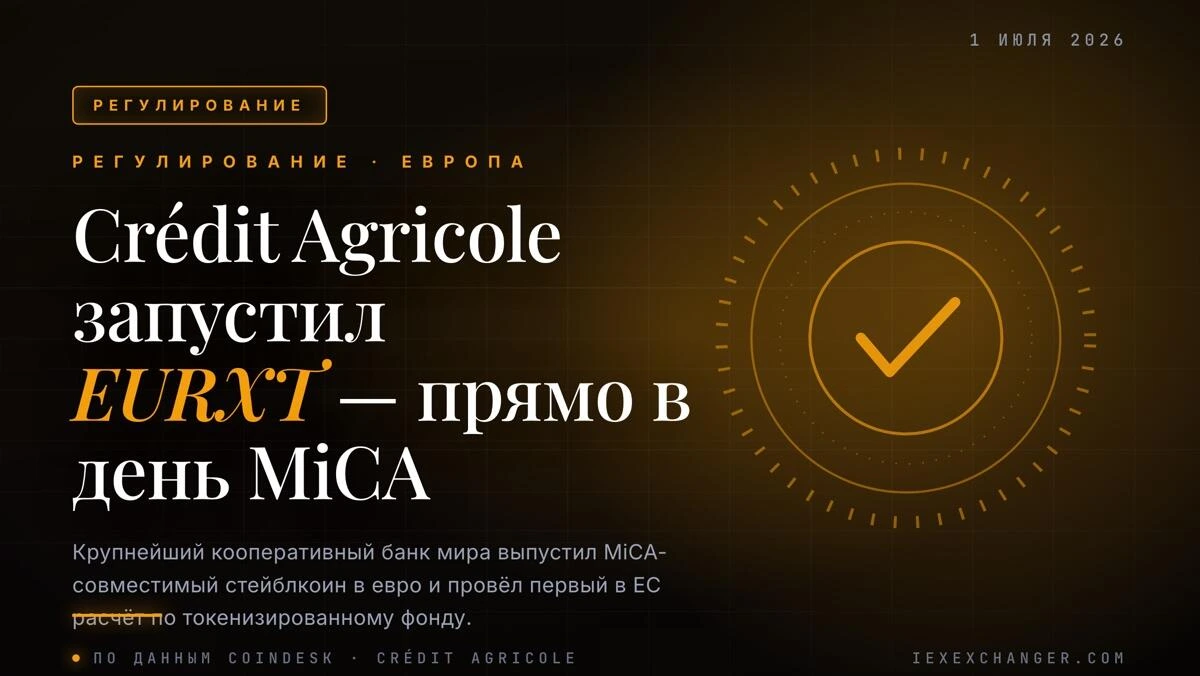
Crédit Agricole — Europe's second-largest bank by total assets and the world's largest cooperative banking network — just entered the euro stablecoin market. The token is called EURXT (EURO eXchange Token), runs on Ethereum, and launched on July 1: the same day the EU's MiCA regulation came into full force for every market participant, no exceptions. The timing is not accidental.
EURXT was issued through CACEIS, a Crédit Agricole subsidiary that handles asset-servicing for institutional clients — fund managers, pension funds, and insurers. It's an ERC-20 electronic money token backed 1:1 by euros held on CACEIS Bank's balance sheet. Reserve transparency is tracked via stable-xt.io.
The launch came with a concrete first: an institutional client used EURXT to settle a subscription into a Luxembourg-domiciled Amundi UCITS money market fund — the first time a tokenized fund in Europe was settled using a euro stablecoin. No bank wire. No correspondent account delays. Just a digital instrument moving through a fully digital settlement layer.
Competition in the space isn't new. Circle's EURC has around 378 million tokens in circulation; Société Générale's EURCV holds roughly 124 million. A consortium of 37 European banks called Qivalis is also building a rival product. Crédit Agricole enters late by calendar, but with a structural edge: EURXT was designed for MiCA from scratch, without the retrofitting that earlier players had to navigate as regulations evolved.
CEO Olivier Gavalda described EURXT as "a stable, secure payment instrument that complies with the latest European regulatory requirements."
For now, the token is only accessible to CACEIS clients. No retail launch is planned, and that restraint makes sense. The euro stablecoin market is a fraction of the dollar-denominated segment, where USDT and USDC together exceed $200 billion. Institutional settlement is the right foothold to build volume before broadening the audience. If major custodians and fund platforms adopt stablecoin settlement as standard practice, growth could scale quickly.
The larger shift from today: MiCA is binding across all 27 EU member states with no transition periods remaining. Operating without a license is a breach of EU law, not a paperwork gap. For stablecoins specifically, MiCA defined a precise legal category — "electronic money tokens" — with clear reserve and supervisory requirements attached. EURXT was built to fit that category exactly. Crédit Agricole's calculation is straightforward: regulatory clarity accelerates adoption, and being the first major European bank to move gives it a durable head start.