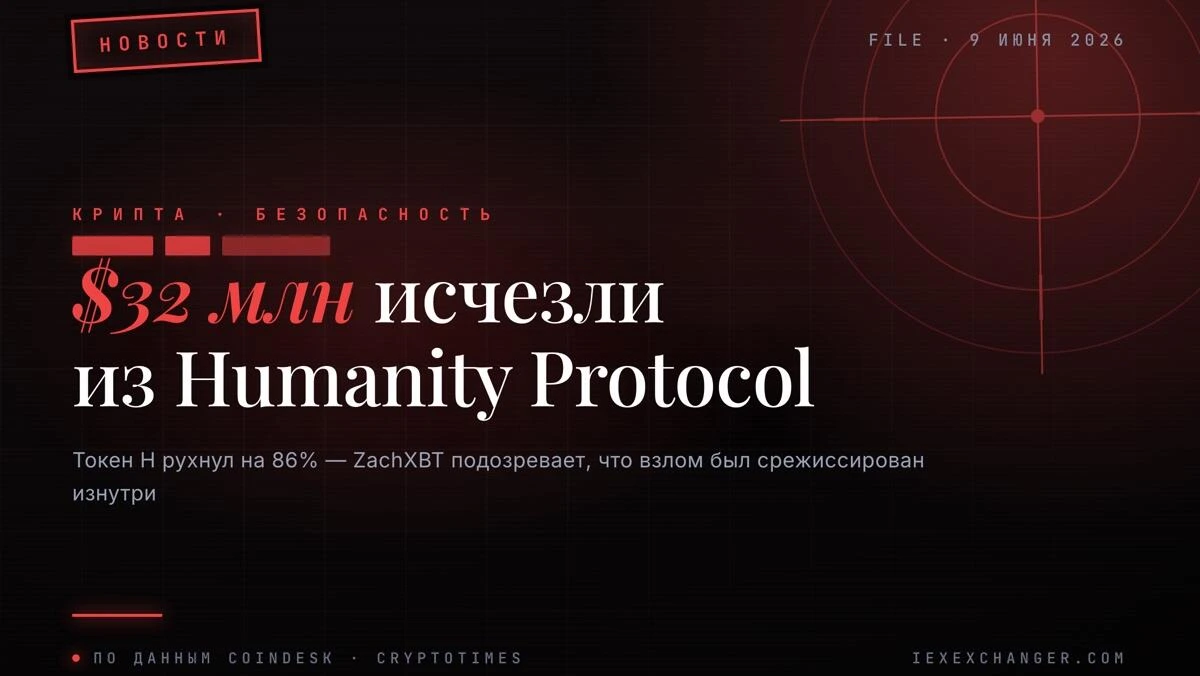
Between Sunday evening and Monday morning, more than $32 million left Humanity Protocol's wallets. Whether it was taken — or handed over — is now the central question.
The project built its reputation as the palm-scanning alternative to Sam Altman's Worldcoin. Users prove their personhood through hand biometrics and zero-knowledge cryptography, without surrendering a retinal scan or a government ID. The H token had been trading around $0.72 going into the weekend. By Monday, it was near $0.10.
The attacker compromised private keys belonging to a member of the Humanity Foundation, drained more than 17 wallets across chains, then minted an additional 100 million H tokens on BNB Chain — created from nothing, worth roughly $11 million — and sold those into the market too. Total losses passed $32 million. The intraday low touched $0.05, a near-90% collapse in a single session.
Founder Terence Kwok confirmed the breach and asked users to avoid the project's bridge and liquidity pools while his team works with security firms and exchange partners to contain the damage.
ZachXBT isn't buying the official version. The on-chain investigator publicly called the exploit "possibly staged," accused the team of manipulating H's price before the collapse, and demanded they disclose their active market-maker agreements. Analyst Elton added forensic detail: the attacker's wallets were funded through exchanges and mixers as far back as late April and early May, weeks before the breach. The minting contract showed signs of being tested in the days prior — someone running through privileged functions before going live. The dumps on Ethereum and BNB Chain happened in tight coordination, not the scattered pattern of a hurried external hack.
That leaves two explanations: an outside attacker who held a stolen key quietly for months and timed their exit, or someone from inside the organization. Either way, around $4 million has already reached mixers. For a project whose core promise is verifiable identity, having its own story be the least verifiable thing right now is an uncomfortable position to defend.