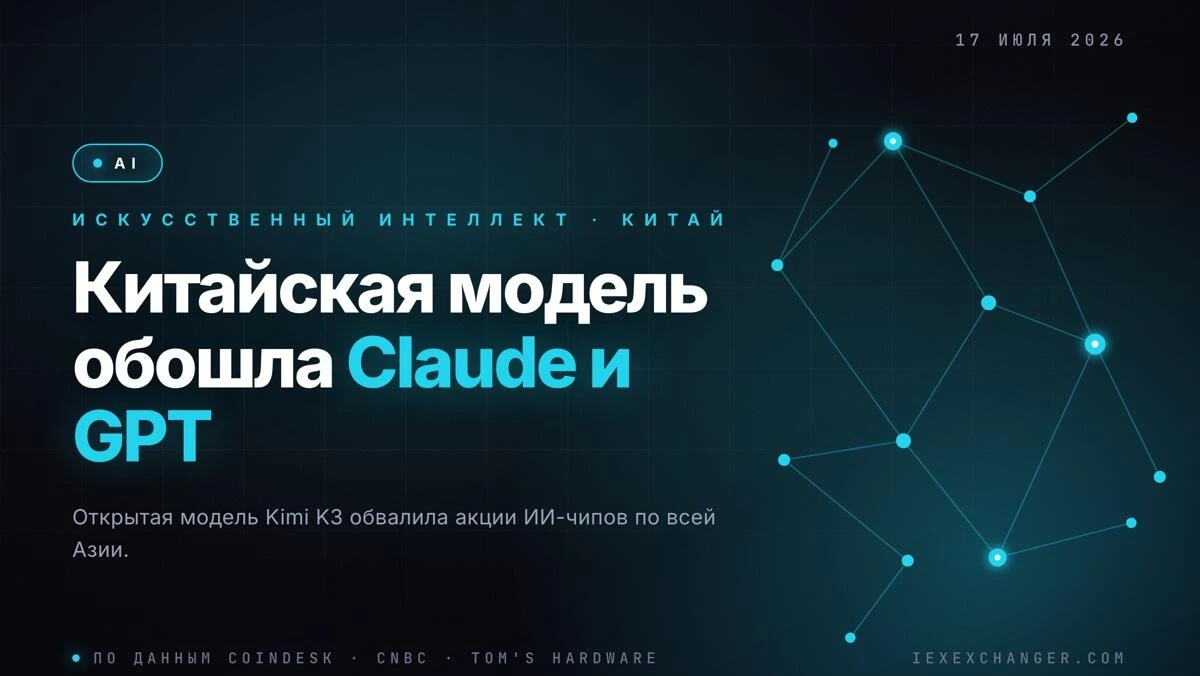
On Thursday, Beijing-based Moonshot AI released Kimi K3, a 2.8-trillion-parameter model with a one-million-token context window. On Arena's Frontend Code leaderboard it scored 1,679, ahead of Claude Fable 5's 1,631 and GPT-5.6's 1,618, taking first place in six of seven categories — a jump from 18th place for Moonshot's previous release.
Only 16 of the model's 896 "experts" activate at once, which is how it manages that scale without runaway compute costs. The bigger story is licensing: full weights go public on July 27, so anyone with enough hardware can run it themselves, no fees attached.
Markets moved fast. Shares of domestic rivals Z.ai and MiniMax fell 27% and 16%. Semiconductor and AI infrastructure stocks slid across Asia, with traders already calling it a "Kimi moment" — an echo of the DeepSeek shock that wiped roughly $600 billion off Nvidia's valuation in a single session. Bitcoin, which tends to track risk appetite, dropped below $63,000.
The investor logic is straightforward: if Chinese labs keep shipping models at this level for free and open-weight, it chips away at the assumption that frontier AI has to be expensive and controlled by a handful of US companies. With futures on AI compute already in the works, releases like this hit expectations across the whole chain, from chipmakers to data centers.
Worth noting: on broader general-purpose tests, K3 still trails the top Claude and OpenAI configurations — this is a win in one domain, coding, not across the board. But markets reacted to the headline, not the fine print, and it's the second time this year the gap at the top has narrowed to a rounding error.