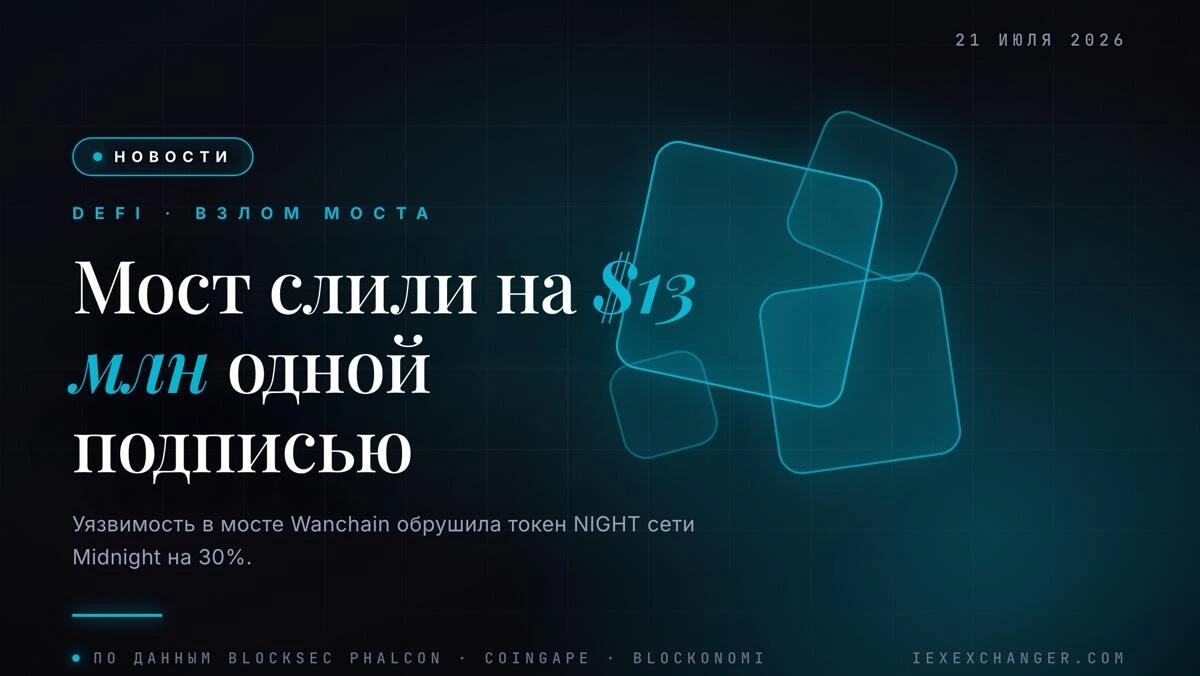
A signature for 3,000 tokens turned into a withdrawal of 203 million. That's how attackers slipped past the Wanchain bridge connecting Cardano and BNB Chain on July 21, draining roughly 515 million NIGHT tokens worth about $13 million.
NIGHT is the token of Midnight, a privacy-focused partner chain built for Cardano by its founder Charles Hoskinson to meet growing demand for confidential transactions. The Wanchain bridge moved assets — including the stablecoin RLUSD — between Cardano and BNB Chain, and it's inside that bridge's code where the flaw was hiding.
Security firm BlockSec Phalcon traced the attack down to the byte level. The bridge's TreasuryCheck validator built its signed message by concatenating 14 variable-length fields with no delimiters and no length prefixes. Different combinations of data could collapse into the exact same byte string and hash. A legitimate signature authorizing a modest 3,110 NIGHT got reused to unlock over 203 million tokens — a 65,000x amplification. Cardano's own serialization function, which would have prevented exactly this kind of collision, simply wasn't used when the bridge built its signature hash.
NIGHT's price crashed more than 30%, hitting a record low near $0.016-0.019. The stolen tokens amount to roughly 2% of NIGHT's 24 billion total supply, but represented nearly the entire bridge treasury. Wanchain took the bridge offline and opened an investigation; the Midnight Foundation moved quickly to reassure holders, stressing the breach was isolated to third-party bridge infrastructure and never touched its validators, consensus mechanism or core protocol.
That distinction is technically accurate — Midnight itself wasn't hacked. But bridges keep being the weak link in multichain infrastructure, for a second year running: Humanity Protocol lost $31 million to a bridge-adjacent exploit in June, and the Ostium oracle was drained for $18 million just last week. Attackers increasingly aren't breaking blockchains themselves — they're finding the seam where two systems are supposed to agree on the same data format and quietly don't.