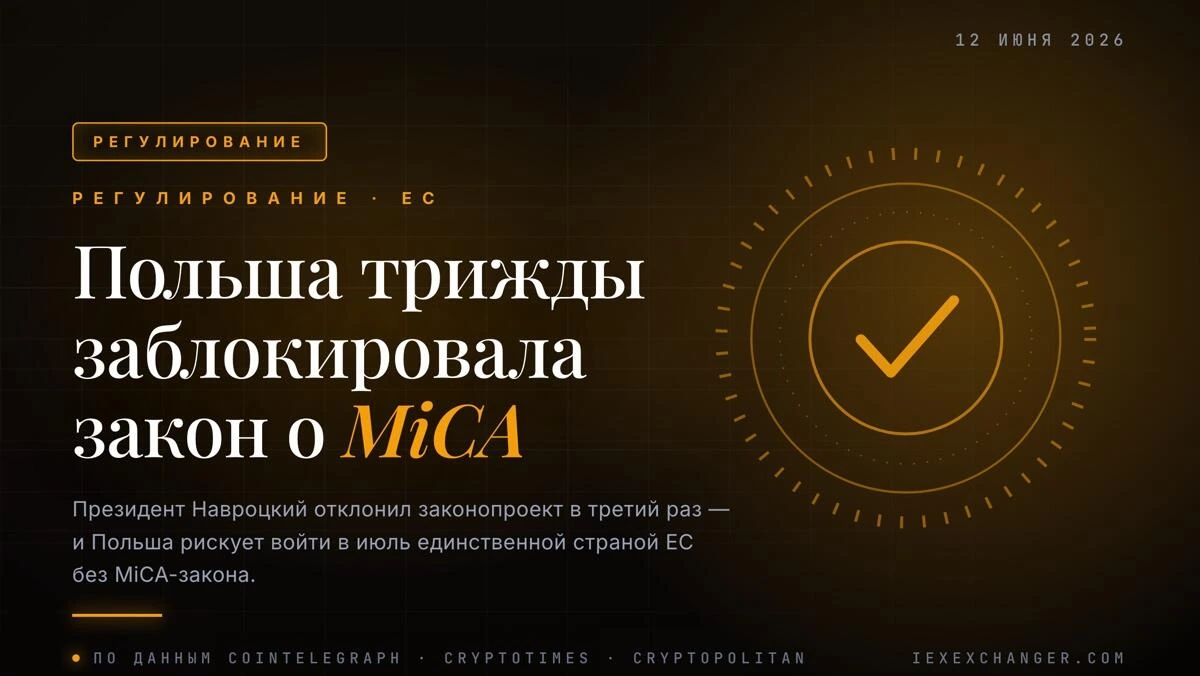
Poland is heading into the final weeks before the EU's MiCA deadline as the only member state without a functioning crypto law — and the political deadlock shows no sign of breaking. President Karol Nawrocki vetoed the MiCA implementation bill for the third time, saying parliament addressed just one of 16 specific regulatory changes his office had formally requested during months of negotiations.
The standoff has been building since late 2025. The Presidential Palace wants stricter consumer protections and maintains the current draft conflicts with Polish constitutional law. Parliament revised and re-passed the legislation twice — but Nawrocki found both rounds of revisions cosmetic. Three vetoes on the same core structure, and the gap between the two sides has not narrowed.
Overriding the veto requires a three-fifths parliamentary majority. The current coalition does not have the numbers. That leaves two real options: the executive branch makes substantive concessions and restarts the legislative process from scratch, or Poland hits July 1 with no framework in place. MiCA's transition period expires across the entire EU simultaneously — there is no individual extension mechanism for lagging member states.
For Polish crypto companies, the timeline is already a problem. Under MiCA, any crypto-asset service provider without a CASP license must stop serving EU clients from July 1. Polish firms technically have a six-month grandfathering window for existing operators — but that protection is tied to the existence of a national implementation law, which currently does not exist. Some companies are not waiting for a political resolution: they are actively applying for licenses in Germany, Lithuania, and the Netherlands instead.
Poland stands alone among EU member states in failing to pass MiCA implementation legislation before the deadline. Resolving the impasse in the weeks remaining before July 1 looks unlikely. For firms that hold neither a Polish nor an alternative EU license by that date, the calculation is straightforward: relocate operations to a compliant jurisdiction, or exit the EU market.