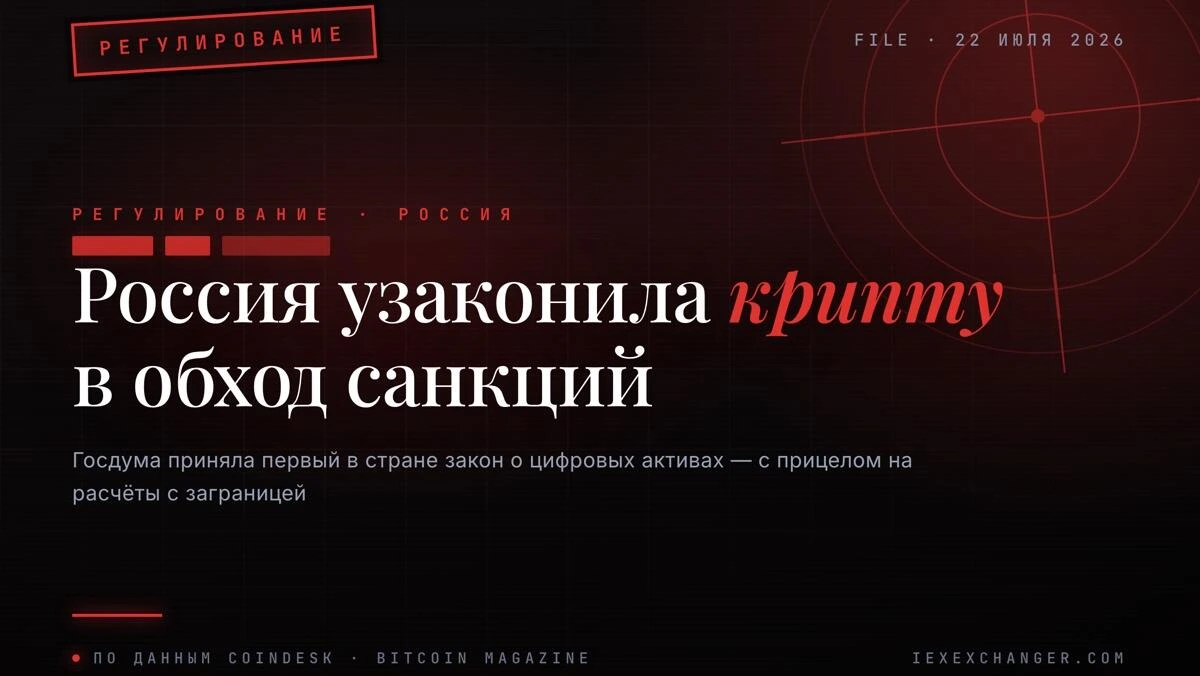
Russia's State Duma has passed, in its second and third readings, the country's first comprehensive crypto law — officially titled "On Digital Currency and Digital Rights." It still needs sign-off from the Federation Council and President Vladimir Putin, but with 327 of 340 deputies backing it at first reading, that formality is expected within two weeks.
The core of the bill is simple, and it lands like a shot across the bow of Western sanctions regimes: Russian residents will be allowed to settle foreign trade contracts with overseas partners in crypto, including with mined coins. Domestically, nothing changes — the ruble stays the only legal tender for goods and services, and banks remain barred from advertising crypto payments.
In effect, Moscow is legalizing what it has quietly been doing for years. After Russian banks were cut off from SWIFT in 2022, crypto became one of the few remaining channels for foreign trade — routed through platforms like Garantex, shut down by US law enforcement in March 2025, and the ruble-pegged stablecoin A7A5, which analysts estimate moved tens of billions of dollars in sanctions-linked flows. The irony: in January 2022, weeks before the invasion of Ukraine, Russia's own central bank was pushing to ban crypto outright.
The new law brings that grey-market machinery under the central bank's roof. Starting September 1, 2026, five categories of operators — exchanges, brokers, asset managers, depositories and exchange bureaus — must get licensed, hold at least 15 million rubles (about $190,000) in capital, and join a self-regulatory body. Existing platforms get a grace period running into mid-2027.
Retail investors without "qualified" status can buy crypto through licensed intermediaries up to 300,000 rubles (roughly $3,800) a year, with cross-border transfers capped at 100,000 rubles; qualified investors get far higher ceilings, but everyone has to pass a risk-awareness test first. Large international transfers face a 48-hour review hold. Only coins clearing steep size thresholds — average market cap above 5 trillion rubles and daily volume above 1 trillion rubles over a two-year window — can trade on licensed venues, meaning Bitcoin, Ethereum and possibly Solana; privacy coins are barred outright.
Whether this actually helps Russia dodge sanctions is another matter. The EU rolled out a crypto-specific sanctions package targeting Russia back in April 2026, and formalizing these channels makes them easier to trace, not harder — a state-licensed exchange leaves a far cleaner paper trail than an anonymous OTC desk, which is exactly the kind of exposure foreign counterparties tend to avoid.