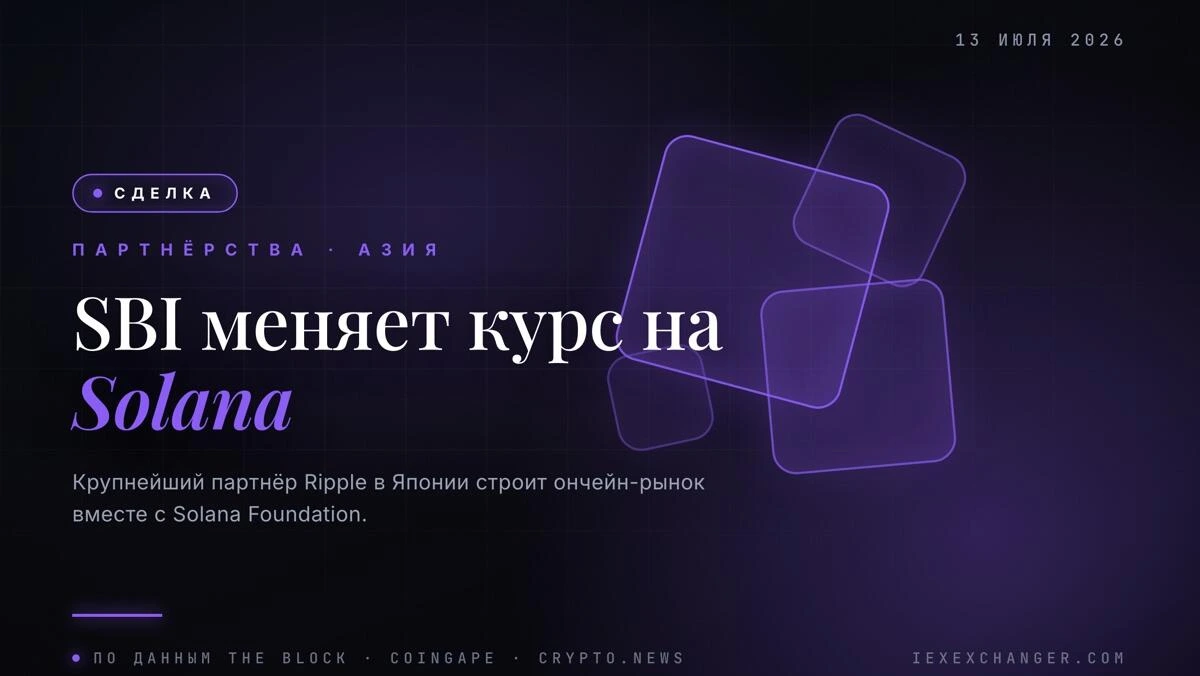
Three years ago, SBI Holdings and Ripple were practically synonymous in crypto circles. The Japanese financial conglomerate held a stake in Ripple, pushed XRP through its SBI VC Trade exchange, and stood as the company's loudest Asian defender through its years-long fight with the SEC. Now SBI has struck a strategic partnership with the Solana Foundation — and renamed its joint venture with blockchain firm R3 to SBI Solana Global.
This isn't a one-off press release. The new entity is meant to anchor an onchain financial market in Japan: issuing and circulating yen-backed stablecoins, tokenizing bonds and real-estate funds, building cross-border payment rails, and serving institutional investors directly on Solana. Solana Foundation president Lily Liu is joining R3's board, which points to an ongoing relationship rather than a single transaction.
The deal fits a pattern SBI has been building all year. Its B2C2 unit already tapped Solana as its primary settlement network for institutional stablecoin flows, supporting USDC, USDT, PYUSD and several others there. SBI VC Trade is launching a 3%-yield lending product for the yen stablecoin JPYSC this month. Earlier in July, SBI was the sole investor in a $76 million round for U.S. exchange EDX Markets, and in June it closed a $289 million acquisition of Bitbank, cementing its position as Japan's biggest crypto player.
None of this reads as a break with Ripple — the relationship stays intact, and SBI recently expanded lending products that include XRP. But the years-long monopoly XRP held on SBI's attention has clearly ended. The conglomerate is building a multi-chain strategy where Solana gets its own institutional lane. For the market, the signal runs wider than one contract: Asia's largest traditional finance groups are no longer betting on a single network — they're picking infrastructure job by job, settlement here, tokenization there, without much regard for old loyalties.