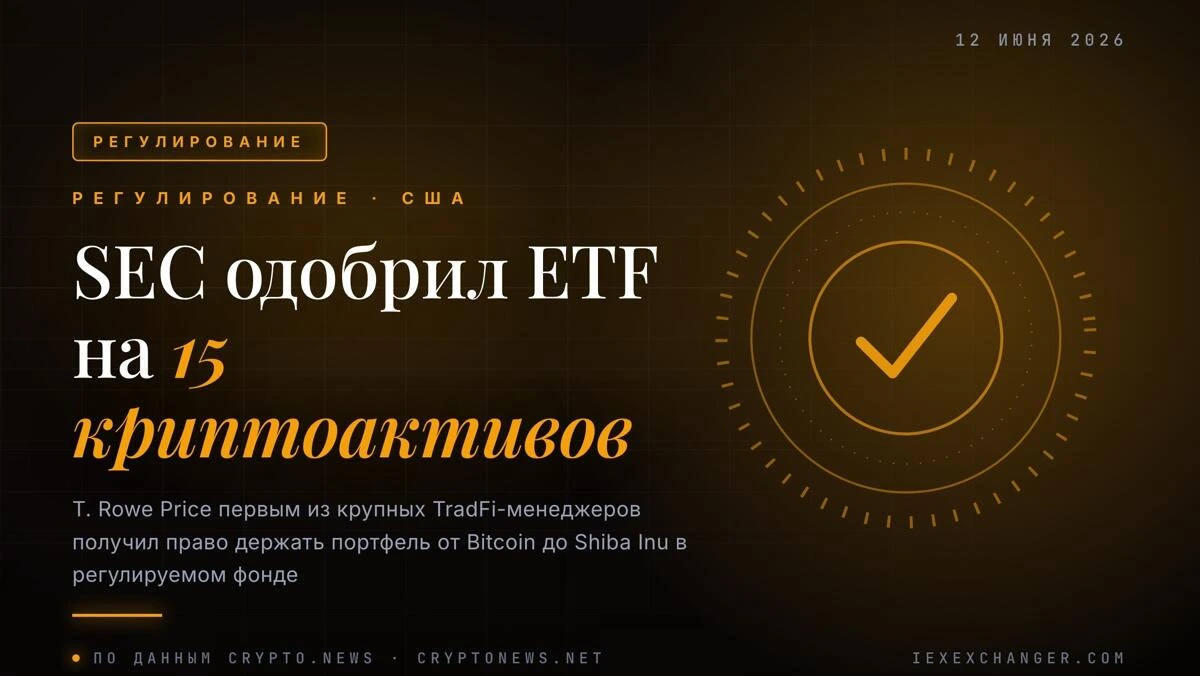
The SEC on June 12 approved what amounts to a new category of crypto product: the T. Rowe Price Active Crypto ETF, an actively managed fund authorized to hold a shifting portfolio of up to 15 digital assets. The eligible list includes Bitcoin, Ethereum, Solana, XRP, Cardano, Avalanche, Litecoin, Polkadot, Dogecoin, Chainlink, Stellar, Hedera, Bitcoin Cash, Shiba Inu, and Sui.
That breadth alone sets it apart from every crypto ETF approved before it. Prior products were single-asset vehicles — you got a Bitcoin wrapper or an Ethereum wrapper, nothing more. T. Rowe Price's managers can now rotate between large caps and small caps, concentrate or diversify across the list, and hold USDC for operational efficiency between positions. The fund benchmarks against the FTSE Crypto US Listed Index but explicitly aims to beat it. Under normal conditions it holds between 5 and 15 assets at any given time.
T. Rowe Price isn't a crypto-native firm. It manages roughly $1.6 trillion — mostly equities and fixed income — and has spent decades cultivating a reputation for careful institutional management. Its entry into active digital asset management signals where large traditional firms see commercial opportunity. For institutional allocators barred from holding crypto directly, this fund offers a familiar regulatory wrapper around an unfamiliar asset class.
Trading will be on NYSE Arca under Rule 8.201-E, using the SEC's 2025 generic listing standards that created a faster-approval pathway for qualifying crypto products. Daily transparency on holdings and broker-dealer firewalls are mandatory. The SEC also explicitly permitted USDC as a stablecoin for operational costs — a quiet first for a regulated public fund structure.
Active management in crypto has a mixed track record. Liquidity gaps between assets like SHIB and Bitcoin are enormous, and timing a market that trades around the clock is harder than it looks from the outside. If T. Rowe Price outperforms its benchmark consistently, expect a wave of similar filings from larger names. If not, critics of discretionary crypto portfolios inside regulated wrappers will have a clean data point to work with.