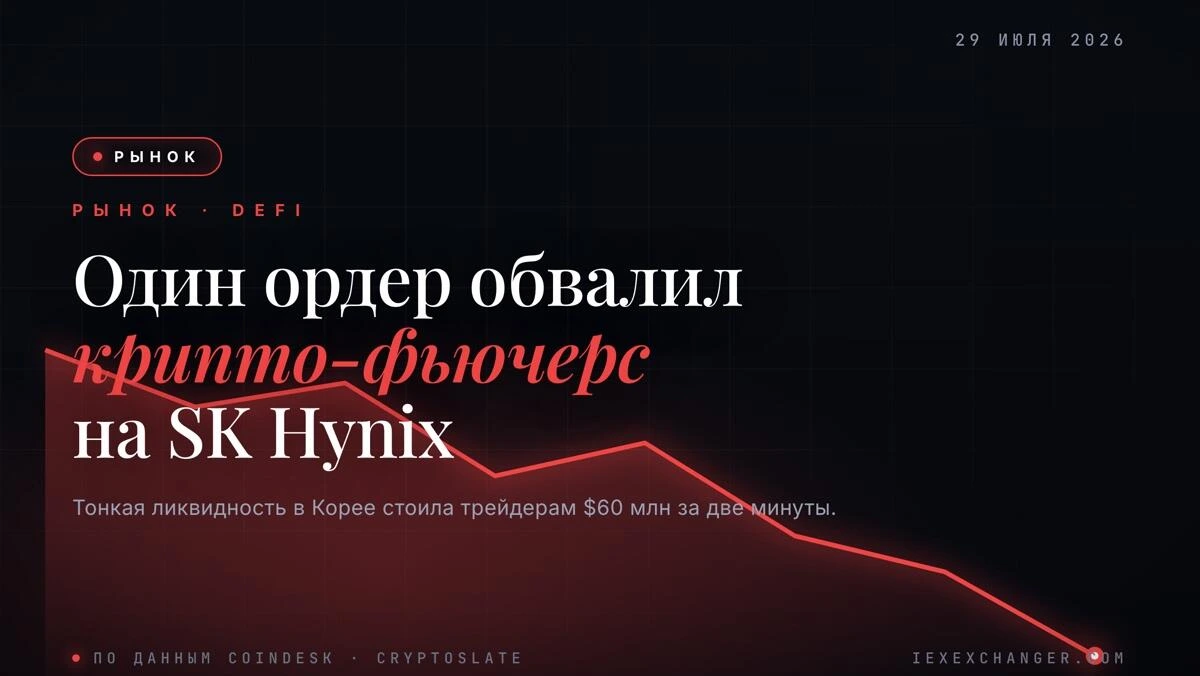
One order on South Korea's Nextrade exchange, placed during pre-market hours with almost no competing liquidity, sent SK Hynix shares tumbling nearly 30% in an instant. Within seconds, that distorted price reached Trade.xyz, a decentralized perpetuals exchange built on Hyperliquid where a contract tracking the memory-chip maker's stock trades around the clock.
The Pyth Lazer oracle faithfully relayed the real Nextrade trade, and the SKHX perpetual's mark price collapsed 19% in about two minutes, from roughly $1,128 to $917. Liquidations began just seconds after the Korean session opened, wiping out around 960 positions and roughly $60 million in trader funds. By the time SK Hynix's real share price had already snapped back to normal on Nextrade, the crypto market had already erased a fifth of its open interest.
Trade.xyz says the system did exactly what it was built to do — nobody hacked anything, and there's no evidence of manipulation. It was simply thin pre-market liquidity in Asia colliding with an on-chain oracle that, unlike a traditional exchange, has no circuit breaker to pause and double-check a suspicious print. Still, the exchange is voluntarily covering every trader's losses within days and says it will reweight its pricing formula to lean more heavily on its own order book rather than external feeds.
It's not the first stumble for this corner of DeFi: Ostium lost $18 million to an oracle price manipulation just weeks earlier. The twist here is that nobody had to cheat — a single real, if freakish, trade was enough to trigger the same kind of damage. That leaves an uncomfortable question hanging over every exchange offering tokenized stock exposure: when the oracle is doing its job perfectly and still relaying a broken price, who ends up eating the loss?