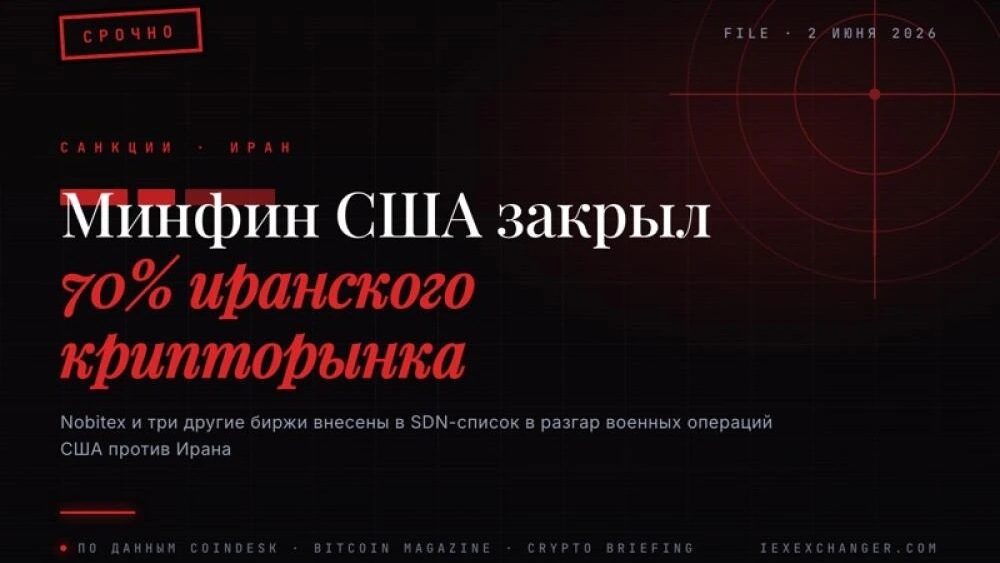
In June 2025, Nobitex survived a $90 million hack. In May 2026, a Reuters investigation laid bare the full scope of its ties to sanctioned Iranian entities. On June 2, the U.S. Treasury made all of that moot: Nobitex and three other Iranian platforms were added to OFAC's Specially Designated Nationals list, severing up to 70% of Iran's crypto trading from the global financial system in a single action — mid-war.
The Four Exchanges and What Treasury Found
OFAC designated Nobitex, Wallex, Bitpin, and Ramzinex, along with named executives: Amir Hossein Rad, Nobitex's chairman and co-founder; current CEO Seyed Ali Khoee; and members of the Kharrazi family — two co-founders with documented ties to former Supreme Leader Khamenei's inner circle.
The market share figures tell the story. Nobitex handled over 50% of all Iranian crypto inflows in 2025. Wallex processed 12%, Bitpin 10%. Ramzinex, founded in 2018, ran $2.45 billion in total transactions. Combined, these four controlled an estimated 70-80% of Iran's digital asset market. Crypto Briefing called this the most systemically important exchange ever sanctioned by the United States — that characterization is hard to contest.
The IRGC Connection: From Exchanges to Hezbollah
Treasury accused all four platforms of processing transactions tied to Iran's Islamic Revolutionary Guard Corps. Blockchain analytics firm Elliptic documented wallet behavior consistent with IRGC-Qods Force and Hezbollah financial flows. The links weren't incidental — they were structural.
Nobitex reportedly advised users to route transfers through the Tron blockchain specifically to evade OFAC's automated screening software. Funds flowing through the platform included ransomware proceeds, Central Bank of Iran assets, and transfers that continued even after Tether froze $344.2 million in Iranian central bank wallets back in April 2026. The exchange had become Iran's primary dollar-adjacent financial gateway — which made it indispensable to the regime, and impossible to leave off the sanctions list indefinitely.
What SDN Designation Actually Does
An OFAC SDN listing isn't a fine. It's a financial quarantine. Any U.S. person or company that continues doing business with a listed entity faces criminal liability, not just civil penalties. Secondary sanctions extend the reach further: foreign firms operating anywhere in the dollar system can lose dollar access if they maintain relationships with SDN-listed parties.
The compliance cascade is already running. Stablecoin issuers like Tether and Circle are obligated to freeze balances associated with these exchanges. Major international platforms must block withdrawals tied to Iranian accounts routed through the sanctioned services. The action doesn't require active enforcement to spread — the threat of secondary exposure does the work automatically.
Twelve Months of Escalation
January 2026: OFAC sanctioned two UK-based crypto platforms linked to the IRGC. Nobitex appeared in the documentation but wasn't targeted. April: Tether froze $344.2 million in Central Bank of Iran wallets. May: Reuters published an investigation tracing the full scale of sanctions evasion through Iranian exchanges. Late May: Treasury Secretary Scott Bessent announced roughly $1 billion in Iranian crypto had been seized since the start of hostilities. June 2: the designations landed.
Bessent's framing was direct: "The regime has chosen to co-opt digital asset technologies for its own corrupt agenda, including evading sanctions and transferring wealth." What's unusual this time isn't the pattern — it's the scale, and the context. This is the first time the dominant exchange of an active adversary state has been fully designated during ongoing military operations.
The People Caught in the Middle
Iran has long relied on crypto not as speculation but as functional financial infrastructure. With the rial collapsing under decades of sanctions pressure, bitcoin and USDT became practical tools for entrepreneurs collecting international payments and ordinary citizens trying to hold savings outside a currency in permanent decline.
The main on-ramps are now closed. P2P markets and decentralized protocols remain, but they operate at a fraction of the scale these exchanges provided. For Iranians who used Nobitex not to move IRGC funds but simply to have a working financial system, the designation lands as a different kind of blow entirely.