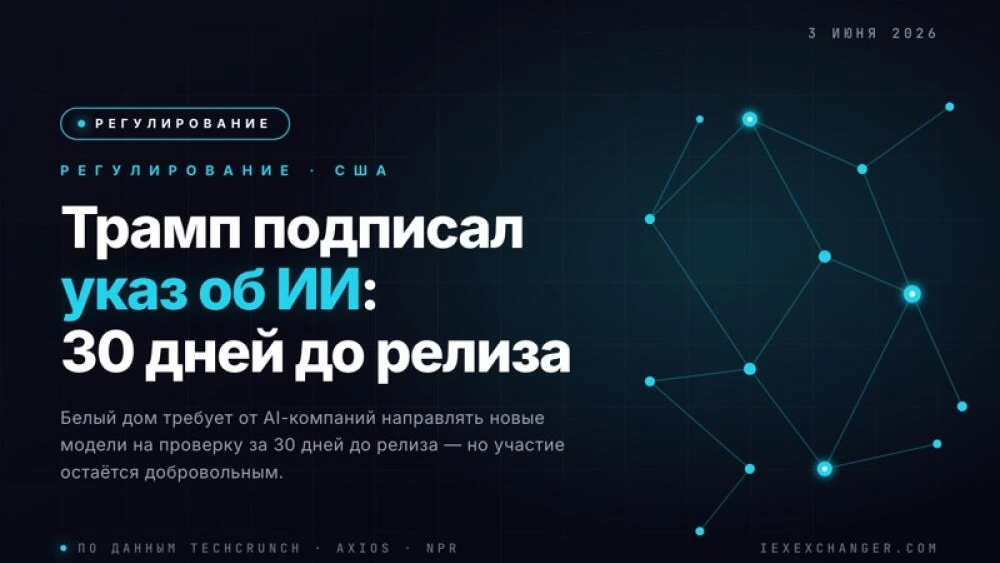
On June 2, 2026, President Donald Trump signed the first U.S. federal executive order establishing oversight of advanced AI models. Under the order, AI companies are asked to voluntarily submit new models for government testing 30 days before public release. No mandatory licensing, no compulsory approval — participation remains strictly voluntary.
What Happened
Trump signed the AI oversight order privately, without a public livestream or ceremony. The order asks developers of frontier AI models to submit them to the government for evaluation 30 days before release. The language is explicit: nothing in the order shall be construed to authorize a mandatory governmental licensing, preclearance, or permitting requirement for AI development or publication.
The order also directs the Department of Justice to treat AI-related cybercrimes — including hacking and unauthorized access — as high-priority enforcement matters, and tasks federal agencies with developing benchmarks to assess AI models' cybersecurity capabilities and creating an information-sharing clearinghouse for AI vulnerabilities.
Why It Matters
This is the first U.S. federal act to establish any kind of pre-market oversight framework for powerful AI systems. Until now, AI regulation in America has been a patchwork: state-level rules, NIST guidelines, and voluntary company commitments. This order, however limited, represents Washington's first structured attempt at federal-level AI governance.
The political context also matters. Trump had already rolled back the Biden-era AI safety requirements. The new order attempts to balance U.S. technological leadership with the light-touch regulatory approach that the tech industry demands.
Silicon Valley's Victory
The original draft required a 90-day advance review period. The tech industry pushed back hard — including venture capitalist David Sacks, formerly Trump's White House AI czar. Lobbyists sought something closer to a two-week window.
The final compromise settled at 30 days. Trump had originally planned a high-profile signing ceremony with AI company leaders but quietly abandoned that format — the order was signed without cameras or public announcement.
What Comes Next
The voluntary nature of the framework raises a core question: will leading labs — OpenAI, Anthropic, Google DeepMind — actually participate, or simply issue statements of support? How robust the new oversight tools become will determine whether the executive order evolves into a real governance mechanism or remains a paper commitment.