
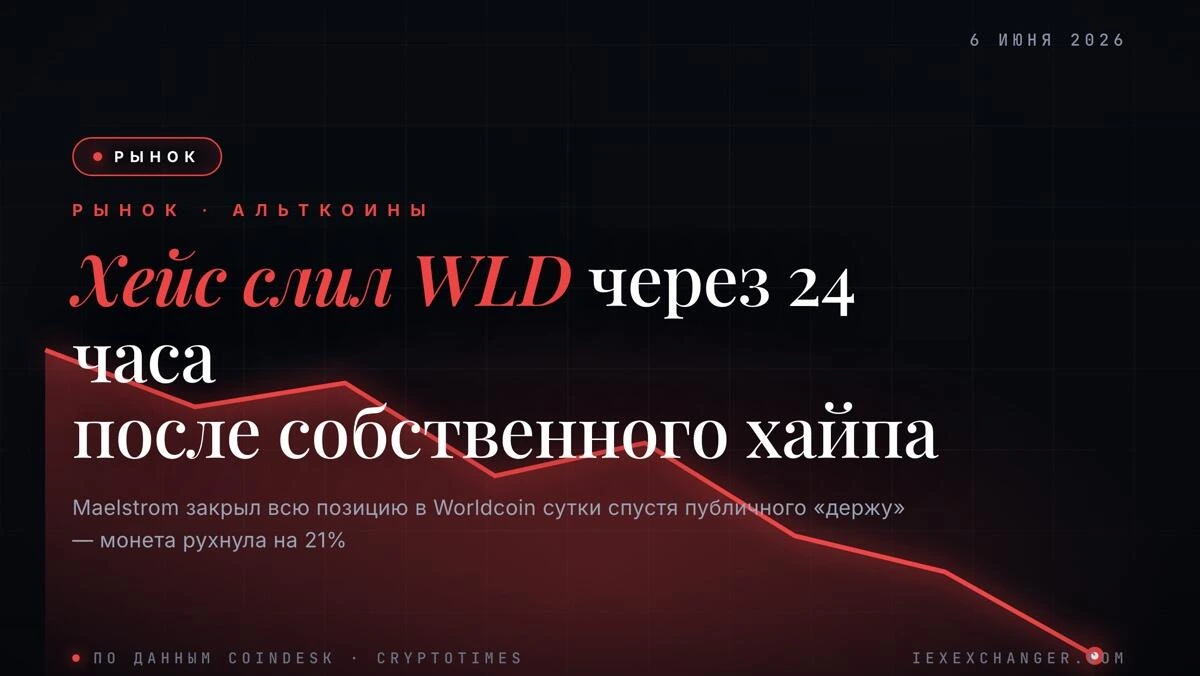
On June 5, Arthur Hayes spent time publicly defending his Worldcoin position. The thesis: WLD is "a high-beta play on AI IPO momentum," and with SpaceX heading for a Nasdaq listing, the AI trade had legs. His fund Maelstrom was holding. He was not selling.
The next morning he posted: "This chart is going in the wrong direction. Dumped $WLD. I'm out." WLD fell 21% in the 24 hours that followed, finishing roughly a third below its recent peak before the selling accelerated.
The stated reason was a decline in SpaceX pre-listing prices. In Hayes's framework, SpaceX pre-IPO momentum acts as a proxy for the broader AI trade. When that proxy weakened, the WLD thesis collapsed with it. It's an unusual chain of reasoning, but consistent with how Hayes typically constructs positions — through unconventional correlations rather than direct project fundamentals.
What generated more controversy than the trade itself was the sequence. Over the previous two weeks, Hayes had made similar moves with HYPE, NEAR, and ZEC — publicly endorsing each token before exiting within days. Crypto analyst ZachXBT mapped all four episodes and accused Hayes of systematically generating exit liquidity from his followers: hype the asset, wait for buyers to pile in, then sell into that demand.
Nothing here is illegal. Hayes controls his own capital and owes no one a heads-up when he changes his mind. But his public statements carry real weight — and a 24-hour gap between "I'm keeping this" and "I sold" has measurable consequences at scale. The question ZachXBT is effectively raising is whether public statements made to a large trading audience carry any implicit responsibility. In traditional finance, that answer exists. In crypto, it mostly doesn't.