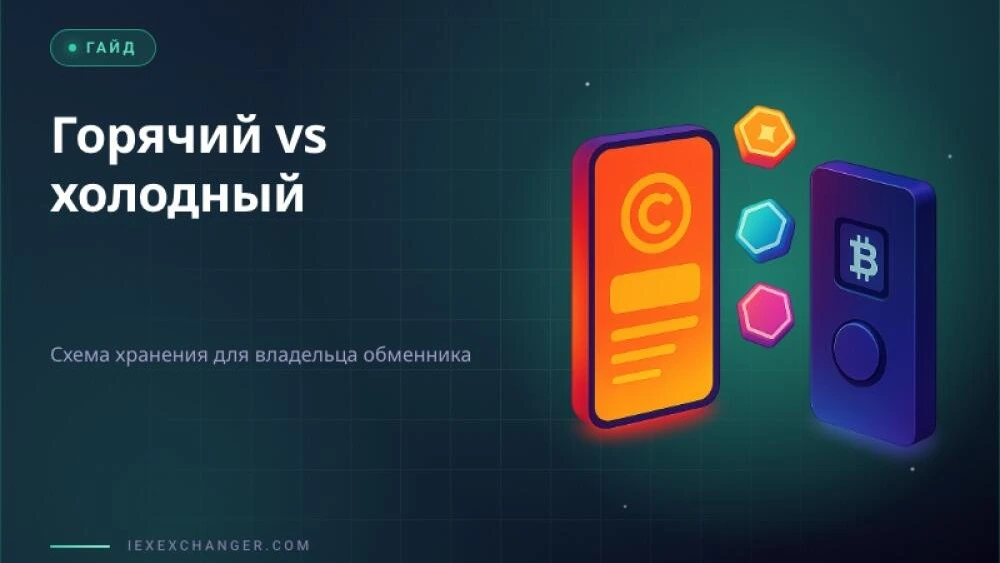
A hot wallet for your exchanger is like your cash register: instant access, but you'd never store your entire reserve there. A cold wallet is the vault — almost impossible to breach remotely. Most operators make the same mistake: they rely on just one. The right answer is both, in the right proportion.
Hot Wallet: Your Exchanger's Operational Cash Register
A hot wallet is always connected to the internet — and that's exactly what makes it essential for automated payouts. A client sends USDT, expects BTC back: funds go out instantly, without any manual step. This is the foundation of exchanger automation.
But speed has a price. A permanent internet connection means permanent risk. Server breach, leaked private key, compromised API — and a hot wallet opens up like a tin can. Exchanges and exchangers have lost hundreds of millions of dollars this way.
The rule experienced operators follow: keep no more than 10–20% of total reserves in a hot wallet. Exactly enough for current payouts. A little less and the automation starts failing. A little more and you're taking on unnecessary risk.
Cold Wallet: Reserves Out of Reach
A cold wallet never connects to the internet. The private key never touches a network — stealing it remotely is practically impossible. This is your insurance reserve: the bulk of your funds that aren't needed right now.
Implementation options:
- Hardware wallet (Ledger, Trezor) — a physical device that signs transactions offline. Reliable and convenient for regularly topping up your hot wallet.
- Air-gapped computer — a laptop that has never been online. More complex to set up, but gives you maximum control.
- Metal seed plate — an engraved backup of your keys stored in a physical safe. Not for daily operations, but invaluable as a last line of defense.
Topping up the hot wallet from cold storage a few times a day is enough — no loss in client service speed.
The Three-Tier Storage Scheme: How It Actually Works
Most serious operators split storage into three tiers — this is real-world practice, not theory:
- Hot (10–20%) — online, automatic payouts. Balance monitoring and auto-refill when it drops below a threshold.
- "Warm" multisig (20–30%) — transactions require multiple keys (e.g., 2 of 3). Used to regularly top up the hot tier. One compromised key gives an attacker nothing.
- Cold storage (50–70%) — hardware wallet or air-gapped machine. Funds move rarely, on a strict schedule or manually.
Even if an attacker gains full access to your hot wallet, they'll reach at most 10–20% of your reserves. Painful — but not fatal to the business.
Four Mistakes That Cost Real Money
Each of these mistakes shows up with real operators — and each one ended in losses:
- Keeping everything in a hot wallet — because "it's simpler for automation." The most expensive mistake there is.
- One address for everything — payouts and reserves mixed together. You lose visibility and the ability to monitor anomalies.
- No withdrawal limits — one compromised API key, and your entire reserve drains in minutes.
- Lost seed phrase — no backup for the cold wallet means no access to funds. Ever.
Self-Custody vs Custodial Services
Keeping reserves on an exchange sounds tempting. No need to deal with keys, everything in one place. But it means handing control of your money to a third party.
An exchange can freeze withdrawals. Demand verification. Or simply shut down — it's happened more than once. A non-custodial wallet where you alone hold the private key eliminates these scenarios by definition.
For an exchanger handling regular volumes, owning your storage infrastructure isn't paranoia — it's a professional standard.
Conclusion
A hot wallet makes your exchanger fast. A cold wallet makes it safe. Neither replaces the other — but together, with the right fund split, they give you a solid operational foundation.
If you're building your own exchanger and want to hold crypto without relying on third parties, take a look at iEXWallet — a non-custodial wallet built specifically for exchanger owners.