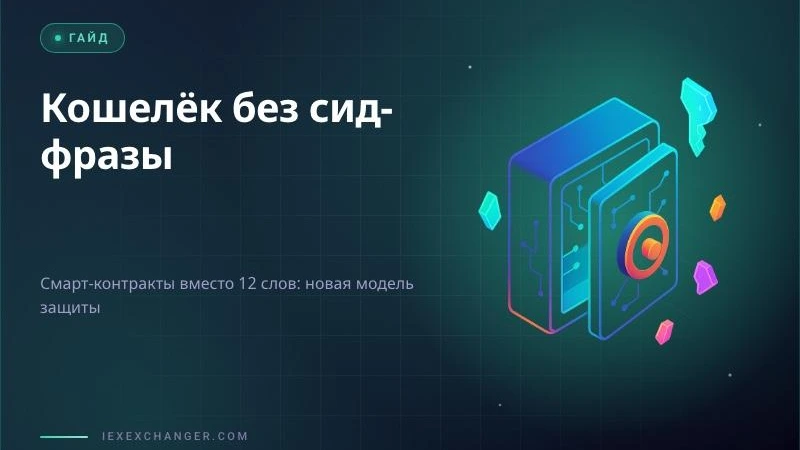
An account-abstraction smart wallet is a new kind of crypto wallet where a smart contract, not a 12-word seed phrase, decides who gets access. For an exchanger business this isn't Ethereum-blog theory: it removes the single point of failure that used to turn one stolen phrase into an empty treasury by morning.
What an account-abstraction wallet actually is
A regular crypto wallet (an EOA, externally owned account) lives or dies on one private key. Lose the seed phrase and you're locked out; someone steals it and they own everything. A smart wallet built on the ERC-4337 standard is different — it's a small program on-chain that decides what counts as a valid "signature." That could be one key, three-of-five multisig, or a phone's biometrics paired with a second device's approval.
Think of the difference between a single front-door key and an intercom system with several access cards you can disable individually. Lose the one key and you're out. Lose one card, and you just cancel that card.
Why the seed phrase became the weak link
An exchanger's wallets aren't a personal stash — they're working infrastructure: incoming payments, automated payouts, a hot balance for fast trades. The more people and scripts that touch a seed phrase or its fragments, the higher the odds it leaks — through a phishing email, a compromised laptop, or plain social engineering ("support here, please confirm your phrase").
That's also why most big exchange hacks aren't really "blockchain hacks" — attackers break the people and processes around the keys, not the cryptography itself.
What a smart wallet changes in practice
Three features shift the security model the most.
- Session keys — a separate, time- and amount-limited key for your payout script. If the server gets compromised, the attacker inherits that session's limit, not the whole balance.
- Social recovery — if the main access is lost, several trusted parties (say, two co-founders plus a hardware key in a safe) can restore control without one master phrase.
- Flexible limits and pauses — cap payouts at $5,000 an hour without a second approval, or auto-freeze on a suspicious transaction pattern.
What this means for your exchanger
In practice, it means less dependency on a single person or device. A payout script gets its own session key with a hard ceiling, not full access to the treasury wallet. An admin leaves the company — you revoke exactly their rights, no need to recreate the wallet or move the entire balance.
That matters most for teams whose scripts call the wallet over an API: the only protection used to be a private-key file sitting on a server; now it's a contract with rules you can actually read and verify.
Limitations and risks
This isn't a universal fix. A smart wallet is a contract, which means its code can be exploited or simply written with a bug — the risk shifts from "key theft" to "access-logic bug." ERC-4337 support isn't equally mature across every chain, and moving an existing treasury from a regular wallet to a smart-contract one is a migration project, not a settings toggle.
Deployment fees for a smart wallet on a new chain also tend to run higher than a plain transaction from a regular address. If your volumes are modest and your team is two people without a dedicated security lead, a classic multisig can still be the simpler, more legible choice.
Common mistakes teams make
- Moving the entire hot balance to a smart wallet on day one, without testing account recovery first.
- Setting up session keys with no amount cap — convenience without actual protection.
- Keeping every social-recovery party in the same office or on the same device — a fire or a raid takes out the wallet along with the people.
Conclusion
Account abstraction doesn't replace basic security hygiene — it moves where the risk boundary sits: instead of the whole balance on one key, you get flexible, revocable permissions tied to specific tasks. For an exchanger paying out over an API and running treasury across more than one person, that's a meaningfully healthier architecture. To work out which wallet setup fits your exchanger and build a treasury with no single point of failure, iEXWallet is a good place to start.