Crypto wallets in 2026 look nothing like they did five years ago. Long 12-word seed phrases are giving way to biometrics and social-recovery systems, wallets are turning "smart" thanks to account abstraction, and multichain is the default mode. Let's walk through the key trends reshaping how users and businesses interact with crypto.
Smart wallets and account abstraction
The loudest trend is the shift from ordinary externally-owned accounts to smart wallets based on smart contracts. In Ethereum that is the ERC-4337 standard.
What it changes in practice: a smart wallet can pay gas in stablecoins rather than only ether, bundle several actions into one transaction, and enforce access rules — limits, allowlists, multisig. Essentially, an account that behaves like a small application rather than a simple address.
Biometrics and passkeys instead of seed phrases
A 12-24 word mnemonic is the main pain point and main vulnerability for newcomers. Modern wallets increasingly offer passkeys and biometric login instead of a seed phrase.
This does not mean cryptography disappears — keys are still there, but their storage and access run through the device's secure environment: Secure Enclave on iOS, similar on Android. The downside is platform and device lock-in. The upside is a dramatically lower entry barrier — and no one loses funds because of a piece of paper with a written-down phrase.
Social recovery: an alternative to backups
What if the device is lost or breaks? It used to be the seed phrase or nothing. Now social recovery is gaining ground: you pick several trusted "guardians" — friends, your other devices, dedicated services — and a majority of them can restore access if something happens.
The approach is not perfect — you depend on guardian availability and on them not colluding. But for most ordinary users it is far more practical than storing a slip of paper in a safe.
Multichain by default
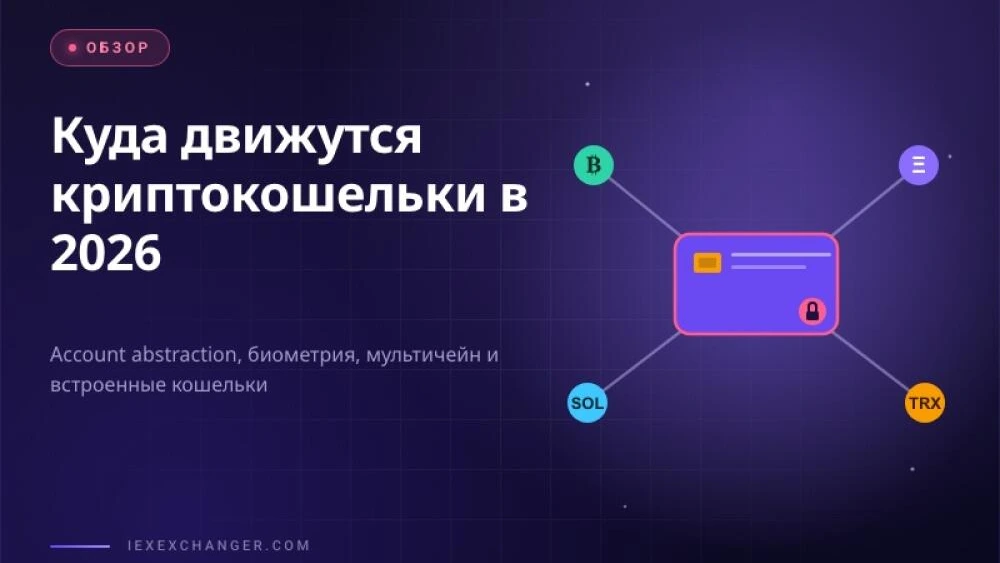
Users used to have "a wallet for Bitcoin", "a wallet for Ethereum", "a wallet for Tron". Now one wallet holds dozens of networks at once, and switching between them becomes invisible.
Under the hood this is solved at the key and UI layer: one seed can derive keys for different standards, while the interface simply shows balances from all networks in one place. For exchangers and services this matters — a customer arrives already on a multichain wallet and expects the same from the service.
Wallets embedded inside applications
Another trend: the wallet stops being a standalone product and embeds directly into apps — games, marketplaces, exchange services. The user doesn't even think "I have a wallet" — for them it is just an account in the service.
This is powered by infrastructure providers like Privy, Magic, Dynamic. For businesses it removes the main hurdle — having to teach customers about cryptocurrency before they can use the service.
What to expect next — and what not to overlook
All these trends converge on one point: the crypto wallet stops being a specialist's tool and becomes an ordinary financial app. But convenience has a price — a new set of trade-offs.
- Provider dependence. Passkeys, embedded wallets, oracles — each adds counterparties you must trust.
- Regulatory pressure. The more wallets resemble banking apps, the more actively regulators step in.
- Retail vs professional gap. Serious amounts are still held on cold wallets with a written-down seed phrase, just like five years ago.
Keeping pace with the times is important. But soberly — without the illusion that technology solves every user problem on its own.
Conclusion
Crypto wallets in 2026 are no longer about "twelve words in a notebook" — they are about smart contracts, biometrics, multichain, and embedded interfaces. For any business working with crypto, understanding these shifts matters: they shape customer expectations and the competitive landscape. For those launching their own exchanger who want to offer clients a next-generation wallet without paying a middleman fee, iEXWallet is a ready solution within the platform.