Multisig for a crypto exchanger is a mechanism that requires multiple signatures before any outgoing transaction goes through. For exchanger owners, this is more than a technical detail: a single compromised key cannot drain the entire reserve on its own. Let's look at how the scheme works, which configuration to choose, and where most teams trip up during implementation.
Why a Single Private Key Is a Liability
A standard hot wallet operates on a simple rule: one key, full access. In practice, that means if the key leaks from your server, gets intercepted via phishing, or ends up with a former employee — the exchanger loses everything. No recovery window, no undo. This is why so many incidents labeled hacks in the industry are really just the theft of a single secret.
Factor in the typical architecture: the hot wallet is connected to an API, the server is internet-facing, and the key sits in an environment variable. One CVE in a dependency or a configuration oversight, and the vulnerability becomes an incident.
How Multisig Works
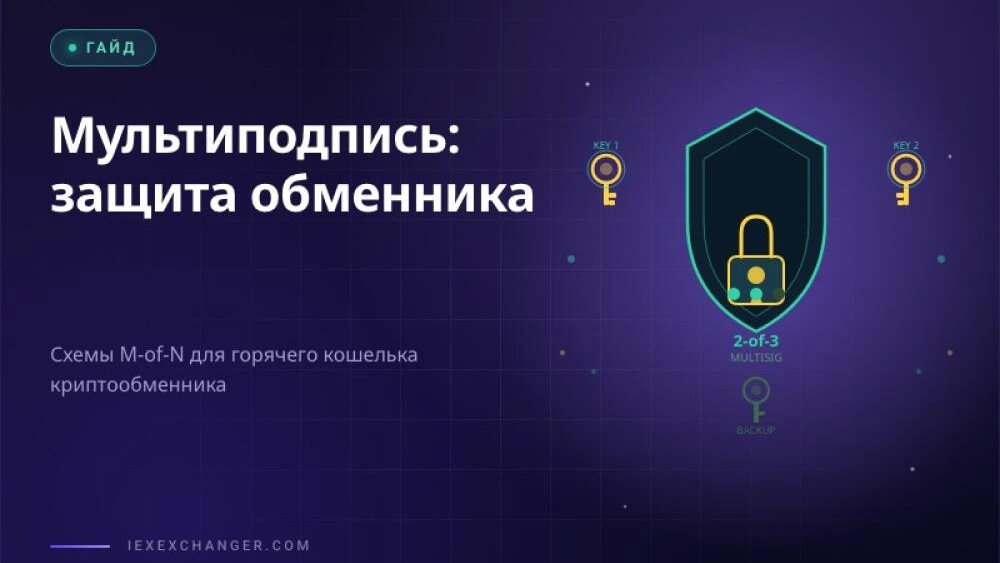
Multisig follows the M-of-N formula: out of N participants, at least M must sign before a transaction is authorized. Until the required number of signatures is collected, the funds stay put. This is not specific to one blockchain — the scheme is supported in Bitcoin (P2SH/P2WSH), Ethereum, TRON, and most major networks.
Example: you run a 2-of-3 setup. One key lives on the exchanger's production server, the second is on a hardware wallet held by your technical lead, the third stays in cold storage as a backup. Automated payouts need the server's signature plus the tech lead's confirmation. If the server is compromised, the transaction still cannot go through without the second key. An attacker needs to compromise two out of three participants simultaneously.
2-of-3 or 3-of-5: What Actually Works
For most small and medium exchangers, 2-of-3 is a sensible starting point. It provides meaningful protection without an overly complex signing process — automated payouts remain possible when one key is on the server and another is in an HSM or with a trusted person.
A 3-of-5 setup makes sense when:
- the team has multiple operators with financial authority;
- the exchanger operates across jurisdictions with separate responsible parties;
- transaction volume is high enough to justify the added signing complexity.
A 2-of-2 setup is worse than it looks: if either key is lost or unavailable, the wallet is locked permanently with no recovery option.
What to Watch During Implementation
The most common mistake is storing all keys on the same server. Technically that's multisig — practically it is not. The entire point of the scheme evaporates if an attacker who gains access to one machine can immediately grab all three secrets.
A sensible key distribution:
- one key on the exchanger's isolated server (for automated transactions);
- a second on a hardware wallet with a responsible person, kept offline;
- a third in encrypted cold storage at a separate physical location.
Another thing worth thinking through: the signing procedure for large withdrawals. If your exchanger runs fully automatically, consider splitting by limit — small transactions can be signed by the server alone, while large ones require manual confirmation from the second key.
Where Multisig Won't Help
To be honest: multisig does not solve every security problem an exchanger faces. If an attacker simultaneously gains control over multiple signers — through coordinated social engineering against the whole team, for instance — the scheme provides no protection. Vulnerabilities in the exchanger engine, smart contract bugs, API flaws — all of that lies outside what multisig guards against. It protects keys, and only keys.
Conclusion
Multisig is one of the few measures that genuinely raises the cost of an attack on an exchanger: compromising a single node is no longer enough. And it does not require rebuilding your architecture from scratch — you just need to distribute keys correctly and establish a clear signing procedure. For any business holding reserves in a hot wallet, this is not optional — it is basic hygiene.
If you are building or already running your own exchanger and looking for a ready-made solution with modern security standards built in, take a look at iEXWallet — a dedicated crypto wallet for exchangers with no third-party fees.