Multisig wallet security means a transaction requires signatures from multiple keys at once — not just one. For crypto exchanger operators, it is one of the most practical tools for limiting the damage from a server breach or a compromised key. Here is how it works and where to start.
What Is Multisig and Why Does an Exchanger Need It
Multisig (multi-signature) is not just a stronger password — it is a fundamentally different architecture for controlling a wallet. Instead of one private key, the wallet requires M signatures out of N possible ones — for example, 2 of 3 or 3 of 5.
For an exchanger this matters for one straightforward reason: a hot wallet never sits idle. Funds flow constantly, and the key lives somewhere on a server. If an attacker gains access to that server, without multisig they take everything. With a 2-of-3 scheme, one compromised key is not yet a catastrophe.
2-of-3 vs 3-of-5: Which Scheme to Choose
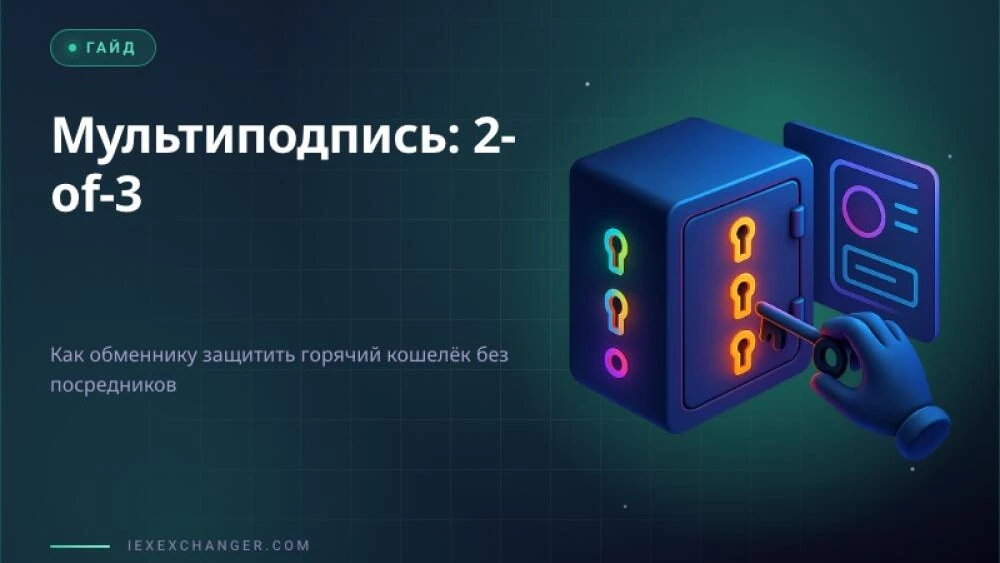
The most practical starting scheme for a small exchanger is 2-of-3: three keys, any two of which authorise a transaction. One key lives on the working server for automated processing, the second is held by the owner on a hardware wallet, and the third sits in cold storage or with a trusted co-signer.
A 3-of-5 setup is for larger operations where several operators need to approve big withdrawals. Operationally heavier, but compromising two keys still gives an attacker nothing.
- 2-of-3 — the go-to starting scheme for most small exchangers.
- 3-of-5 — when the platform scales and a team is involved.
- 2-of-2 — tight control, but a single key failure locks you out entirely.
Hot, Warm, Cold: Where to Apply Multisig
It is not equally useful everywhere. A hot wallet processing hundreds of transactions an hour cannot demand three signatures for every one — the operation would grind to a halt. A sensible layered approach looks like this:
- Hot wallet — minimal balance, strict daily limits, hardware confirmation for large withdrawals.
- Warm wallet — tops up the hot wallet on a schedule, 2-of-3 scheme, manually authorised.
- Cold reserve — 3-of-5, touched only in critical situations.
Splitting balances across these layers is its own discipline — but without it, multisig only covers part of the risk surface.
How to Set Up Multisig: First Steps
Start by choosing a tool that supports the right standard. For Bitcoin that means P2SH or P2WSH (native segwit multisig). For Ethereum, use a smart-contract wallet like Safe (formerly Gnosis Safe). For other networks, check the documentation — not every protocol supports multisig natively.
Three steps you should not skip:
- Define your scheme and decide exactly where each key will be physically stored.
- Generate keys on separate devices — hardware wallets where possible.
- Test a transaction on a test network before touching real funds.
Three Mistakes That Make Multisig Useless
The first: storing keys in different places that turn out to be different folders in the same Google account. Physically separate devices in separate locations — not cloud directories.
The second: never testing recovery. If one key is lost, you need to know with certainty that the remaining two actually let you move funds. Running a key-loss simulation once a quarter is the kind of routine most people only think about after the fact.
The third: forgetting about seed phrases. Multisig does not eliminate the need to store secure backups of every key. Lose the seed for two of your three keys and no scheme will save you.
Conclusion
Multisig is one layer of security, not a complete solution. For an exchanger whose hot wallet is always running, a 2-of-3 scheme is a sensible and realistic first step — as long as the keys genuinely live separately, recovery has been tested, and seed backups are safe.
If you are building an exchanger and want to manage wallets without third-party dependencies or hidden fees, take a look at iEXWallet — a built-in wallet solution designed for exchanger operators.