
Multisig wallet for your exchanger isn't just a nice-to-have — it's the difference between surviving a server breach and losing everything in minutes. When your hot wallet runs 24/7 and processes dozens of transactions daily, a single stolen key is a disaster waiting to happen.
What Multisig Is — and Why Generic Advice Misses the Point for Exchangers
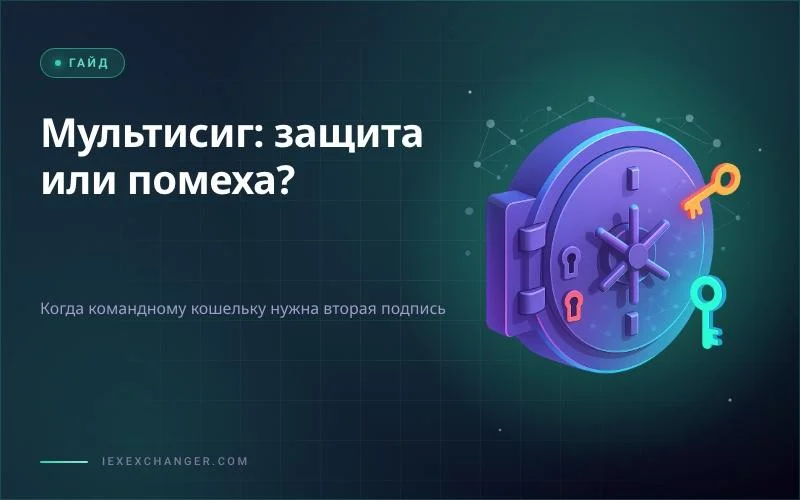
A multisig (multi-signature) wallet requires more than one key to authorise any transaction. With a 2-of-3 setup, you have three keys and any two are enough to send funds — think of it as a safe with two locks, where neither owner can open it alone.
The standard advice is "use multisig and you're safe." That holds for personal savings. But for an exchanger processing orders around the clock, it's more complicated. If the scheme requires a human to sign every transaction, that person must always be reachable. What happens when they're asleep, on holiday, or their account is compromised?
Why a Single Private Key on Your Hot Wallet Is Never Enough
Picture a typical scenario: the exchanger server is breached, the key sitting in the filesystem is gone. The attacker drains everything in minutes. Not a hypothetical — the real story of dozens of small exchangers that ran on a single key.
With multisig, the same scenario plays out differently. The attacker grabs one key, but without the second, no transaction gets signed. They have one lock of the safe — and the money stays put. That extra time is your window to freeze funds and investigate.
Which Scheme to Choose: 2-of-2, 2-of-3, or 3-of-5
Each scheme trades security for operational flexibility differently:
- 2-of-2 — both keys are always required. Maximum security, but if one key is lost, funds are permanently locked. Only makes sense when both keys are under airtight control with near-zero loss risk.
- 2-of-3 — the business favourite. One key can be lost or compromised and the other two still keep things running. Best practice: keep keys in separate locations — the hot server, an offline device, and an offline backup.
- 3-of-5 — for larger operations with a team. Distributes signing authority but adds friction to every transaction. Worth it when daily turnover runs into the hundreds of thousands.
For most small and mid-sized exchangers, 2-of-3 is the right call.
How to Automate Multisig Without Sacrificing Speed
The biggest fear when switching: "orders will stall waiting for a signature." That's solvable. One key lives on the automated processing server; the second sits on a separate hardened device that co-signs transactions based on pre-set rules — amount limits, whitelisted addresses, that kind of thing.
This is called a hot multisig: automatic first-key signing plus a programmatic trigger for the second key based on conditions. No human in the loop, yet still protected if one server is breached. The third key stays fully offline and only comes out if one of the two active keys is lost.
Common Mistakes When Switching to Multisig
- All keys on the same server. That's not real multisig — breach the server and the attacker gets every key at once.
- Losing the backup key. The backup is often stored carelessly — a USB stick in a desk drawer. Better: encrypted, in a different physical location.
- No recovery testing. Many operators set up multisig and never rehearse recovery. They find out it doesn't work when it's already critical.
- Starting too complex. A 3-of-5 scheme for a solo founder is operational overhead with no real security gain over 2-of-3.
Conclusion
A multisig wallet for your exchanger is not a one-time setup — it's an operational architecture. The right scheme (2-of-3 in most cases), keys stored in separate locations, and a tested recovery process protect against the most realistic threats: server breaches and a compromised team member. The worst time to implement this is after the fact.
If you're building or already running your own exchanger and want infrastructure where custody is thought through from day one, take a look at iEXWallet — a crypto wallet built for exchanger operators, with no middleman fees.