A multisig wallet for a crypto exchange isn't just a setup for the overly cautious — it's a practical control tool. Picture this: one employee knows the private key to your hot wallet. One slip and all the funds are gone. Multi-signature wallets close that gap: every transaction requires multiple approvals at once. Here's how the 2-of-3 scheme works, where it genuinely saves money, and where it won't help.
Why a Single Key Isn't Enough
A standard wallet works like a house key: whoever holds it, owns the place. For a personal wallet, that's perfectly fine. For an exchange moving tens of thousands of dollars a day, it's a liability.
Two threats are always in play. External: a phishing email, a compromised laptop, a malicious browser extension. One stolen key and an attacker has full access. Internal: a dishonest employee or business partner who also knows that key.
Multisig solves both problems with one principle: a transaction cannot go through without multiple parties signing off.
How 2-of-3 Works in Real Life
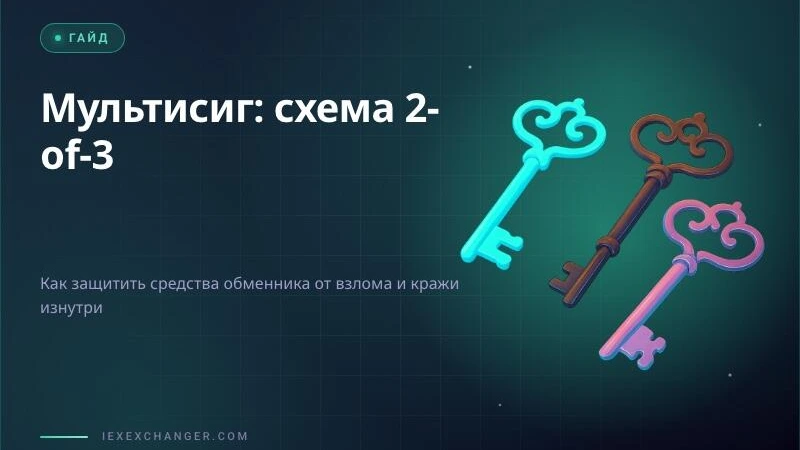
The 2-of-3 setup is the most common choice for small businesses. Three keys are created, but any two of them are enough to authorize a transaction.
Here's how a typical exchange splits it:
- Key 1 — the business owner, on a personal device.
- Key 2 — an operations manager or second trusted person.
- Key 3 — an offline backup: a paper seed or hardware wallet locked in a safe.
The result: any one of the three can lose their key and the funds remain accessible through the other two. But none of them can authorize a transfer alone. That's the whole point.
Two Scenarios Where Multisig Saves the Day
Scenario 1: hot wallet hack. An attacker gets key 2 via phishing or a stolen phone. Without a second key, they're stuck. The transaction won't go through. You lose time, not money.
Scenario 2: rogue employee. An operations manager decides to help themselves to a large sum. Their single key isn't enough — your signature is required too. The 2-of-3 scheme blocks the theft before the money ever leaves.
Both scenarios are real, not theoretical. Exchanges have gone dark exactly this way: one compromised key, no second check.
Where Multisig Won't Help — Honestly
Multi-signature isn't a silver bullet. A few situations where it won't protect you:
- If an attacker compromises two keys at once — say, both the owner's and manager's devices.
- If both signers act in concert — through collusion or coordinated social engineering targeting both.
- If all three keys are lost without backups — funds are frozen permanently.
One honest operational trade-off: multisig adds friction. Every transfer requires coordinating two people. It's worth deciding in advance what share of funds lives in multisig as reserves, and how much stays on a fast single-key hot wallet for instant payouts.
Getting Started Without a Developer
You can implement multisig without specialized technical knowledge. A few concrete steps:
- EVM networks (Ethereum, Polygon): Gnosis Safe is the de facto standard, with a web interface. No developer needed.
- Bitcoin: Electrum has straightforward multisig wallet support.
- Generate three keys on separate devices — not the same one.
- Write the backup key on paper or save it to a hardware wallet, then lock it in a physical safe.
- Test it: send a small amount first and confirm that two keys are genuinely required to authorize it.
Don't rush to move everything into multisig at once. Start with a dedicated reserve wallet — the portion of funds you don't need immediately for payouts.
Conclusion
Multisig is two hours of setup, done once, that closes the two most common exchange vulnerabilities: external hacking and insider theft. If your hot wallet runs on a single key and holds more than a few thousand dollars — that's a risk worth fixing today.
For anyone building an exchange from scratch and wanting built-in fund custody infrastructure from day one, iEXWallet is a dedicated wallet solution for exchange operators with no middleman fees.