A crypto wallet for an exchange business is nothing like a personal one. Every month, thousands of exchangers route money through third-party services and pay for the privilege: in fees, spreads, and delays. At low volume, it barely registers. At serious scale, it's real money flowing to a middleman instead of your bottom line.
The Hidden Cost of Someone Else's Wallet
Every transaction through a third-party service carries a price — a fact that's easy to miss in the daily grind. An exchange charges a withdrawal fee. An aggregator bakes in a spread. A payment processor adds its own cut. Each looks small in isolation — 0.1%, 0.5%, "just a flat $2." Across 500 transactions a day, the picture looks completely different.
There's also a risk that doesn't show up in a spreadsheet: you don't control the keys. If the platform decides to freeze the account, delay a withdrawal, or run an unscheduled compliance check — your funds and your clients' funds go into limbo. Not for an hour. Sometimes for weeks.
What a Business Crypto Wallet Actually Is
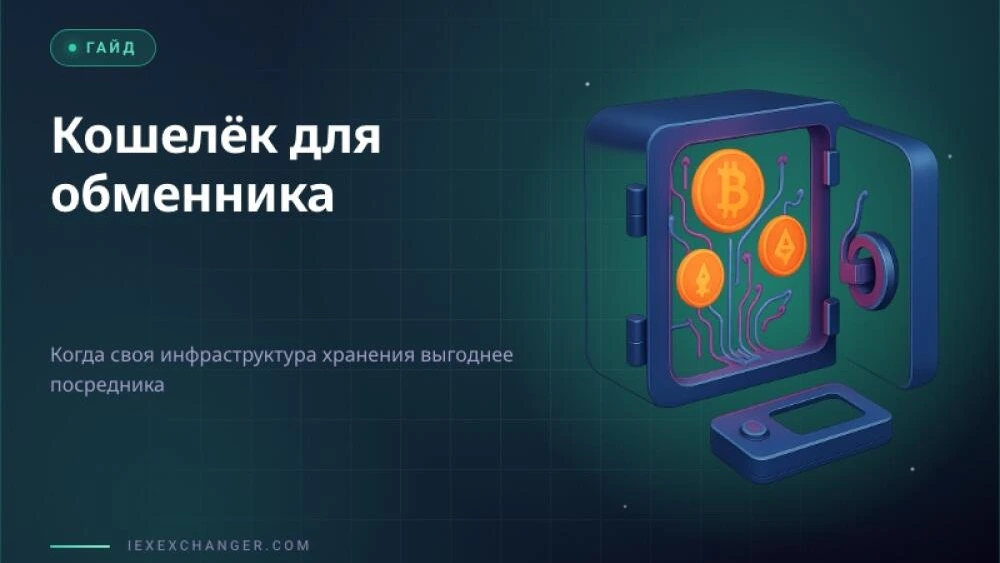
A business wallet is infrastructure where the private keys belong to you. No middleman between your client and your business. Your system generates the deposit addresses, you monitor incoming transactions, and you sign the outgoing ones.
You don't have to build from scratch. Modern solutions provide ready-made infrastructure: HD address derivation — one master key generates thousands of unique client-facing addresses, real-time blockchain monitoring, and hot and cold storage management. The exchanger owner's job is to configure the logic, not to become a cryptography expert.
How a Wallet Works Inside an Exchange Operation
In simplified terms, the wallet does three things. First — a unique deposit address is generated for each order: the client sees it, sends the coins, and the system automatically links the incoming payment to that specific deal. Second — the system monitors the blockchain and registers the payment as confirmed once the required number of confirmations is reached — think of it as a postal stamp that proves the package arrived. Third — on instruction from the exchange engine, the wallet broadcasts the outgoing transaction with the correct network fee.
The hot wallet holds the working balance — funds needed for fast payouts. Cold storage keeps the reserve offline, away from the network unless needed. A well-configured system moves excess funds from hot to cold automatically, triggered by a set threshold.
How This Compares to Running Through an Exchange
When an exchanger uses an exchange account as its wallet, it inherits all the exchange's risks: withdrawal limits, verification requirements, and the possibility of sudden suspension. The exchange operates by its own rules — rules that can change tomorrow without notice.
With a business wallet, there are no externally set limits. No risk of an account being flagged by an automated system mid-business-day. And most importantly — network fees go straight to miners, without the aggregator's markup.
- Exchange account: quick to launch, but dependent on someone else's rules and limits.
- Aggregator / gateway: convenient, but spreads and fees are built into every transaction.
- Business wallet: higher barrier to entry, but full control and lower costs at scale.
When You Don't Need a Business Wallet Yet
If your exchanger processes less than $50–100K per month, the savings on fees may not offset the cost of deploying and maintaining the infrastructure. Starting out on an aggregator or exchange account is a perfectly reasonable choice — it makes sense at that stage.
A business wallet justifies itself when transaction volume is high and every extra percentage point is felt. Or when independence is genuinely critical — for instance, if you work with larger clients who expect reliability guarantees.
Conclusion
Running your own wallet infrastructure isn't a privilege reserved for large players — it's a logical step for any exchanger that's serious about margins and long-term growth. The sooner you move to an independent custody model, the less you pay to middlemen and the more control you have over your own business.
If you want to launch an exchanger with your own wallet and no middleman fees, take a look at iEXWallet — ready-made custody infrastructure for your exchange operation.