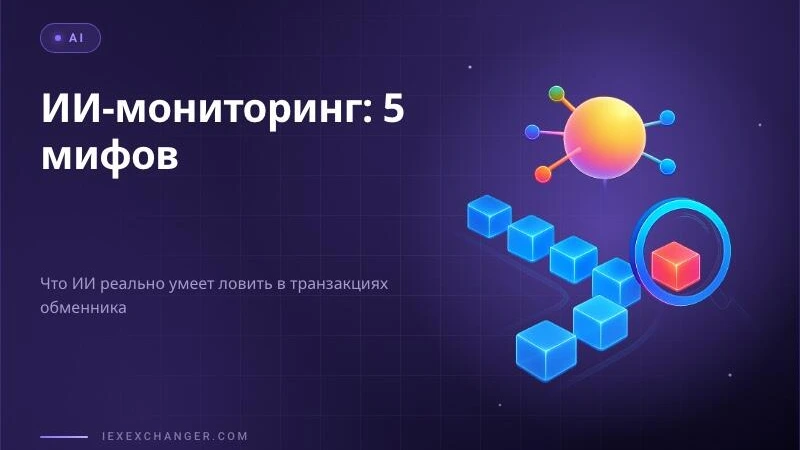
AI transaction monitoring for crypto exchangers scans your payment flow in real time, hunting for fraud, layering, and structuring patterns that a human analyst would probably spot sometime around lunch on day three — if at all. The topic has collected so much hype and confusion that some exchanger owners ignore it entirely, while others buy the first slick demo they see. Here are the five myths that trip people up most, and what to actually do about them.
Myth 1: "AI monitoring is only for big exchanges"
Not true — a small exchanger running 200-300 transactions a day carries just as much risk as a large platform, and a single mistake often hurts more. Picture this: one client runs 15 transfers of $900 each in a single evening to dodge a $1,000 internal limit — classic structuring. A human operator who's also answering live chat and processing withdrawal requests probably won't connect fifteen scattered transfers into one pattern. A model trained on behavioral patterns flags it in seconds.
Myth 2: "AI replaces manual review entirely"
No — and any vendor promising "fully automated compliance, zero human involvement" is either oversimplifying or selling vapor. AI is good at clearing out 95% of routine noise and surfacing the 5% of cases that genuinely need a human call: block, request documents, or clear it. The final decision on a disputed transaction — and definitely the report to a regulator — still gets signed off by an actual compliance officer. The tool saves hours; it doesn't remove accountability.
Myth 3: "More data always makes the model more accurate"
Not quite — past a certain point, irrelevant data dilutes the signal instead of sharpening it. Think of a detective handed the entire precinct archive instead of three solid leads: technically more information, but the useful part drowns in noise. For an exchanger, a tight set of features — client history, transaction velocity, amount patterns, wallet clustering — beats terabytes of unlabeled raw logs every time.
Myth 4: "Rolling out AI monitoring is slow and expensive, like installing a banking core"
In practice, for a mid-sized exchanger it's usually an API integration measured in weeks, not a months-long IT project with its own dedicated team. Most modern tools run on a subscription model and plug into your existing payment stack without a backend rewrite. The part that actually takes time isn't the tech — it's tuning the rules to your specific risk profile: which amounts, countries, and client types count as elevated risk for your business.
Myth 5: "AI can't be fooled"
It can — fraudsters adapt too, and adversarial schemes built to target a specific model's blind spots exist and keep evolving. A model that never gets retrained on fresh data gradually loses its edge against new evasion tactics, the same way antivirus software goes stale without updated definitions. An honest vendor will tell you straight: the tool reduces risk, it doesn't zero it out, and the rules need periodic review as your exchanger grows.
How to choose AI monitoring for your exchanger
Before signing anything, run the tool past a short list of practical criteria.
- Explainability — the model should say why it flagged a transaction, not just spit out a bare "risk: 87%" score.
- Stack compatibility — API integration without rewriting your payment module.
- Adjustable thresholds — set limits around your actual client profile instead of living with someone else's defaults.
- Near-real-time response — not a batch report that lands once a day.
- Regular retraining — the vendor keeps updating the model against new fraud patterns instead of shipping it and walking away.
Conclusion
AI transaction monitoring isn't a magic button, and it isn't reserved for the big exchanges — for an exchanger with a steady client flow, it takes the routine load off compliance and catches schemes a tired human would miss. The call is still yours: the technology only highlights what deserves attention. If you're launching your own exchanger and want compliance and automation built in from day one, take a look at iEXExchanger.